

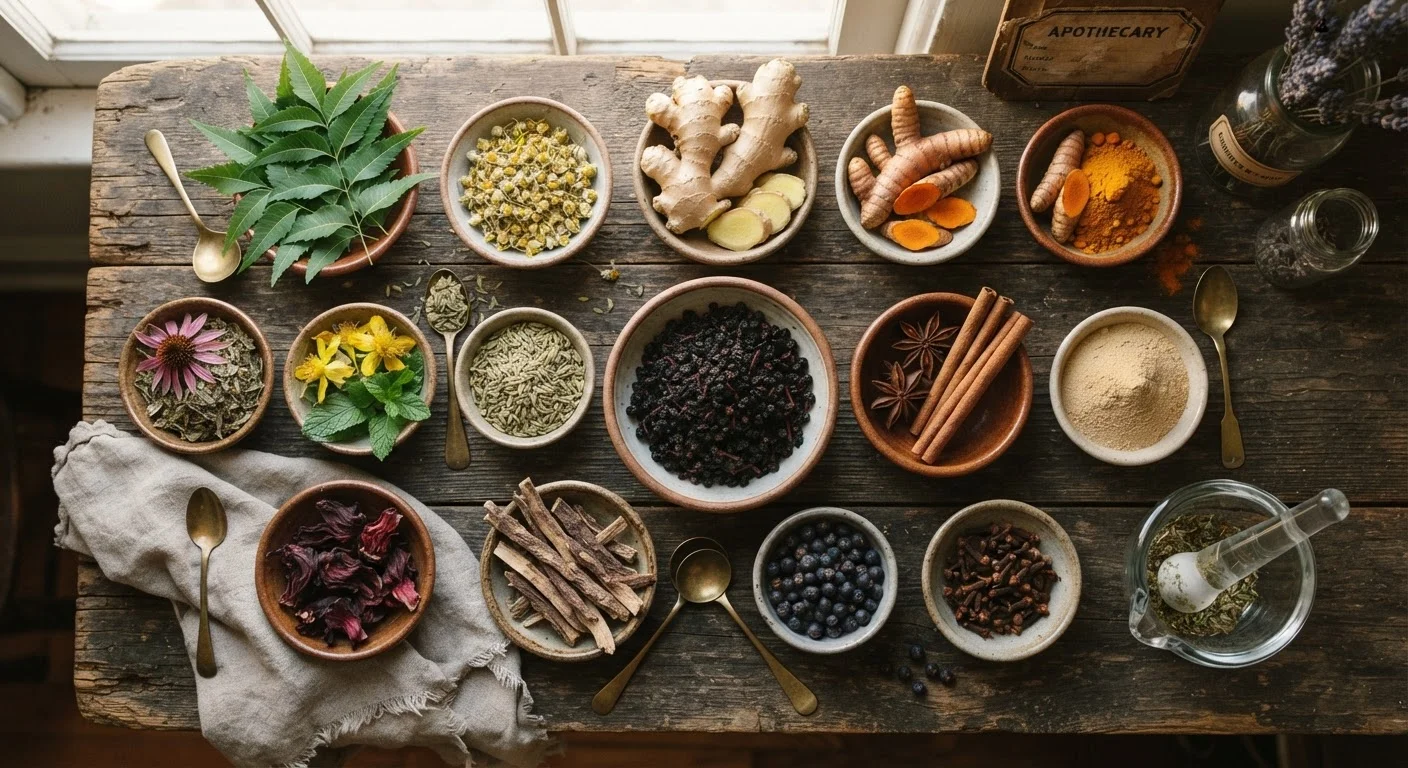
Why Traditional Home Remedies Still Matter
Long before the modern pharmacy, every household was its own dispensary. Grandmothers in Chennai, healers in Oaxaca, and herbalists in rural Germany all turned to plants, foods, and rituals to address everyday ailments — coughs, stomach upsets, skin irritations, and fatigue. These practices were not guesswork; they were refined over generations of observation and shared knowledge.
Today, the World Health Organization estimates that roughly 80 percent of people in low- and middle-income countries rely on traditional medicine as a primary source of care. But traditional healing is not confined to developing nations — interest in home-based, plant-derived remedies is surging across the US and Europe as well.
If you are new to this landscape, our beginner's guide to home remedy practice offers a grounded starting point. This survey takes a wider view, examining how distinct cultures approached healing at home and where their wisdom intersects with contemporary science.
~80%
Global reliance on traditional medicine
According to the World Health Organization, roughly 80% of people in low- and middle-income countries use traditional medicine as a primary healthcare resource.
25%
Modern drugs derived from plants
The WHO has estimated that approximately 25% of modern pharmaceutical drugs are derived from or modeled on plant-based compounds documented in traditional medicine.
3,000+
Years of Ayurvedic practice
Ayurvedic medicine is among the oldest codified healing systems, with texts dating back more than three millennia on the Indian subcontinent.
South Asian Traditions: Ayurveda and the Kitchen Pharmacy
Ayurveda — meaning science of life in Sanskrit — is one of the world's oldest codified healing systems, originating in the Indian subcontinent more than 3,000 years ago. At its core is the idea that health depends on balance among three constitutional forces (doshas): vata, pitta, and kapha.
In daily home practice, Ayurvedic remedies are remarkably kitchen-centered. Turmeric (Curcuma longa) is stirred into warm milk for inflammation and respiratory discomfort — a preparation now widely studied for curcumin's anti-inflammatory properties. Neem (Azadirachta indica) leaves are used topically for skin conditions, and laboratory research has identified numerous bioactive compounds in neem with antimicrobial activity. Ginger and black pepper are combined to support digestion, a pairing supported by research showing piperine in black pepper enhances the absorption of other plant compounds.
For a closer look at the chemistry behind some of these pantry staples, see our article on how ginger, turmeric, and honey work in the body.
When exploring Ayurvedic kitchen remedies, prioritize preparations that use whole-food ingredients — such as turmeric in warm milk or ginger in tea — over concentrated extracts or supplements, which carry higher risks of dosage-related issues.
Whole-food preparations deliver bioactive compounds in lower, buffered concentrations, generally reflecting how these remedies were safely used for generations. Concentrated extracts lack the same long safety track record.
Before integrating any herbal remedy into your routine, cross-reference it with a reliable drug interaction database or ask your pharmacist — especially if you take any prescription medications.
Herb-drug interactions are a documented clinical concern. Common examples include St. John's Wort affecting antidepressants and blood thinners, and grapefruit compounds altering drug metabolism — demonstrating that 'natural' does not mean interaction-free.
East Asian Practices: TCM and Food-as-Medicine
Traditional Chinese Medicine (TCM) encompasses acupuncture, herbal formulas, dietary therapy, and movement practices. At the home remedy level, food-as-medicine principles are most accessible. Ginger tea is prescribed for cold and flu symptoms, nausea, and digestive sluggishness — uses echoed in several clinical trials examining ginger's effect on nausea. Chrysanthemum and wolfberry (goji) infusions are traditionally consumed to support eye health and reduce heat-related symptoms.
Japanese folk medicine (kampo-influenced home care) frequently relies on miso soup for gut health, green tea for antioxidant support, and umeboshi (pickled plum) for digestive upset. Korean traditions overlap substantially, with ginger, garlic, and fermented foods like kimchi serving dual roles as culinary staples and functional health foods. Emerging research on the gut microbiome has lent scientific interest to fermented food traditions across Asia.
Latin American Folk Remedies: Curanderismo and Herbal Teas
Curanderismo is a healing tradition practiced across Mexico, Central America, and communities throughout the US Southwest. It integrates indigenous plant knowledge with Spanish colonial influences and, in some regions, African healing elements. Herbal teas — known as tés or aguas de hierbas — are the most common home remedy form.
Té de manzanilla (chamomile tea) is perhaps the most ubiquitous Latin American home remedy, given to children and adults alike for stomach cramps, colic, anxiety, and sleep difficulties. Clinical reviews suggest chamomile (Matricaria chamomilla) has mild anxiolytic and antispasmodic properties, lending credence to these traditional uses. Hierba santa, epazote, and ruda are used for digestive complaints, though some of these carry safety considerations and require caution — particularly during pregnancy.
For more on herbal approaches to digestion, our guide on home remedies for digestive discomfort covers the evidence in detail.
African and Middle Eastern Traditions: Honey, Oils, and Spices
Across sub-Saharan Africa, North Africa, and the Arabian Peninsula, honey has occupied a central place in healing for millennia. Raw honey's antimicrobial properties — attributed partly to hydrogen peroxide production and its low water activity — are among the more robustly researched attributes of any traditional remedy. It appears in wound care, cough relief preparations, and topical skin applications across dozens of distinct traditions.
Black seed (Nigella sativa), known in Arabic as habbatus sauda, has been used in Islamic traditional medicine for respiratory, immune, and digestive complaints for over a thousand years. Modern pharmacological research has identified thymoquinone as a key bioactive constituent with anti-inflammatory and antioxidant activity, though human clinical evidence remains limited and ongoing. Frankincense resin (from Boswellia species) is used topically and aromatically in East African and Middle Eastern households for respiratory support and inflammation.
These traditions connect naturally to broader herbal remedy practices studied globally.
European Folk Medicine: Herbs From the Countryside
European herbal medicine draws from Greek and Roman classical texts, monastic gardens of the medieval period, and rural folk traditions that persisted alongside official medicine. Elderberry (Sambucus nigra) was prepared as syrups and teas across northern and central Europe for cold and flu symptoms — a use that has attracted meaningful clinical investigation, with some small trials suggesting elderberry extracts may modestly shorten cold duration. Valerian root was used across Germanic and Scandinavian traditions for sleep difficulties and nervous tension, and remains the subject of ongoing research. Calendula (pot marigold) was applied as a skin-soothing poultice throughout the Mediterranean and central Europe for minor wounds and irritations.
The overlap between European herbal tradition and home remedies for minor skin irritations is considerable, with several botanicals still widely used today.
What Cross-Cultural Patterns Tell Us
One of the most striking findings in ethnobotany is convergent remedy development: cultures with no historical contact independently arrived at similar uses for their local plants. Ginger appears in South Asian, East Asian, West African, and Caribbean healing traditions for nausea and digestive discomfort. Honey is used for wound care from Ethiopia to Finland to the American Southwest. This convergence suggests that repeated, multigenerational empirical observation — however uncontrolled — reliably identified plants with genuine bioactivity.
What unifies most traditional systems is also a dietary philosophy: food and medicine are not sharply separated. This resonates with findings from research into traditional dietary patterns around the world, which consistently show that whole-food, plant-forward eating underpins both cuisine and everyday health maintenance.
For a deeper examination of how these systems have shaped modern holistic practice, see our overview of healing traditions that inform holistic medicine today.
Using Traditional Remedies Safely Today
Traditional use is a meaningful signal — but not a guarantee of safety or effectiveness in any individual case. Several key principles apply when incorporating home remedies from any tradition:
- Preparation matters. Decoctions, infusions, poultices, and raw applications of the same plant can yield very different outcomes. Follow traditional preparation methods and consult reliable sources.
- Interactions are real. Herbal remedies can interact with prescription medications. St. John's Wort, for instance, is known to affect the metabolism of numerous drugs.
- Special populations require extra caution. Pregnant individuals, children, older adults, and those with chronic conditions should consult a healthcare provider before using herbal or traditional remedies.
- Not all traditional practices are benign. Some historically used plants are toxic, carcinogenic, or contraindicated in specific conditions. Traditional use does not equal universal safety.
To build a practical, evidence-informed home remedy toolkit, our guide to stocking a home remedy cabinet offers curated, condition-specific guidance. And for a science-focused lens on common kitchen remedies, The Kitchen Pharmacy examines what research actually confirms.
This article is for general informational and educational purposes only and does not constitute medical advice. Always consult a qualified healthcare professional before starting, stopping, or changing any health practice, especially if you have an existing medical condition or take prescription medications.
The content on this site is for informational purposes only and is not a substitute for professional advice. Always consult a qualified professional for guidance specific to your situation.