

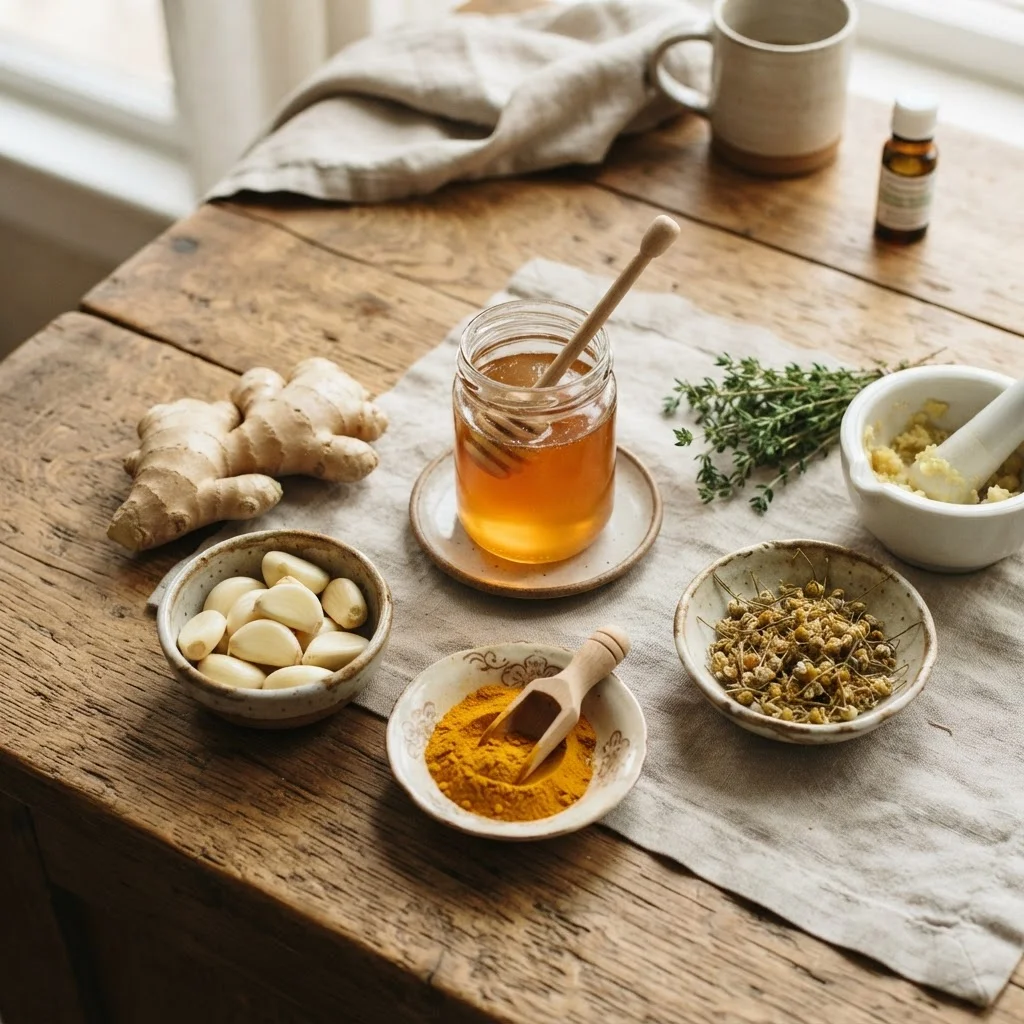
Why the Kitchen Has Always Been the First Pharmacy
Long before pharmacies existed, healers and households turned to the ingredients closest at hand. Across virtually every culture, the kitchen served as the first line of defense against coughs, stomach upsets, and minor wounds. Today, modern research is revisiting many of these traditions — and finding that some have a more credible biological basis than previously recognized.
This doesn't mean kitchen ingredients replace medicine. Rather, it means that for minor, self-limiting ailments, certain household staples may offer genuine supportive value. Understanding which ones have evidence behind them — and which are more folklore than fact — helps you make informed decisions about home care. For a broader look at how different traditions approach this, see home remedies across cultures.
~80%
Global population using traditional plant-based medicine
The World Health Organization estimates roughly 80% of the world's population relies on traditional plant-based remedies as a primary healthcare resource.
2012
Year landmark honey-vs-cough-syrup study was published
A study in the journal Pediatrics found buckwheat honey outperformed dextromethorphan for relieving nighttime cough in children, helping validate a centuries-old remedy.
2,000+
Published studies on curcumin (turmeric's key compound)
PubMed indexes over 2,000 studies on curcumin, reflecting significant scientific interest — though researchers note most trials are small and bioavailability remains a key challenge.
Four Kitchen Ingredients with Notable Research Backing
Honey
Raw honey — especially darker, less processed varieties — contains hydrogen peroxide, defensin-1 proteins, and polyphenols that contribute to antimicrobial activity. A well-cited 2012 study published in Pediatrics found that buckwheat honey was more effective than a common cough suppressant (dextromethorphan) for nighttime cough in children over age 1. The World Health Organization has noted honey as a potential demulcent for soothing throat irritation. Note: honey should never be given to infants under 12 months.
Ginger
Ginger (Zingiber officinale) contains gingerols and shogaols — compounds studied for their effects on nausea and inflammation. Multiple clinical trials and systematic reviews support ginger's effectiveness for pregnancy-related nausea and post-operative nausea, though results for other nausea types are more mixed. Ginger tea or small amounts of fresh ginger in warm water are traditional preparations with a reasonable safety profile for most adults.
Garlic
Allicin, the sulfur compound released when garlic is crushed or chopped, has demonstrated antimicrobial properties in laboratory settings. Some human studies suggest regular garlic consumption may modestly support immune function and cardiovascular health, though evidence for preventing or shortening colds specifically remains mixed. Garlic can interact with anticoagulant medications, so those on blood thinners should use it cautiously.
Turmeric
Curcumin, turmeric's primary active compound, has been widely studied for anti-inflammatory properties. However, curcumin is poorly absorbed on its own — black pepper's piperine significantly enhances its bioavailability. Research into turmeric for joint discomfort and digestive support is ongoing and shows some promise, though most trials are small and more robust human evidence is still needed. Explore herbal remedies more broadly for related plant-based approaches.
Applying Kitchen Remedies Responsibly
Understanding a remedy's evidence base is only part of responsible use. Preparation, storage, and context matter too. Fresh ginger steeped in hot water differs from ginger extract capsules in both dose and bioavailability. Similarly, raw local honey differs meaningfully from highly processed commercial varieties in its bioactive content.
Kitchen remedies are most appropriate when the ailment is mild, familiar, and self-limiting — a scratchy throat, a queasy stomach after travel, or minor digestive discomfort after a rich meal. They are not appropriate as substitutes for prescribed medications, and they are not suitable for managing serious, persistent, or undiagnosed symptoms.
Match the Remedy to the Ailment
Before reaching for a kitchen remedy, consider whether the condition is genuinely mild and self-limiting. Honey is appropriate for a scratchy throat — not for a fever lasting more than two days. Ginger may ease mild nausea, but persistent vomiting warrants a call to your doctor. Knowing the limits of home care is as important as knowing its possibilities.
If you're building a practical home remedy toolkit, our guide on building a home remedy cabinet covers what's worth keeping on hand. For guidance on using these remedies safely — including preparation and storage — see using home remedies safely.
This article is for general informational and educational purposes only and does not constitute medical advice. Always consult a qualified healthcare professional for personal health concerns, diagnosis, or treatment decisions.
Frequently Asked Questions
Some kitchen remedies have meaningful research support, while others rest primarily on traditional use. Evidence quality ranges from robust clinical trials to small preliminary studies. It's important to view these ingredients as supportive measures, not substitutes for proven medical treatments.
Yes. Ingredients like garlic and ginger can interact with blood-thinning medications, and turmeric may affect drug metabolism. Always inform your healthcare provider about any home remedies you use regularly, especially if you take prescription medications.
Raw honey should never be given to infants under 12 months due to the risk of infant botulism. Adults and older children can generally consume it safely in food quantities, though people with diabetes or pollen allergies should use it with caution.
If symptoms are severe, worsening, or persist beyond a few days, professional medical evaluation is warranted. Kitchen remedies are best suited to mild, familiar, self-limiting complaints. See our guide on <a href="/natural-remedies/home-remedies/when-a-home-remedy-is-enough-and-when-it-isnt">when home care is appropriate</a> for more guidance.
Honey — particularly raw and Manuka varieties — has one of the strongest research bases among household remedies, especially for soothing throat irritation and mild wound support. Ginger also has a substantial body of evidence, particularly for nausea.
Pregnancy significantly changes how the body processes even familiar foods and herbs. Some kitchen remedies considered safe in typical food quantities may carry risks in larger therapeutic amounts during pregnancy. Always consult a qualified healthcare professional before using any home remedy while pregnant.
The content on this site is for informational purposes only and is not a substitute for professional advice. Always consult a qualified professional for guidance specific to your situation.