

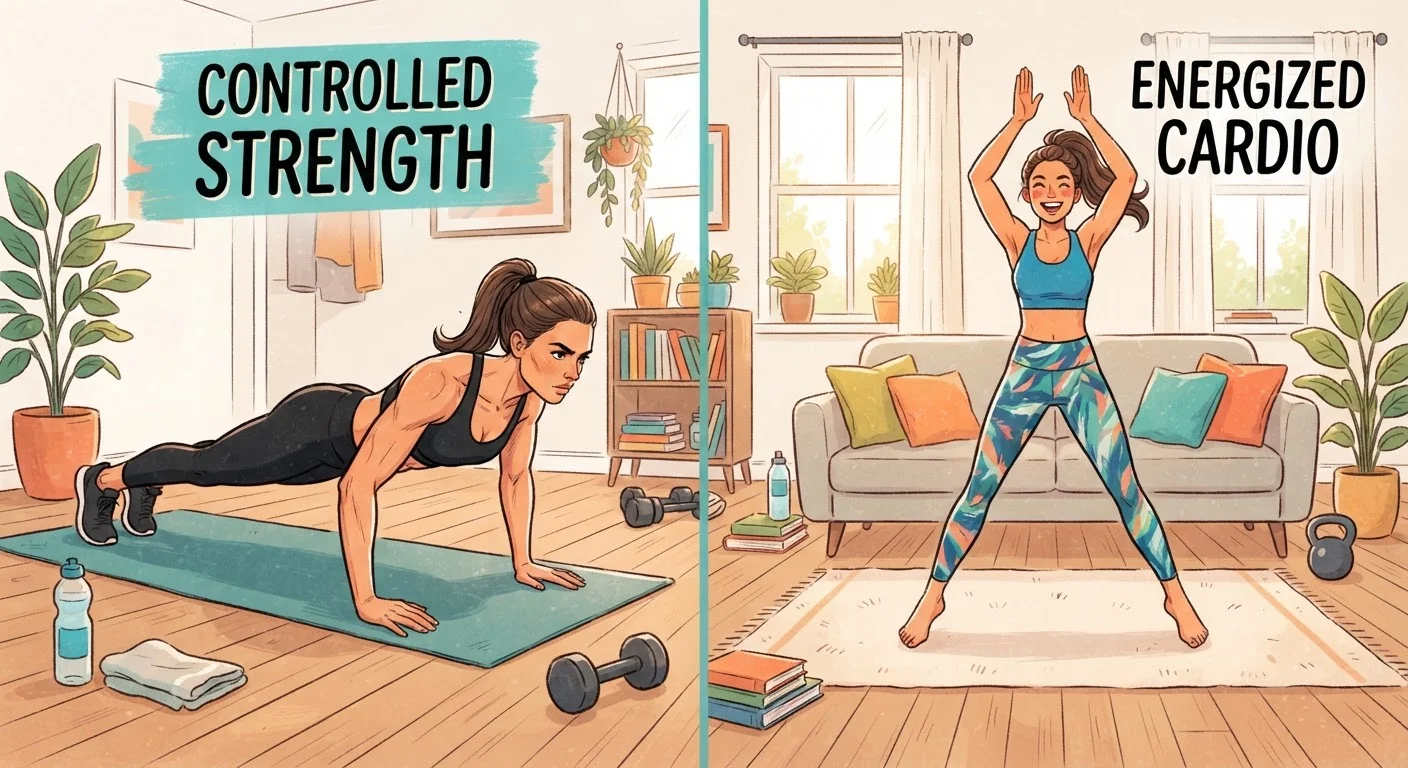
Our Verdict
Neither strength nor endurance training is universally superior — each serves distinct physiological goals. Strength training reshapes muscle and builds force capacity, while endurance training supports heart health and sustained performance. Most home exercisers benefit from understanding both and periodizing between them based on their evolving goals.
| Best for | Recommended |
|---|---|
| Those focused on building muscle, improving posture, and increasing functional force | Strength Training |
| Those prioritizing cardiovascular health, fat metabolism, and sustained energy output | Endurance Training |
| Those wanting a well-rounded fitness foundation without specializing in either | Hybrid Training |
What Separates Strength from Endurance Training
At the most fundamental level, strength training and endurance training ask the body to adapt in opposite directions. Strength work trains your neuromuscular system to generate maximum force over a small number of repetitions. Endurance work conditions your cardiovascular and muscular systems to sustain effort over time — think minutes or miles, not reps.
These aren't just stylistic preferences. They trigger different biochemical pathways, recruit different muscle fiber types, and produce measurably different physical adaptations. Understanding this distinction helps you design a home program that actually matches what you want your body to do.
For a broader look at structuring home-based fitness, see The Complete Guide to Home-Based Fitness for Long-Term Health.
How Each Approach Works in a Home Setting
Strength training at home relies on progressive overload — gradually increasing the demand placed on muscles to force adaptation. Without a barbell, this means manipulating leverage, tempo, unilateral load, and movement complexity. A two-legged squat becomes a Bulgarian split squat; a standard push-up progresses to an archer push-up or pseudo-planche. Reps typically stay in the range of 3–8 per set, with longer rest periods (90 seconds to 3 minutes) to allow full neuromuscular recovery between efforts.
Endurance training at home looks quite different. It involves maintaining elevated heart rate — generally 60–80% of maximum — for extended durations. Circuit training, jump rope, bodyweight flows, stair climbing, and dance-based movement all qualify. Rest periods are shorter, rep ranges are higher (15–25+), and the session's objective is sustaining output rather than maximizing it.
Learn how progressive overload drives gains at home without any gym equipment, using only bodyweight adjustments and smart programming.
| Strength Training | Endurance Training | |
|---|---|---|
| Primary goal | Build muscular force and size | Improve stamina and cardiovascular capacity |
| Typical rep range | 3–8 reps per set | 15–25+ reps or timed intervals |
| Rest periods | 90 sec – 3 min between sets | 15–45 sec, or minimal rest |
| Home equipment needed | Bodyweight progressions, optional bands or rings | None required; jump rope optional |
| Muscle fibers targeted | Primarily fast-twitch (Type II) | Primarily slow-twitch (Type I) |
| Key home example | Archer push-ups, pistol squat progressions | Jump rope circuits, bodyweight flow sequences |
| Adaptation timeline | Neurological gains in 2–4 weeks; hypertrophy over months | Cardiovascular improvements within 4–6 weeks |
Choosing Based on Your Goals
The right emphasis depends on what you're actually trying to accomplish. Consider these scenarios:
- You want to build visible muscle and improve posture: Prioritize strength-focused sessions with challenging progressions. Explore exercise variations every home trainer should know to keep difficulty scaling upward.
- You want to improve heart health, manage weight, or build stamina: Endurance-style training — including longer circuits and aerobic movement — is the more direct route.
- You want overall fitness without a narrow specialty: A hybrid approach, alternating emphasis across training weeks, is well-supported by exercise science and keeps motivation high.
If you're also weighing whether to use bodyweight-only methods or add resistance tools, Bodyweight Training vs. Resistance Equipment breaks down those trade-offs clearly.
Start With Your Weakest Link
If you find yourself consistently winded before your muscles fatigue, prioritize endurance work first. If you tire muscularly before your breathing does, strength progressions will be more productive. Honest self-assessment of where your training breaks down first is the simplest way to identify which emphasis serves you best right now.
Combining Both in a Home Routine
Most health-conscious adults don't need to choose exclusively. Research consistently shows that combining strength and cardiovascular training — often called concurrent training — produces robust improvements in both domains, provided sessions are structured to avoid excessive fatigue accumulation.
A practical weekly split might look like: two to three days emphasizing high-effort, low-rep strength progressions and one to two days of sustained aerobic or circuit-style endurance work. Core stability, which supports both modalities, can be woven throughout. Core strength without crunches offers floor-based options that complement both training styles.
If you're newer to home training or reconsidering a gym membership, understanding what home workouts genuinely offer is worth the time — see the real pros and cons of ditching the gym for a balanced perspective.
This article is for general informational and educational purposes only and does not constitute medical or fitness advice. Consult a qualified healthcare or fitness professional before beginning any new exercise program, especially if you have existing health conditions.
The content on this site is for informational purposes only and is not a substitute for professional advice. Always consult a qualified professional for guidance specific to your situation.