

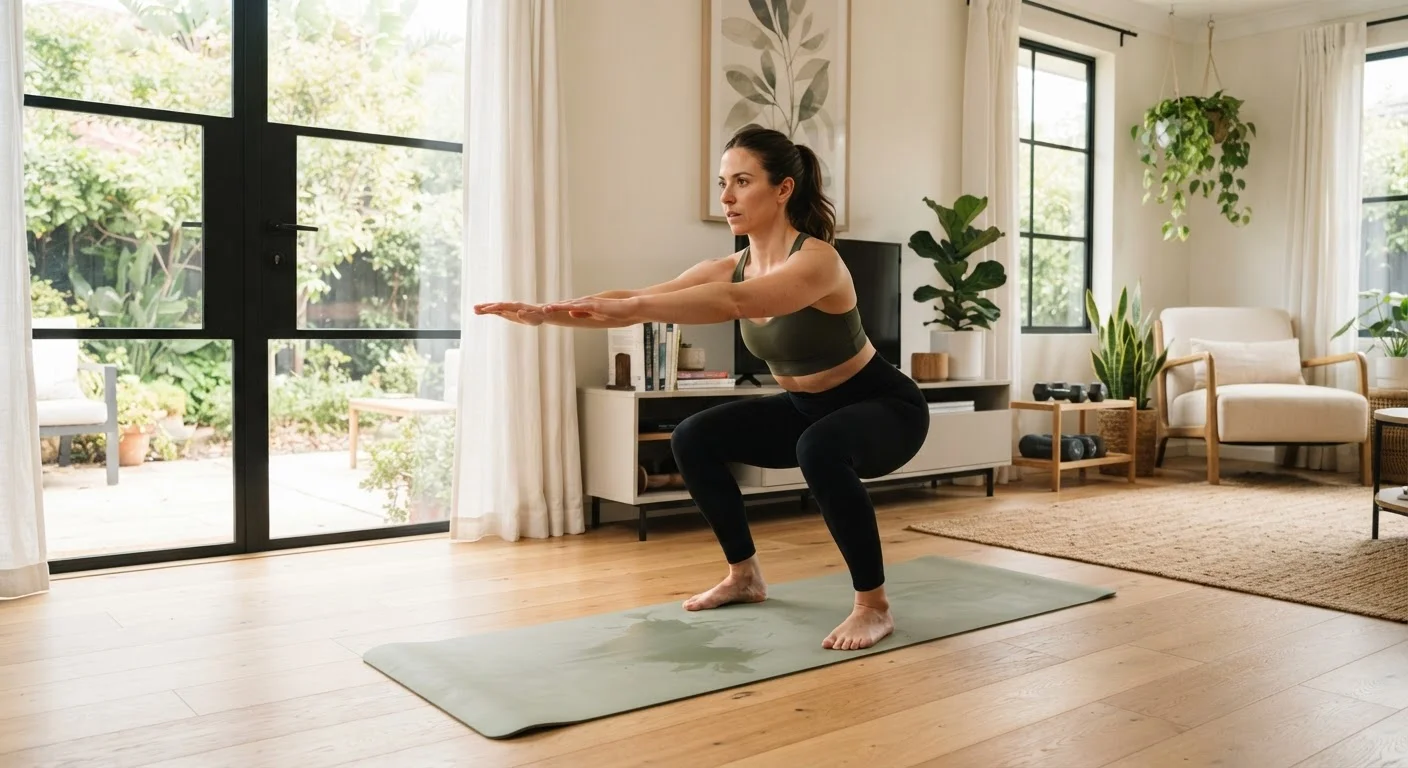
Why Home-Based Fitness Works for Long-Term Health
The evidence for home-based exercise has grown steadily over the past decade. Research consistently shows that structured physical activity performed at home can improve cardiovascular health, muscular strength, body composition, and mental well-being — outcomes that were once assumed to require gym access. Convenience is often cited as the primary advantage, but the deeper benefit is reduced friction: when a workout requires no commute, no membership, and no equipment, adherence becomes significantly easier to sustain.
For long-term health, consistency outweighs intensity. A moderate workout performed reliably three to four times per week produces far greater cumulative benefit than sporadic high-effort sessions. Home training naturally supports this principle by lowering the barriers that typically interrupt gym routines — schedule conflicts, social anxiety, cost, and travel time.
See our home fitness starter checklist to set up an environment and schedule that supports exactly this kind of consistency from day one.
This article is for general informational and educational purposes only and does not constitute medical advice. Consult a qualified healthcare professional before starting any new exercise program, particularly if you have an existing health condition or injury.
Foundational Principles of Bodyweight Training
Effective home fitness is built on a small set of movement principles that apply regardless of experience level.
The Core Movement Patterns
Rather than thinking in terms of individual exercises, structure training around fundamental patterns: push (push-ups, pike press), pull (rows using a table edge or resistance band), hinge (glute bridges, Romanian deadlift holds), squat (bodyweight squat, split squat), carry/brace (plank variations, dead bugs), and locomotion (jumping jacks, step-ups). Covering all six patterns in a weekly routine ensures balanced muscular development and reduces injury risk.
Progressive Overload Without Weights
Progressive overload — the gradual increase of training demand — is the mechanism behind all fitness improvement. At home, this is achieved by advancing to harder exercise variations, increasing repetitions or sets, slowing tempo, reducing rest intervals, or adding instability. For a practical library of progressions, our exercise variations reference guide covers bodyweight movement progressions across every major pattern.
When you hit a plateau, change the tempo before changing the exercise. Slowing the lowering phase of any movement to three to four seconds dramatically increases difficulty without requiring a harder variation.
Tempo manipulation increases time under tension — a key driver of muscular adaptation — and is one of the most underused tools in bodyweight training.
Keep a minimum viable workout in your back pocket: five minutes of movement is always better than zero. On low-energy days, commit only to the warm-up — you'll often continue once you've started.
Behavioural research on habit maintenance shows that reducing the threshold for action helps preserve the habit loop on difficult days, preventing extended breaks that erode consistency.
Intensity and Volume Guidelines
General public health guidelines recommend at least 150 minutes of moderate-intensity or 75 minutes of vigorous-intensity physical activity per week, plus muscle-strengthening activity on two or more days. A well-designed home routine can meet both targets without any equipment.
Designing Your Home Workout Routine
A sustainable home routine is built around three variables: frequency, structure, and progression.
Frequency
Three to four sessions per week is a productive and sustainable target for most adults. This allows adequate recovery between sessions while creating enough training stimulus for consistent progress. Beginners may start with two sessions and build from there.
Session Structure
Each session should follow a predictable format: a 5-minute dynamic warm-up (leg swings, arm circles, hip rotations), a main training block of 20–35 minutes covering two to three movement patterns, and a 5-minute cool-down with light stretching. Predictable structure reduces decision fatigue and makes it easier to start.
Sample Weekly Framework
- Day 1: Push and hinge focus (push-up variation, glute bridge progression, plank holds)
- Day 2: Active recovery — walking, yoga, or gentle mobility work
- Day 3: Squat and carry focus (split squats, step-ups, dead bugs)
- Day 4: Rest or light movement
- Day 5: Full-body circuit combining locomotion and pull patterns
If you're newer to structured movement, our introduction to strength and mobility training provides the foundational concepts to complement this framework.
150 min
Weekly moderate activity recommended by public health guidelines
The U.S. Department of Health and Human Services Physical Activity Guidelines for Americans recommend at least 150 minutes of moderate-intensity aerobic activity weekly for adults.
2×
Minimum weekly muscle-strengthening sessions advised
Major public health guidelines recommend muscle-strengthening activities targeting all major muscle groups on at least two days per week.
~30%
Reduction in all-cause mortality linked to meeting activity guidelines
A body of epidemiological research suggests that adults who meet recommended physical activity levels have meaningfully lower risks of cardiovascular disease and early mortality compared to inactive peers.
Recovery: The Overlooked Half of Fitness
Fitness adaptations — stronger muscles, improved endurance, greater mobility — occur during recovery, not during the workout itself. Neglecting recovery is one of the most common reasons home trainers plateau or experience overuse discomfort.
Sleep
Sleep is the body's primary recovery tool. Research in exercise science consistently links adequate sleep (generally seven to nine hours for adults) with better strength gains, reduced injury risk, and improved mood and motivation. Prioritising sleep is arguably the highest-leverage recovery intervention available.
Active Recovery Days
On rest days, light movement — a 20-minute walk, gentle yoga, or mobility work — promotes circulation, reduces muscle soreness, and maintains the daily movement habit without adding training stress. Complete sedentary rest is rarely necessary for home-training volumes.
Mobility and Flexibility Work
Incorporating regular mobility work — hip flexor stretches, thoracic rotations, hamstring lengthening — reduces stiffness, improves movement quality, and supports longevity in training. Our broader resource on strength and flexibility training covers programming recovery-oriented work alongside strength sessions.
Building Lasting Fitness Habits at Home
The technical components of a home routine matter far less than the behavioural systems that keep you showing up. Habit research points to a few reliable mechanisms.
Habit Anchoring
Attach your workout to an existing daily anchor — a consistent time of day or a regular activity like morning coffee or an evening wind-down. This removes the need for ongoing motivation and makes the workout feel automatic over time.
Environment Design
Keep your workout space ready to use. A mat left unrolled, shoes placed near the door, or a playlist already cued removes micro-barriers that, in aggregate, frequently derail intentions. The home fitness starter checklist offers practical guidance on setting up a dedicated space that supports daily use.
Tracking Progress Simply
Recording completed sessions — even with a simple tally in a notebook — provides a visual streak that reinforces consistency. Note the key exercises and repetitions completed so you can identify when to apply progressive overload.
Connecting Movement to Broader Wellness
Home fitness exists within a larger picture of daily health. Integrating movement as a daily wellness habit — alongside sleep, nutrition, and stress management — produces compounding health benefits that no single gym session can replicate. The goal is not a perfect workout; it is a practice that fits your life and improves with time.
The content on this site is for informational purposes only and is not a substitute for professional advice. Always consult a qualified professional for guidance specific to your situation.