

Why Exercise Variations Matter for Home Trainers
One of the most powerful advantages of bodyweight training is its built-in scalability. Rather than adding weight plates to increase difficulty, home trainers adjust leverage, range of motion, tempo, or limb position to make any exercise easier or harder. Understanding this principle turns a handful of basic movements into a complete training system.
This reference guide covers the most useful variations across four foundational movement patterns: push, pull, squat, and hinge. Whether you're just starting out or looking to progress beyond familiar staples, these options give you reliable pathways to keep challenging your body. For a structured approach to putting these movements together, see our home workout planning guide.
| Equipment needed | None (most variations) or minimal |
| Core movement patterns covered | Push, squat, hinge, core, pull |
| Suitable for | Beginner to intermediate home trainers |
| Primary training principle | Progressive overload via leverage and range of motion |
| Space requirement | A standard yoga mat footprint (~6 × 2 ft) |
Push-Up Progressions: From Foundational to Advanced
The push-up trains the chest, anterior shoulder, and triceps — and its many variations make it appropriate for nearly every fitness level.
- Incline Push-Up: Hands elevated on a countertop or sturdy chair reduces load on the upper body. The entry point for beginners building pressing strength.
- Standard Push-Up: Hands shoulder-width apart, body in a rigid plank. The benchmark movement for upper-body pressing endurance.
- Wide-Grip Push-Up: Hands placed wider than shoulder-width increases chest recruitment while reducing triceps involvement.
- Close-Grip (Diamond) Push-Up: Hands close together under the sternum shifts the emphasis to the triceps and inner chest.
- Decline Push-Up: Feet elevated on a chair or sofa increases shoulder and upper chest loading — a natural step toward handstand progressions.
- Archer Push-Up: One arm extends laterally as the other bends, distributing most of the load to a single side. A stepping stone toward the one-arm push-up.
Squat and Hinge Variations for Lower Body Development
Lower body movements divide broadly into knee-dominant patterns (squats) and hip-dominant patterns (hinges). Both are essential for balanced leg strength and injury resilience.
Squat Variations
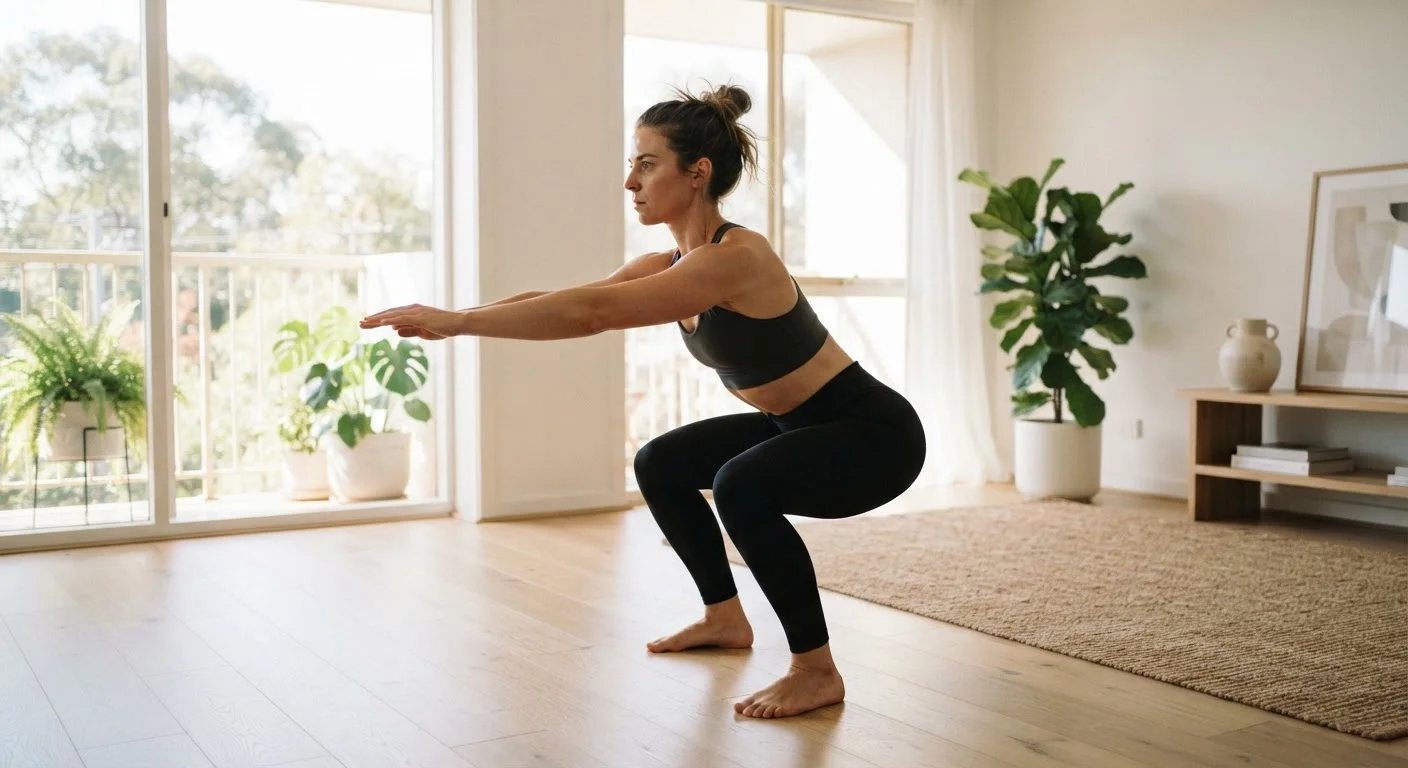
- Bodyweight Squat: Feet hip-width apart, hips descend to parallel or below. The foundational pattern for lower body training.
- Sumo Squat: Wider stance with toes turned out increases inner thigh and glute recruitment.
- Bulgarian Split Squat: Rear foot elevated, front foot forward — a demanding single-leg variation that builds balance and unilateral leg strength simultaneously.
- Pistol Squat Progression: A single-leg squat to full depth. Begin with an assisted version using a doorframe before progressing to the freestanding form.
Hip Hinge Variations
- Glute Bridge: Supine position, feet flat, hips driven upward. Targets glutes and hamstrings with minimal spinal loading.
- Single-Leg Glute Bridge: One foot lifted isolates each side, correcting common strength imbalances.
- Romanian Deadlift (RDL) — Bodyweight: Standing hinge at the hips with a slight knee bend and flat back, feeling a hamstring stretch at the bottom. The pattern transfers directly to loaded hinge work if you add resistance later.
For guidance on how these movement types serve different training goals, see our strength vs. endurance comparison.
Progressive overload
Gradually increasing the difficulty of an exercise over time to continue challenging the body and driving adaptation. In bodyweight training, this is achieved by changing leverage, tempo, range of motion, or moving to harder variations rather than adding external weight.
Unilateral training
Exercises that train one limb at a time (e.g., single-leg squat, single-arm push-up). Unilateral work helps identify and correct strength imbalances between sides of the body.
Hip hinge
A movement pattern in which the hips fold backward while the spine stays neutral and the knees bend slightly. It primarily targets the posterior chain — the glutes, hamstrings, and lower back.
Anterior chain
The muscles running along the front of the body, including the quadriceps, hip flexors, abdominals, and chest. Balanced training addresses both the anterior and posterior chain.
Posterior chain
The group of muscles along the back of the body — glutes, hamstrings, spinal erectors, and upper back. Strong posterior chain muscles support posture and athletic performance.
Isometric hold
An exercise position held statically without movement, such as a plank or wall sit. Isometric training builds muscular endurance and stability without requiring dynamic repetitions.
Core and Pulling Alternatives Worth Knowing
Core training at home extends well beyond sit-ups, and pulling movements are achievable even without a pull-up bar.
Core Variations
- Plank: A static hold in a push-up position that trains anterior core stiffness without spinal flexion.
- Side Plank: Lateral hold targeting the obliques and quadratus lumborum — important for rotational stability.
- Dead Bug: Supine, arms and legs extended, opposite limbs lower together while the lower back presses flat. Excellent anti-extension core training.
- Hollow Body Hold: A gymnastics-derived position that builds deep anterior core tension. Our floor-based core exercise guide explains this and related movements in detail.
Pulling Alternatives
- Inverted Row (using a sturdy table): Lie beneath a stable table edge, grip it, and pull your chest upward. A practical horizontal pulling option that requires no equipment.
- Band Pull-Apart (resistance band): If a light resistance band is available, this targets the rear deltoids and mid-back — muscles easily neglected in push-dominant home routines.
- Doorframe Row: Grip both sides of a door frame at hip height, lean back, and row yourself toward the frame. A zero-equipment pulling option for beginners.
This article is for general informational purposes only and is not a substitute for advice from a qualified fitness professional or healthcare provider. If you have an existing injury or health condition, consult a professional before beginning a new exercise program.
The content on this site is for informational purposes only and is not a substitute for professional advice. Always consult a qualified professional for guidance specific to your situation.