

Our Verdict
Home workouts are a genuinely effective, sustainable option for most health-conscious adults — not just a compromise. The trade-offs around equipment limits and accountability are real, but they're manageable with intentional planning and progressive programming. The gym retains advantages for those chasing peak strength or who thrive in community settings.
Home training is best suited to adults who value flexibility, privacy, and time efficiency, and who are willing to invest modest effort in structuring their own progressive routine.
Why This Decision Matters More Than You Think
Choosing where you train isn't just logistical — it shapes how consistently you train, how much you enjoy it, and ultimately whether the habit sticks. The gym vs. home question deserves an honest answer rather than a trendy one. This breakdown covers what the research and practical experience actually suggest about each environment, so you can make a choice grounded in your real life.
If you're starting out or returning to fitness after a break, building a structured home routine is a practical first step regardless of which direction you lean.
The Real Advantages of Training at Home
Home training has moved well beyond improvised push-ups on a carpet. Used intelligently, it can deliver comprehensive fitness development across strength, endurance, and flexibility.
No commute means fewer reasons to skip sessions
Removing travel time eliminates one of the most common barriers to consistency. Studies on exercise behavior consistently identify convenience as a top driver of long-term adherence.
Significantly lower ongoing cost than gym membership
A basic home setup requires only a one-time equipment investment. Over one to two years, most home trainers recoup those costs compared to monthly membership fees.
Fully flexible scheduling around your real life
You can train at 6 a.m., during a lunch break, or late at night without worrying about opening hours, class schedules, or equipment availability.
Privacy reduces self-consciousness for beginners
Many people — especially those new to exercise — find the gym environment intimidating. Training privately allows you to learn movements and build confidence without social pressure.
Customised environment optimised for your preferences
You control music, temperature, layout, and equipment choices. A personally optimised space can improve both workout quality and enjoyment over time.
Convenience is the most consistent predictor of exercise adherence in behavioral research. Removing the commute, the locker room queue, and the scheduling constraint eliminates several friction points that cause people to skip sessions. For parents, shift workers, or anyone with an irregular schedule, this flexibility isn't a luxury — it's what makes consistent training possible at all.
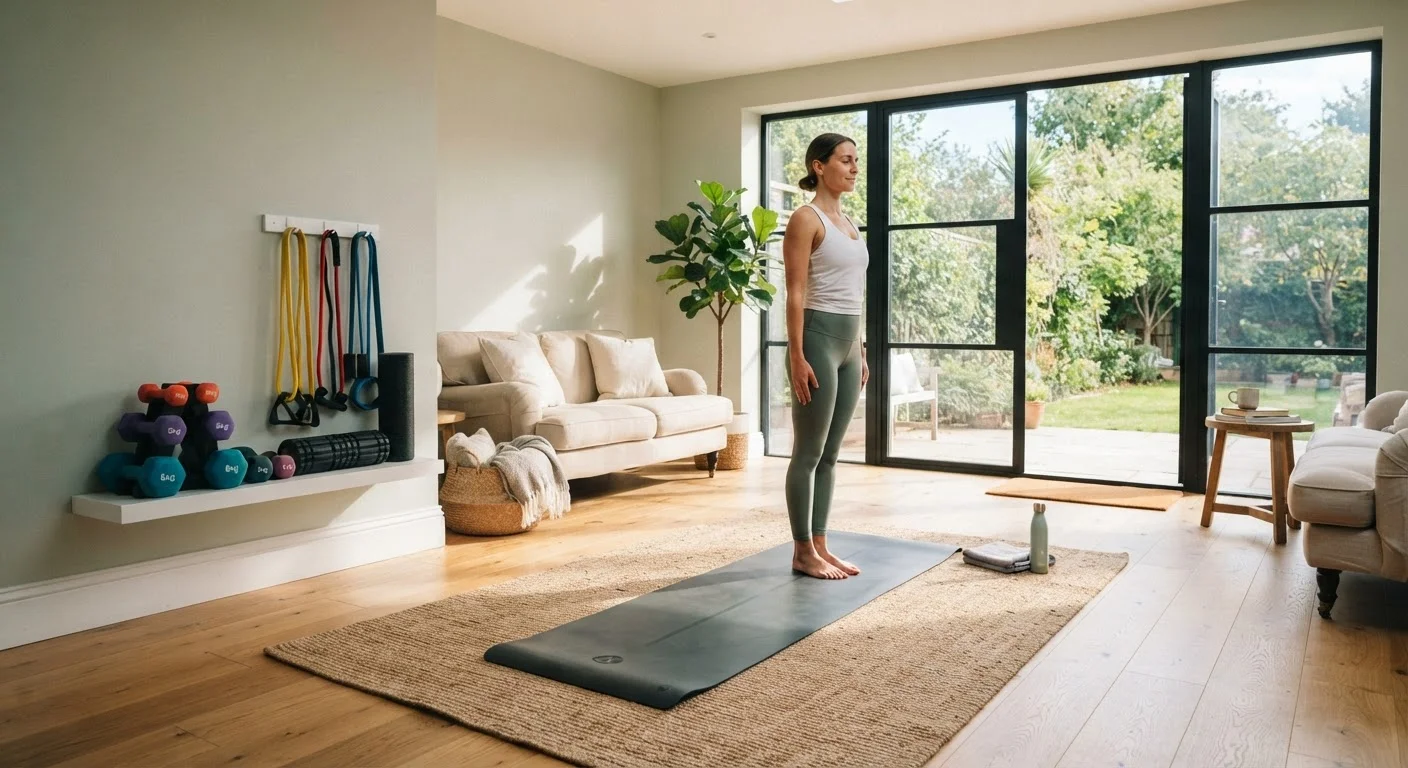
The cost argument is also real. A gym membership in the US averages roughly $50 per month, and that figure rises sharply for premium facilities. A modest home setup — a mat, a set of resistance bands, and a pair of adjustable dumbbells — can serve most fitness goals for years. You can learn more about how bodyweight and resistance-based approaches compare in our bodyweight vs. resistance equipment guide.
The Genuine Drawbacks You Should Weigh
Honesty matters here. Home training has real limitations that affect specific goals and personality types — and glossing over them doesn't help anyone make a better choice.
Accountability and social motivation are harder to replicate
The implicit social environment of a gym — other people training, instructor presence — creates accountability that home settings lack by default. This requires deliberate substitution.
Progressive overload has real equipment limits
Advancing strength gains requires progressively heavier or harder stimuli. Without a full rack or cable system, intermediate and advanced lifters may encounter a ceiling on certain movements.
Home distractions can undermine training quality
Family members, chores, notifications, and domestic tasks compete for attention in ways a gym environment doesn't allow. Maintaining focus requires intentional boundary-setting.
No immediate access to expert technique guidance
Gyms typically offer staff or personal trainers who can correct form in real time. At home, poor movement patterns may go unchecked, increasing injury risk over time.
Specialist equipment is absent or expensive to replicate
Squat racks, cable machines, rowing ergometers, and saunas require significant investment and space to bring home. Many training modalities remain gym-dependent for most people.
The accountability gap is arguably the biggest practical challenge. Gyms create implicit social pressure to show up and work hard; at home, that pressure evaporates. Research on exercise adherence consistently finds that social context and external accountability are among the strongest predictors of long-term consistency. Without deliberate substitutes — workout partners, apps with check-in features, or scheduled virtual classes — many people find motivation harder to sustain at home.
Progressive overload — the principle of gradually increasing demand on your muscles to drive adaptation — is also more complex without a full weight rack. Bodyweight progressions (moving from a standard push-up to an archer push-up, for example) can extend this curve considerably, but there are real ceiling effects for those pursuing maximum strength or hypertrophy. Common myths about home training often overstate what bodyweight alone can achieve at advanced levels.
Special Populations: Check With a Professional First
If you're pregnant, recovering from an injury, managing a chronic condition, or are new to exercise after a significant health event, home training may still be appropriate — but the program design matters considerably more. Please consult a qualified healthcare provider or certified fitness professional before starting or significantly changing your routine. General guidance in this article is not a substitute for personalised advice.
Making Home Training Work Long-Term
The cons above are genuine — but most are addressable. Accountability gaps can be closed with structured programming, community apps, or a training partner who checks in remotely. Equipment limits can be extended with a few targeted investments. The key is treating home training as a system to design, not a default that runs itself.
For those targeting specific outcomes, it helps to align your environment to your goals early. Training for strength versus endurance at home involves meaningfully different approaches, and knowing which you're pursuing shapes every equipment and programming decision you make.
Motivation will fluctuate regardless of where you train — that's normal. Strategies for maintaining home training consistency during busy or low-energy periods are worth building into your plan from the start, not reaching for only when things slip.
This article is for general informational purposes only and does not constitute medical or personal fitness advice. Consult a qualified healthcare or fitness professional before beginning a new exercise program, particularly if you have any existing health conditions or injuries.
The content on this site is for informational purposes only and is not a substitute for professional advice. Always consult a qualified professional for guidance specific to your situation.