

Why Move Beyond the Crunch?
For decades, crunches were the default answer to the question of how to train your core. Yet movement science has shifted this thinking considerably. The crunch is a spinal flexion exercise — it trains the rectus abdominis (the "six-pack" muscle) by curling the spine repeatedly. This muscle group matters, but it represents only one part of a much larger system.
Your core is better understood as a cylinder of muscles wrapping around your trunk: the transverse abdominis at the front and sides, the multifidus along the spine, the diaphragm above, and the pelvic floor below. This cylinder's job is primarily to resist movement — holding your spine stable while your arms and legs do work. Exercises that train this anti-movement function are generally considered more functional and safer for long-term spinal health.
For a broader foundation on movement patterns that support everyday function, see the eight foundational movement patterns that underpin resilient strength.
Key Floor Exercises and How They Work
The following exercises are well-established in physical therapy and fitness research for targeting deep core stability. Each can be performed on a mat at home with no equipment.
80%
Adults who experience back pain at some point
According to the National Institute of Neurological Disorders and Stroke, approximately 80% of adults experience low back pain at some point in their lives, highlighting why core stability training is widely prioritized.
2–3×
Recommended core training sessions per week
Most exercise physiology guidelines suggest training core stability two to three times weekly to allow adequate recovery while producing meaningful adaptation.
Forearm Plank
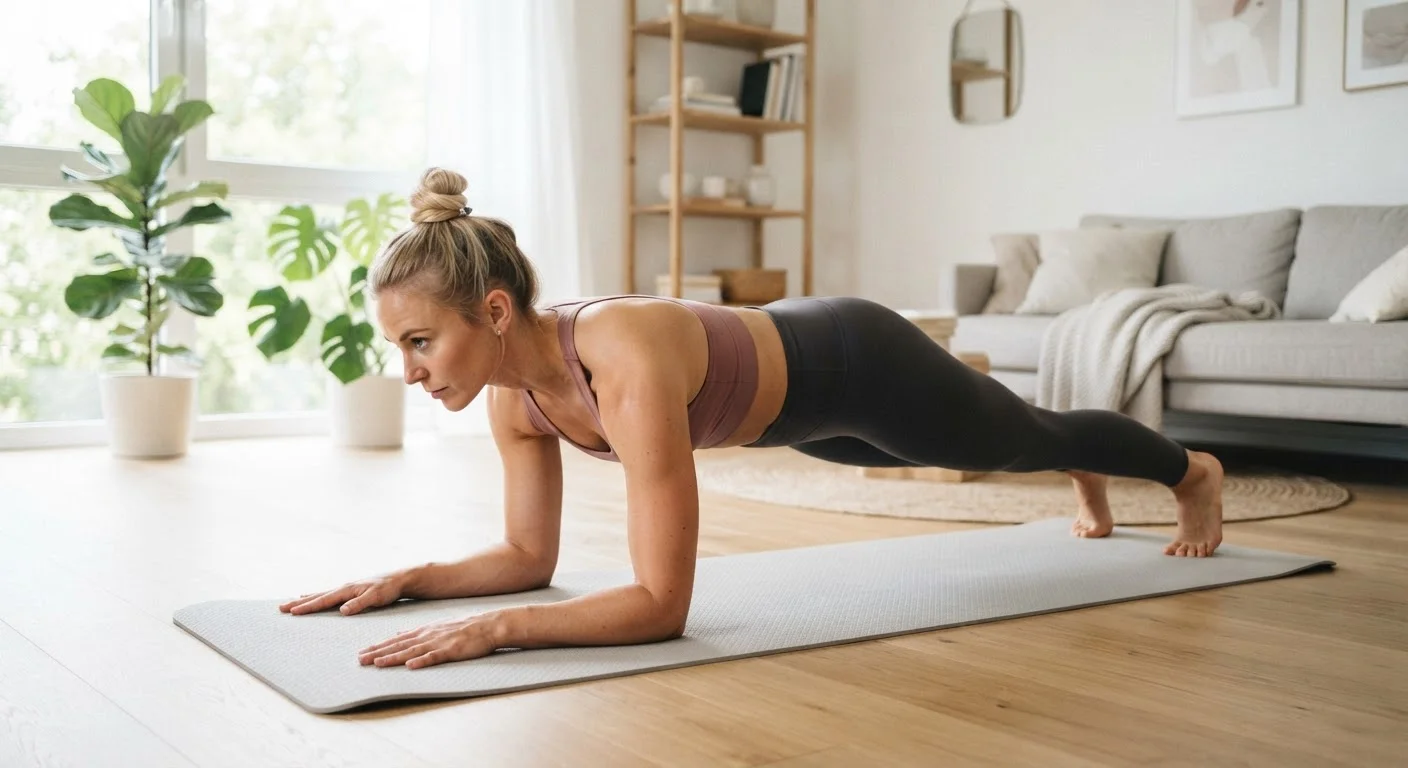
The plank is an anti-extension exercise — your core must prevent your lower back from sagging under gravity. Set up with forearms flat, elbows beneath shoulders, and feet hip-width apart. The goal is a straight line from head to heels. Squeeze your glutes, brace your abdomen gently (as if bracing for a light punch), and breathe steadily. Start with 3 sets of 15–20 seconds and build gradually.
Dead Bug
The dead bug is widely used in rehabilitation for its ability to train the deep core while protecting the lumbar spine. Lie on your back, arms pointing to the ceiling, knees bent to 90 degrees above your hips. Slowly lower one arm overhead while extending the opposite leg toward the floor — without letting your lower back arch off the mat. Return and repeat on the other side. Control, not speed, is the priority.
Hollow Body Hold
Used by gymnasts as a foundational position, the hollow hold trains full-body tension through the core. Lie on your back, press your lower back firmly into the floor, extend your legs and arms, and lift both slightly off the ground. Your body forms a shallow bowl shape. Even a few seconds of quality tension is valuable when starting out.
Bird Dog
Starting on hands and knees, extend your right arm forward and left leg back simultaneously, maintaining a level pelvis. This challenges rotational stability — resisting the urge to rotate at the hips as one side is loaded. Return slowly and alternate sides.
Technique Principles That Make the Difference
Start Shorter, Not Longer
Beginners often try to hold planks for as long as possible, which typically leads to form breakdown well before the time limit. Instead, stop each hold a few seconds before your form degrades and rest briefly. Multiple clean, short sets build better neuromuscular habits than a single prolonged struggle.
Two technique principles apply across all of these exercises and determine whether they actually deliver results:
- Neutral spine: Maintain the natural curves of your spine rather than flattening or exaggerating them. This is the position your stabilizers are designed to protect.
- Breathing through the brace: Bracing does not mean holding your breath. Practice exhaling fully while keeping your core lightly engaged — this coordinates the diaphragm with your deep abdominals, which is exactly how the system is meant to function.
If you are new to structured home training, building a home workout routine from the ground up provides a structured starting framework before adding dedicated core sessions.
For those exploring progressions beyond the basics, exercise variations every home trainer should know covers bodyweight movement alternatives worth adding as you advance.
This article is for general informational purposes only and does not constitute medical advice. If you experience pain during exercise or have an existing back condition, consult a qualified healthcare professional before beginning a new training program.
Frequently Asked Questions
Crunches are not inherently harmful for most healthy adults, but they place repeated flexion stress on the lumbar spine. For people with existing back issues, this load can be uncomfortable. More importantly, crunches mostly work superficial muscles rather than the deep stabilizers your spine relies on for support.
Research suggests that multiple shorter holds — such as three sets of 10–20 seconds — can be as effective as one long hold, particularly for beginners. Quality of form matters far more than duration. Stop the hold as soon as your hips drop or your lower back arches.
Strengthening the deep core muscles is often recommended as part of a broader approach to managing lower back discomfort. However, if you experience persistent or acute back pain, you should consult a qualified healthcare professional before starting any new exercise program.
Most fitness guidelines suggest training any muscle group two to three times per week with rest days in between for recovery. Core muscles recover relatively quickly, so many people include brief core sessions three to four times weekly as part of a broader routine.
No equipment is required. A non-slip yoga mat or exercise mat is helpful for comfort and grip, but even that is optional. All exercises described can be performed on any firm, flat floor surface at home.
The content on this site is for informational purposes only and is not a substitute for professional advice. Always consult a qualified professional for guidance specific to your situation.