

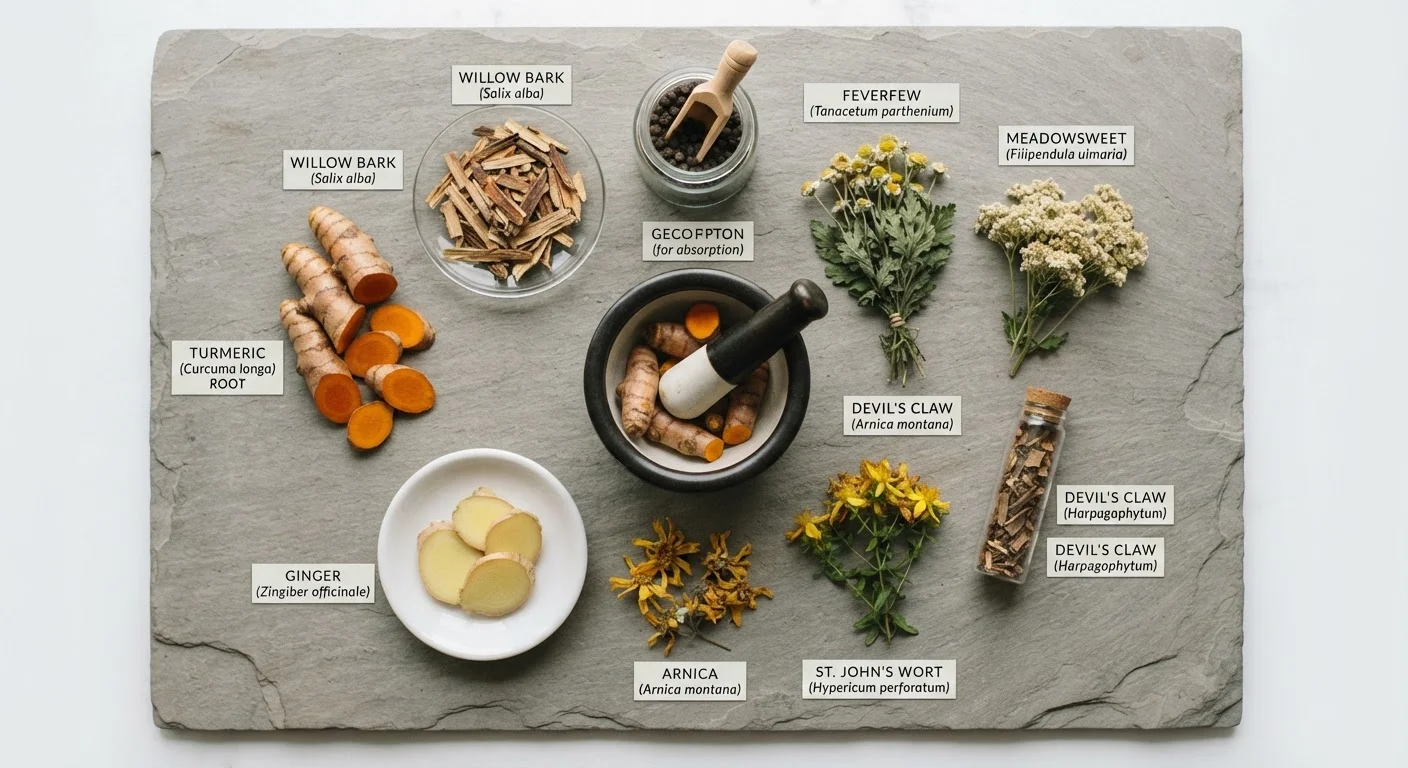
Why Natural Compounds Enter Pain Research
Plants and plant-derived substances have been used to manage pain for millennia. Modern research has begun to examine whether those traditional applications hold up under controlled study — and in some cases, the answer is cautiously encouraging. In others, the evidence remains thin or inconsistent.
Understanding what "evidence-informed" actually means is essential before drawing conclusions from any single study. Many compounds have demonstrated activity in laboratory or animal models without ever producing the same effects reliably in human trials. This reference summarizes the research landscape for several commonly discussed compounds — not as treatment recommendations, but as an educational map of what science has and has not established.
For a broader look at how pain signals arise in the first place, see our article on the biology of pain. Understanding pain mechanisms helps clarify why certain compounds are worth investigating at all.
| Research status of most herbal pain compounds | Preliminary — small trials, inconsistent results (General consensus across systematic reviews in pain research) |
| Curcumin bioavailability challenge | Poor absorption without formulation aids (Multiple pharmacokinetic studies on curcumin) |
| Willow bark active compound | Salicin — related to the aspirin family (Established phytochemical classification) |
| Capsaicin mechanism | TRPV1 receptor desensitization (Neuropharmacology literature) |
| Boswellia serrata studied condition | Knee osteoarthritis (small trials) (Cochrane and individual clinical trial reviews) |
| Key limitation across all compounds | Small study sizes and short follow-up periods (Reflected in systematic reviews of natural pain compounds) |
Key Compounds and Their Research Profiles
Curcumin (from turmeric): Curcumin is the primary active polyphenol in turmeric. Multiple small clinical trials have examined its role in reducing inflammatory markers, particularly in osteoarthritis. Results are mixed, partly because curcumin is poorly absorbed on its own — a known bioavailability challenge that researchers continue to study. For a detailed review, see curcumin's research profile.
Salicin (from willow bark): Willow bark contains salicin, a compound chemically related to aspirin. Some clinical studies suggest it may modestly reduce lower back pain and osteoarthritis discomfort, though evidence quality varies and gastrointestinal sensitivity is a documented concern in some individuals.
Gingerols (from ginger): Gingerols and shogaols are active compounds in ginger with documented anti-inflammatory properties in laboratory settings. Human trials examining exercise-induced muscle soreness and mild joint pain have produced modest, inconsistent results. How ginger works in the body offers a closer look at the underlying mechanisms.
Boswellic acids (from frankincense resin): Extracted from Boswellia serrata, boswellic acids have shown some ability to inhibit specific inflammatory enzymes in controlled research. Several trials in knee osteoarthritis populations have reported improvements in pain scores, though study sizes remain small and longer-term safety data are limited.
Capsaicin: Derived from chili peppers, capsaicin works through a distinct mechanism — temporarily desensitizing pain-signaling nerve fibers that use a receptor known as TRPV1. Topical capsaicin is one of the more studied natural-derived pain applications, with regulatory-approved formulations available for specific nerve pain conditions. Over-the-counter concentrations vary considerably from prescription forms.
CBD (cannabidiol): Research on CBD for pain remains active but inconclusive. Preclinical data suggest interactions with endocannabinoid and inflammatory pathways. Human trial results for pain outcomes are mixed, and regulatory classification of CBD products varies by jurisdiction. Consult a qualified healthcare provider before considering any cannabinoid-based product.
Polyphenol
A class of naturally occurring plant compounds characterized by multiple phenol units. Many polyphenols have been studied for antioxidant and anti-inflammatory properties, though their effects in living systems vary considerably.
Bioavailability
The proportion of an ingested substance that enters the bloodstream and reaches the site of action. Poor bioavailability means a compound may have biological activity in theory but limited real-world effect because the body absorbs little of it.
TRPV1 Receptor
A pain-sensing ion channel found on nerve fibers, activated by heat, acid, and capsaicin. Repeated activation by capsaicin can temporarily desensitize these fibers, reducing their ability to transmit pain signals.
Inflammatory Markers
Measurable proteins or molecules — such as C-reactive protein or certain cytokines — that rise in the bloodstream or tissues during an inflammatory response. Researchers often track these to gauge whether a compound has anti-inflammatory activity.
Placebo-Controlled Trial
A clinical study design in which some participants receive the treatment under investigation while others receive an inactive placebo, without either group knowing which they received. This method helps researchers separate real treatment effects from expectation-driven improvements.
Endocannabinoid System
A cell-signaling network found throughout the body that plays roles in regulating pain, mood, appetite, and immune function. Cannabinoids such as CBD are thought to interact with this system, though the exact mechanisms remain under investigation.
Reading the Evidence: What to Look For
Not all research carries equal weight. A single small study — especially one conducted in cells or animals — says far less about human benefit than a well-designed, placebo-controlled clinical trial with adequate participant numbers. When evaluating any natural compound for pain, consider the study population (does it match your situation?), the outcome measures used, and whether results have been replicated independently.
Common myths about natural pain relief highlights how easily promising early-stage data can be misread as proof of effect. The holistic pain management overview can also help frame these compounds within a broader, multi-modal approach to pain — one that typically includes movement, sleep, and stress management alongside any supplemental strategy.
Natural does not mean risk-free. Several compounds discussed here can interact with medications or affect specific populations differently. Always discuss any supplement with a licensed healthcare professional, particularly if you are pregnant, nursing, managing a chronic condition, or taking prescription medications.
This article is for general informational and educational purposes only. It is not medical advice and does not substitute for consultation with a qualified healthcare provider. Do not start, stop, or change any treatment based on information in this article.
The content on this site is for informational purposes only and is not a substitute for professional advice. Always consult a qualified professional for guidance specific to your situation.