

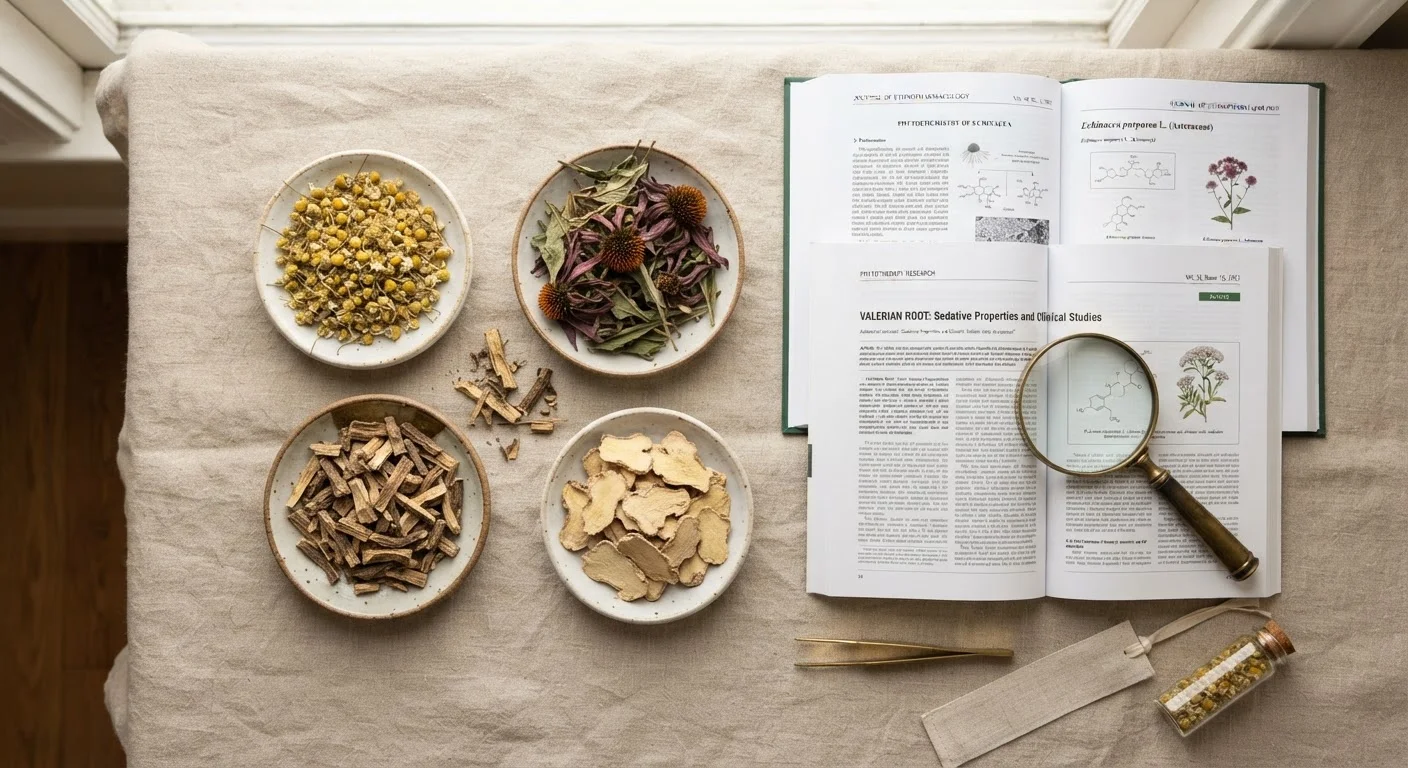
Why the Language of Evidence Matters
When a product label says an herb is "clinically studied" or a blog claims it's "scientifically proven," these phrases sound authoritative — but they carry very different weights. A single in-vitro (test-tube) study is not the same as a well-designed human trial. A 500-year history of traditional use in one culture is not the same as a systematic review of published research.
Understanding these distinctions is not about being skeptical of herbal medicine; it's about being an informed consumer of health information. The term evidence-informed exists precisely to acknowledge that herbal remedies occupy a nuanced space where multiple evidence types are often all that's available — and all relevant. To build your vocabulary around this topic, see The Herbal Remedy Glossary for plain-language definitions of key terms used in herbal medicine literature.
Evidence-Informed vs. Evidence-Based: A Key Distinction
"Evidence-based" in a strict clinical sense typically requires randomized controlled trial data before a treatment is recommended. "Evidence-informed" is a broader, more pragmatic framework that incorporates all credible knowledge sources — including traditional records and mechanistic science — when RCT data is limited or unavailable. For most herbal remedies, evidence-informed is a more honest framing given the current state of research funding and methodology.
The Hierarchy of Evidence in Herbal Research
In conventional medicine, evidence is typically ranked from weakest to strongest: anecdotal reports, case studies, observational research, animal studies, and then randomized controlled trials (RCTs) and systematic reviews at the top. For herbal medicine, this hierarchy still applies — but the picture is complicated by a significant research gap.
Most well-funded clinical trials are designed for pharmaceutical compounds: single, patentable molecules at fixed doses. Herbs are complex mixtures whose composition varies by growing conditions, preparation method, and plant part used. Standardizing these variables for reproducible trials is difficult and expensive. As a result, many herbs that have been used safely for generations have never been tested in large, well-designed human trials — not because they lack potential, but because the research infrastructure and funding haven't prioritized them.
~25%
Prescription drugs derived from plant compounds
The World Health Organization has estimated that roughly one-quarter of pharmaceutical drugs in use are derived from, or modeled on, plant-based compounds, underscoring the biological plausibility of herbal medicine.
80%
Global population relying on herbal medicine
WHO estimates that approximately 80% of the world's population uses herbal medicine as part of primary healthcare, generating a vast base of traditional use data — though not controlled clinical evidence.
This is where the evidence-informed framework earns its value: it holds traditional use, mechanistic data, and clinical findings in honest tension rather than falsely elevating or dismissing any one source.
What 'Traditional Use' Actually Tells Us
Traditional use records — from Ayurvedic texts, Traditional Chinese Medicine pharmacopoeias, Native American botanical knowledge, and European herbalism — document centuries of human experience with plants. This is not trivial. When an herb has been used consistently across multiple cultures for a similar purpose, that convergence is meaningful signal worth investigating.
However, traditional use has real limitations as evidence. It cannot tell us about mechanisms of action, safe dose ranges for diverse modern populations, or interactions with contemporary medications. Confirmation bias — the human tendency to remember successes and forget failures — may also have shaped historical records. Evidence-informed practice treats traditional use as a credible hypothesis generator, not a confirmed conclusion.
Applying an Evidence-Informed Lens: Practical Guidance
When evaluating any herbal remedy claim, consider asking three questions: What type of evidence supports this? How consistent is that evidence across multiple sources? And what safety information exists for the populations most relevant to you?
An herb supported by both traditional records and at least some human research — even if preliminary — warrants more confidence than one backed only by a manufacturer's in-house cell-culture study. Transparency about limitations is a marker of credibility, not weakness. Sources that acknowledge "evidence is promising but not yet conclusive" are generally more trustworthy than those that claim certainty where none exists.
Most importantly, evidence-informed does not mean self-directed. Even herbs with strong research profiles can interact with medications or be contraindicated for certain health conditions. Always discuss herbal use with a qualified healthcare provider — this guidance is especially important for people who are pregnant, nursing, managing chronic illness, or caring for children or older adults.
This article is for general informational and educational purposes only. It is not a substitute for professional medical advice, diagnosis, or treatment. Always consult a qualified healthcare professional before making decisions about your health.
Frequently Asked Questions
It means a remedy is evaluated using all available knowledge — clinical trials, traditional use, laboratory research, and expert consensus — weighed together rather than relying on one source. This approach acknowledges the real limits of herbal research without dismissing centuries of use.
No. Traditional use suggests an herb may have real effects and an acceptable safety profile across generations, but it cannot confirm mechanisms, optimal dosing, or effectiveness in controlled conditions. It is a valuable starting point for research, not a substitute for it.
Funding for herb research is limited compared to pharmaceutical drugs. Additionally, standardizing a whole plant or extract for reproducible trials is technically challenging, and patent restrictions make commercial investment less attractive. This creates a research gap that leaves many traditional remedies understudied.
Yes. An herb supported by consistent traditional records, plausible laboratory-established mechanisms, and a reasonable safety history may still be considered evidence-informed — with appropriate caveats. The key is transparency about what type of evidence exists and what remains unknown.
Watch for absolute language like 'cures,' 'guaranteed,' or 'proven to treat.' Reliable sources distinguish between preliminary findings and established conclusions, note limitations, and recommend professional consultation. Claims lacking any referenced evidence source deserve particular skepticism.
Not necessarily — but discuss any herbal remedy with your healthcare provider, especially if you have a medical condition, take medications, or are pregnant. Mixed evidence calls for caution and individualized guidance, not blanket avoidance or uncritical acceptance.
The content on this site is for informational purposes only and is not a substitute for professional advice. Always consult a qualified professional for guidance specific to your situation.