

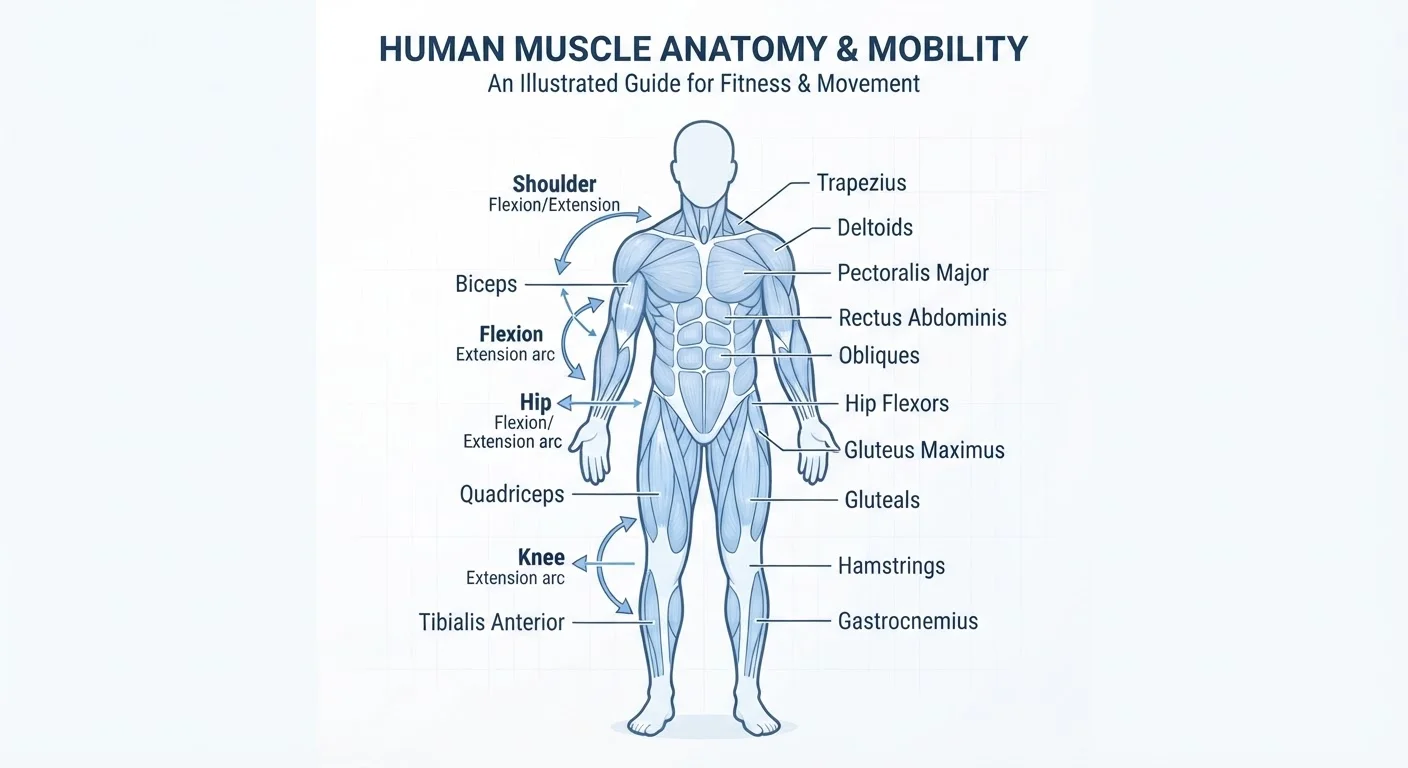
Why Movement Vocabulary Matters
Every discipline has a language, and strength and flexibility training is no different. When a coach cues you to "load eccentrically" or a program calls for "active mobility work," the instruction is only useful if you know what it means. This glossary is designed as a practical reference — a place to look up terms as you encounter them, clarify concepts you half-know, and build a clearer mental model of how your body moves and adapts.
If you're new to structured training, consider pairing this guide with our grounded introduction to strength and mobility to see these concepts applied in context. For a broader look at how strength and flexibility interact, explore the science behind training both qualities together.
Range of Motion (ROM)
The full arc of movement available at a joint, measured in degrees. ROM can be passive (achieved with external assistance) or active (achieved through your own muscular effort). Training both forms leads to more functional, usable flexibility.
Eccentric Loading
The phase of a muscle contraction in which the muscle lengthens under tension — for example, lowering a weight during a bicep curl. Eccentric loading is particularly effective for building strength through a full range of motion and is a key mechanism in injury rehabilitation.
Isometric Contraction
A muscle contraction in which the muscle generates force without changing length. Holding a plank or a wall sit are common examples. Isometric work is often used to build strength at specific joint angles and to improve positional stability.
Mobility
The ability to move actively through a joint's available range of motion with control. Mobility differs from flexibility in that it requires muscular engagement — it is strength through length, not just passive reach.
Flexibility
The passive capacity of muscles and connective tissue to lengthen, allowing a joint to move through its range. Flexibility is a prerequisite for mobility but is not sufficient on its own for functional movement.
Progressive Overload
The training principle of gradually increasing the demands placed on the body — through load, volume, frequency, or complexity — so that it continues to adapt. This principle applies to both strength and flexibility work.
Tensile Strength
The capacity of a tissue — such as a tendon or ligament — to resist being pulled apart under tension. Regular strength training progressively improves tensile strength, reducing injury risk at connective tissue sites.
Proprioception
The body's internal sense of its own position in space, mediated by sensory receptors in muscles, tendons, and joints. Strong proprioception supports balance, coordination, and injury prevention.
Hypertrophy
The increase in muscle fiber size resulting from resistance training. Hypertrophy is distinct from strength gains, which can occur without significant size change, especially in early training phases.
Active Flexibility
Flexibility achieved and held through the contraction of the muscles surrounding a joint, without external support. Active flexibility directly translates to functional movement and athletic performance.
Neuromuscular Coordination
The efficiency with which the nervous system recruits and sequences muscle fibers to produce controlled movement. Improved coordination often accounts for early strength gains before significant muscle growth occurs.
Fascial Tissue
The connective tissue system that surrounds, supports, and connects muscles, organs, and bones throughout the body. Fascial health contributes to overall movement quality and is influenced by hydration, sustained postures, and training load.
Core Terms at a Glance
The following quick-reference facts capture essential benchmarks and classifications you'll encounter across most training programs. Use them alongside the definitions above to put numbers and categories to the concepts.
| Passive vs. Active ROM | Passive ROM is typically 10–20° greater than active ROM at most joints (General exercise science consensus) |
| Connective Tissue Adaptation | Tendons and ligaments adapt more slowly than muscle — often 3–6 months (Sports medicine research general consensus) |
| Eccentric Phase Importance | Eccentric contractions produce up to 20–50% more force than concentric at the same load (Strength and conditioning research consensus) |
| Proprioception Role | Impaired proprioception is a significant predictor of re-injury after ankle and knee sprains (Sports rehabilitation literature) |
| Neuromuscular Gains | Early strength gains (weeks 1–6) are primarily neural, not structural (Exercise physiology research consensus) |
| Flexibility Training Frequency | Most research supports stretching 3–5 days per week for measurable ROM improvement (ACSM flexibility guidelines, general consensus) |
Understanding how these terms connect helps you read training plans more accurately, communicate with coaches or healthcare providers, and make informed decisions about your practice. For a structured way to apply these concepts before each session, see this pre-session movement readiness checklist.
One of the most practically important terms is progressive overload — the principle that the body adapts when training stimulus increases gradually over time. This applies equally to flexibility: learn how to apply progressive overload specifically to mobility training. For a comprehensive overview of all the principles covered here in action, see our complete strength and flexibility training resource.
This article is for general informational and educational purposes only and does not constitute medical or fitness advice. Consult a qualified healthcare or fitness professional before beginning any new exercise program, particularly if you have existing injuries, health conditions, or are in a special population group such as pregnancy or older adulthood.
The content on this site is for informational purposes only and is not a substitute for professional advice. Always consult a qualified professional for guidance specific to your situation.