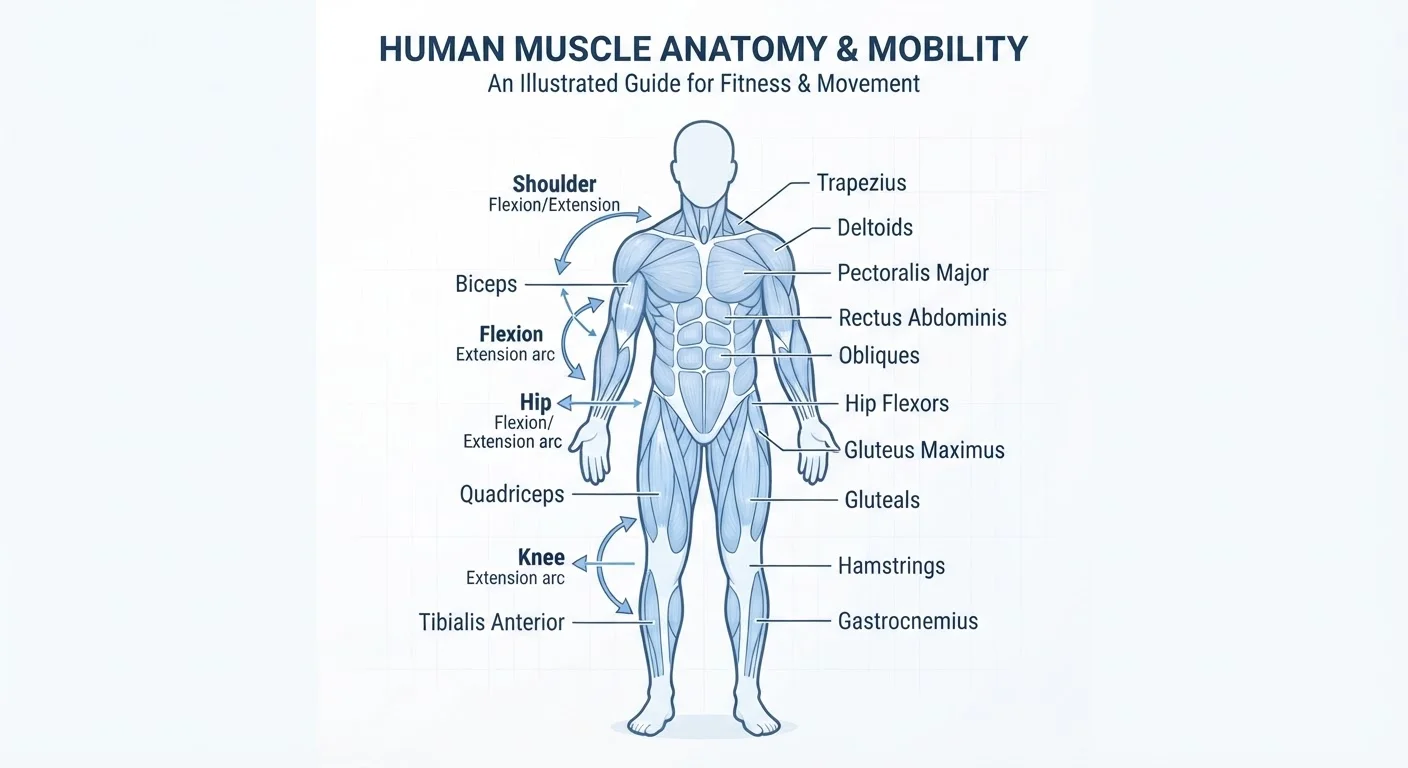


Why Flexibility Training Needs a Progressive Plan
Most people treat stretching as something they do at the end of a workout — the same routine, the same positions, the same duration, week after week. It feels productive, but without progressive challenge, the nervous system and connective tissue have little reason to adapt further. The same logic that explains why lifting the same weight indefinitely stops building muscle applies directly to flexibility work.
Progressive overload — the systematic increase of training stimulus over time — is the foundational principle behind any lasting physical adaptation. Applied to strength work, it means adding load, reps, or sets. Applied to mobility, it means deliberately increasing the demand placed on joints, muscles, and connective tissue so that the body is continually nudged past its current functional range. For a deeper look at how these two qualities interact, see how flexibility and strength complement each other.
Understanding this framing shifts flexibility from an afterthought into a trainable quality — one you can measure, program, and improve with intention.
The Four Levers of Flexibility Overload
Just as strength training uses variables like load, volume, and rest to drive adaptation, flexibility work has its own set of adjustable parameters. Knowing which lever to pull — and when — is what separates purposeful mobility training from passive routine.
If some of these terms are unfamiliar, the glossary of strength and flexibility terms provides clear definitions for range of motion, tensile strength, eccentric loading, and more.
Quick Wins: Start Applying Overload Today
You don't need to overhaul your entire routine to begin training flexibility progressively. Small, targeted adjustments made consistently will produce measurable results over weeks and months.
Tracking Progress and Avoiding Common Pitfalls
Flexibility gains are often invisible until they become obvious — which makes tracking essential. Simple benchmarks work well: note how far your fingers reach in a standing forward fold, how flat your hips sit in a pigeon pose, or how much hip flexion you can access in a lunge. Revisit these benchmarks every two to four weeks to verify adaptation is occurring.
One common mistake is chasing intensity over consistency. Aggressive overstretching can irritate tendons and ligaments, triggering a protective tightening response that erases recent gains. Overload in flexibility, as in strength, works best when increases are gradual — typically no more than a 10% increase in hold time or depth per session progression.
Age also affects the rate of connective tissue adaptation. If you're navigating how flexibility changes across different life stages, how physical capacity shifts with age offers useful context for calibrating your expectations.
For those building full-body programming around these principles, the comprehensive guide to strength and flexibility training covers how to integrate progressive mobility work into a balanced routine. And if you're applying overload without gym access, progressive overload in home training outlines equipment-free strategies that translate directly to flexibility sessions.
This article is for general informational and educational purposes only and does not constitute medical advice. Consult a qualified healthcare or fitness professional before beginning a new exercise program, particularly if you have existing injuries, joint conditions, or other health concerns.
The content on this site is for informational purposes only and is not a substitute for professional advice. Always consult a qualified professional for guidance specific to your situation.