
Why Movement Patterns Matter More Than Isolated Exercises
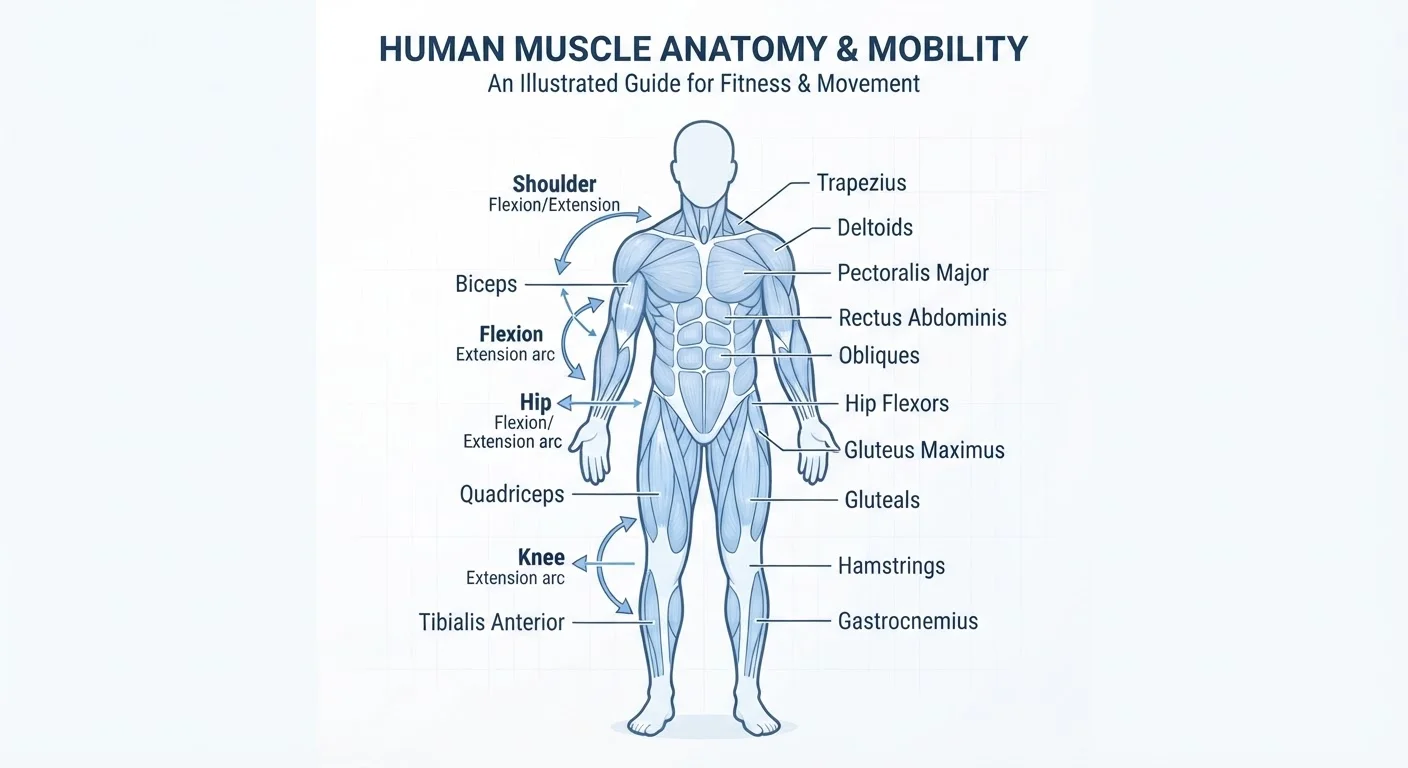
Walk into any gym and you'll see people training muscles — biceps curls, leg extensions, calf raises. But the human body doesn't move in isolated segments; it moves in coordinated patterns. Functional strength training shifts the focus from individual muscles to the movement patterns those muscles produce, building capacity that carries over directly into how you move through your day.
These eight foundational patterns — recognized across physical therapy, strength and conditioning, and rehabilitation communities — reflect the primary ways the human body generates and controls force. Train them consistently and you build a body that is resilient, balanced, and genuinely capable. For a primer on key terminology used throughout this article, see our glossary of strength and flexibility terms.
The Squat
The squat is one of the most universal movement patterns in human life — sitting down, standing up, picking something up off a low shelf. It involves simultaneous flexion and extension at the hip, knee, and ankle, demanding coordination and strength through the entire lower body and a stable, upright trunk.
Bodyweight squats, goblet squats, and split squats are all effective entries into this pattern. Prioritize depth that maintains a neutral spine and heel contact with the floor, rather than chasing a specific range of motion before you're ready.
The squat is the sit-to-stand motion of everyday life, trained deliberately.
The Hip Hinge
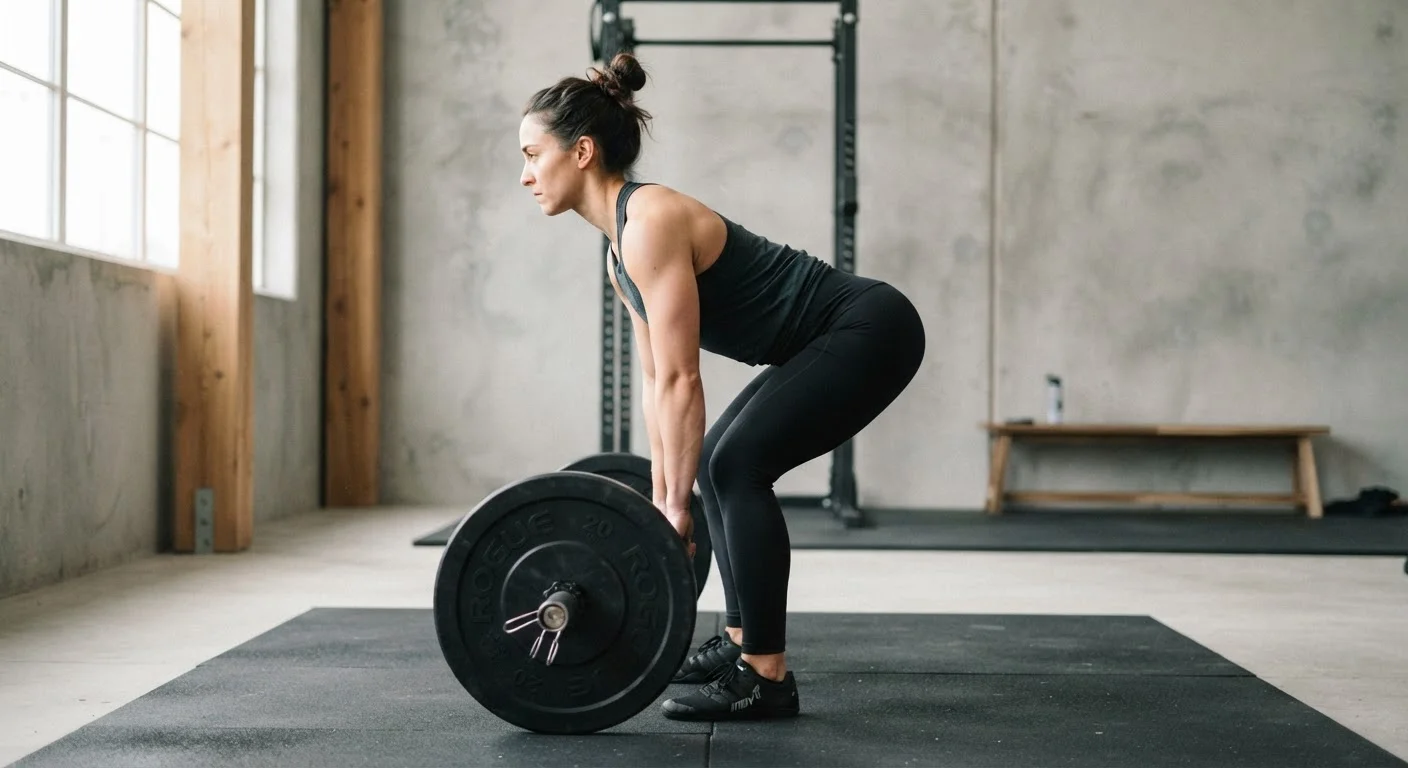
Often confused with the squat, the hip hinge is a distinct pattern centered on flexion and extension at the hip joint while the spine remains long and the knees bend only minimally. Deadlifts, Romanian deadlifts, and kettlebell swings all express this pattern.
The hinge is essential for safe lifting mechanics — anytime you pick something up from the floor without squatting, you're hinging. Developing strong, conscious control of this movement protects the lower back and powers the glutes and hamstrings efficiently. See how this complements floor-based core work.
A strong hip hinge is the foundation of safe lifting mechanics for life.
The Horizontal Push
Pushing something away from your body — a door, a box, or a barbell — engages the chest, anterior shoulders, and triceps as primary movers, with the serratus anterior and rotator cuff stabilizing the shoulder blade. Push-ups are the most accessible expression of this pattern and, when performed with full-body tension, are highly effective.
Progressing from incline push-ups to flat and eventually loaded variations builds the pressing strength needed for everyday tasks like pushing a loaded cart or getting up from the floor.
The push-up, done well, is one of the most complete horizontal push exercises available.
The Horizontal Pull
The horizontal pull — rowing movements — directly counterbalances pressing patterns. It trains the mid-back muscles (rhomboids, mid and lower trapezius, rear deltoids) that are typically underworked in people who spend long hours seated or forward-flexed.
Resistance band rows, dumbbell rows, and TRX-style rows are all effective. Consistently including horizontal pulling helps maintain shoulder health, upright posture, and the kind of pulling strength needed when opening heavy doors or hauling luggage.
Horizontal pulling counteracts the forward-rounding posture pattern many adults develop over time.
The Vertical Push
Pressing overhead — the vertical push — trains the shoulders, upper trapezius, and triceps in a range of motion that directly maps to reaching overhead in daily life. Shoulder press variations, pike push-ups, and loaded carries overhead all fall into this category.
Because the overhead position requires good shoulder mobility and thoracic (mid-spine) extension, some people need preparatory mobility work before loading this pattern heavily. Prioritize controlled range of motion over load.
Overhead pressing ability reflects the shoulder mobility and stability that daily reach demands.
The Vertical Pull
Pull-ups, chin-ups, and lat pulldown variations train the vertical pull — pulling your body or a load downward from overhead. This pattern develops the latissimus dorsi, biceps, and mid-back muscles that stabilize the spine and support posture.
For those not yet able to complete a full pull-up, band-assisted pull-ups or inverted rows provide a strong entry point. Developing this pattern supports activities from climbing to lifting overhead objects down from a shelf.
The vertical pull is one of the most undertraining patterns in typical gym routines.
The Carry
Carrying — walking while holding or supporting a load — is one of the most functional patterns humans perform and one of the most neglected in formal training. Farmer's carries (weight in each hand), suitcase carries (weight on one side), and overhead carries each challenge stability, grip strength, and anti-rotation control simultaneously.
Carries train the deep core in a way that transfers directly to real life: moving furniture, carrying shopping bags, transporting a child. They also reinforce good posture under load without requiring complex technique. This connects naturally with building movement into daily habits.
Carrying a load through space may be the most transferable movement pattern to real life.
Rotation and Anti-Rotation
The final foundational pattern addresses how the trunk generates, transfers, and resists rotational forces. Throwing, reaching across the body, and twisting to look behind you all involve rotation. Equally important is anti-rotation: the ability to resist unwanted twisting, which protects the spine during asymmetrical loading.
Pallof press variations, rotational medicine ball exercises, and single-arm or single-leg movements all develop this capacity. Including both rotation and anti-rotation work rounds out a truly complete functional strength program.
Training both rotation and anti-rotation builds a spine that can generate and resist force safely.
Putting It All Together
A well-designed training week doesn't need to feature all eight patterns in every session, but it should address each pattern with roughly equal frequency over time. Pairing opposing patterns — push with pull, squat with hinge — within the same session is one of the most practical ways to build muscular balance and reduce overuse risk.
Balance Opposing Patterns Each Week
For every pushing session, include an equal volume of pulling work. The same applies to squat and hinge patterns. This symmetry prevents the muscular imbalances that often lead to joint pain and overuse injuries over time. A simple pairing approach — push/pull in one session, squat/hinge in another — keeps programming balanced without complexity.
These patterns also appear naturally throughout everyday life. Carrying groceries, climbing stairs, and reaching overhead are all expressions of functional movement. For more on embedding movement into your routine without formal exercise, explore how everyday objects create movement opportunities.
If you're newer to this style of training, our grounded introduction to strength and mobility provides the broader context you need to start safely and build lasting habits. And if you're thinking about how these needs shift over time, physical capacity changes across the decades is worth reading alongside this article.
This article is for general informational purposes only and does not constitute medical or exercise advice. Consult a qualified healthcare or fitness professional before beginning a new training program, especially if you have an existing injury or health condition.
The content on this site is for informational purposes only and is not a substitute for professional advice. Always consult a qualified professional for guidance specific to your situation.