

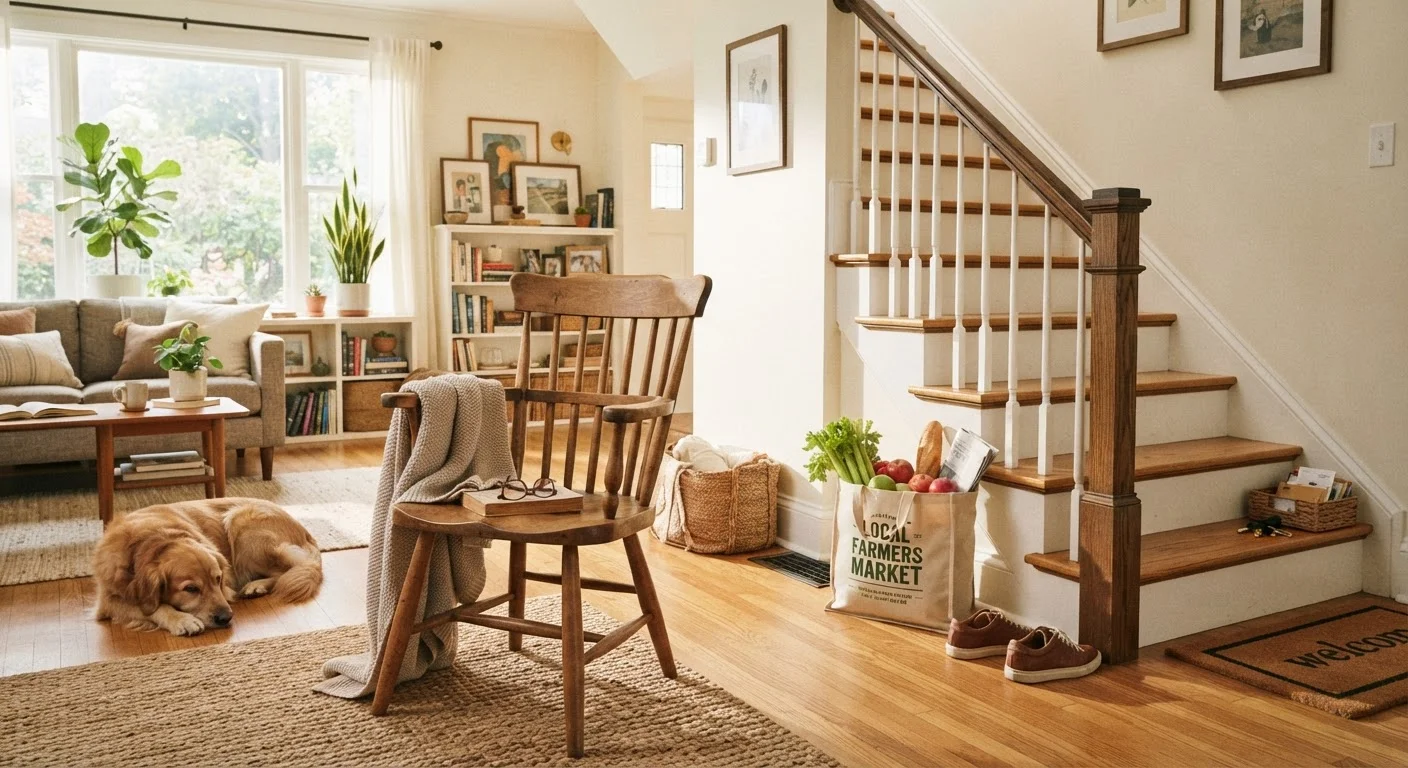
Why Everyday Objects Matter for Movement
Most people think of physical activity as something that happens in a gym or during a scheduled workout. But research into incidental movement — the unplanned activity woven into ordinary tasks — suggests that what happens outside dedicated exercise time also shapes how active we truly are.
If you've ever done a movement audit of your day, you may have been surprised by how much sitting accumulates between intentional workouts. That's where everyday objects come in. Stairs, chairs, bags, walls, and even the kitchen counter can all serve as functional movement tools — no equipment required.
This isn't about turning chores into an exhausting fitness program. It's about training your eye to spot the brief movement opportunities that already exist in your environment, then choosing to use them more deliberately.
The Staircase
If your home, office building, or apartment block has stairs, you have access to one of the most effective low-tech movement tools available. Stair climbing engages the glutes, hamstrings, calves, and core simultaneously — making it a compound movement that builds both cardiovascular fitness and lower-body strength.
Rather than treating stairs as an inconvenience to avoid, try making them your default. Take an extra trip up and down when carrying laundry, or pause mid-flight to do a slow, controlled step-up before continuing. Even a few deliberate stair trips per day add up across a week.
Stair climbing works multiple major muscle groups simultaneously with zero equipment needed.
Grocery and Shopping Bags
Carrying bags is a practical version of the farmer's carry — one of the foundational functional movement patterns that builds grip strength, shoulder stability, and core endurance.
Rather than making one trip with a cart or rolling bag, consider carrying moderate loads by hand when it's safe and appropriate to do so. Distribute weight evenly between hands where possible. This also applies to carrying a backpack with some weight rather than an empty bag — small additions that accumulate real training effect over a week of errands and commutes.
Carrying bags by hand is a practical version of the farmer's carry movement pattern.
A Sturdy Chair or Countertop Edge
A solid chair back or a kitchen countertop can serve as a balance aid for standing exercises like single-leg stands, calf raises, or hip hinges. These movements support ankle stability, balance, and lower-body strength — all relevant to injury prevention as we age.
While waiting for coffee to brew or food to cook, try standing on one foot for 20–30 seconds per side, using the counter only as a light safety touch. Progressing from two-point to single-leg balance over several weeks can noticeably improve proprioception — the body's sense of its own position in space.
A kitchen countertop doubles as a balance aid for single-leg exercises during routine tasks.
A Hallway or Open Wall
Walls are useful for a variety of isometric and bodyweight exercises. A wall sit — where you slide your back down a flat wall until thighs are roughly parallel to the floor — builds quad strength and endurance with no equipment at all. Wall push-ups offer an accessible upper-body pressing variation for those building toward floor-level push-ups.
Hallways can also serve as a cue to move. Some people find it useful to link brief movement bursts to transitions — every time you walk down the hallway, you add a short walking lunge or a set of calf raises. These "habit stacks" leverage existing routines to build new ones.
A flat wall is enough to perform effective isometric exercises like wall sits and wall push-ups.
The Floor Itself
Getting down to the floor and back up again is a movement skill that many adults gradually lose — yet it draws on flexibility, balance, and coordination in ways that matter for long-term independence. Sitting on the floor while watching television, reading, or talking on the phone naturally encourages more varied postures than a couch allows.
Practice transitioning from standing to sitting on the floor and returning to standing using different strategies — crossing your legs, using one knee, or lowering with control. This kind of incidental floor work supports hip mobility and overall movement quality without requiring a separate session.
Regularly getting down to the floor and back up trains balance and mobility in one functional movement.
A Commute Route or Parking Lot
Even a car-dependent commute contains hidden movement options. Parking slightly further from the entrance, walking to a farther transit stop, or getting off one stop early are all small choices with a cumulative effect. The active commute doesn't need to mean cycling to work — it can simply mean choosing the longer walking path when one exists.
Similarly, a daily walk integrated into transit or errand-running routines is one of the most well-supported health habits in the research literature — and it costs nothing beyond the time already being spent in transit.
Parking farther away or choosing a longer transit stop transforms a routine commute into movement.
Building the Habit of Noticing
These strategies work best when they become automatic rather than effortful. The first step is simply paying attention. Walk through your home, workplace, or commute route and ask: where is movement already possible here, and am I taking it?
Start With One Object, One Week
Pick a single everyday object from this list — ideally one already present in your daily routine — and commit to using it more deliberately for one week. Tracking these micro-habits is easier than tracking formal workouts, and the feedback loop of seeing consistent small wins helps reinforce the behavior. Once that one habit feels automatic, layer in a second.
Over time, consistent use of these micro-opportunities can meaningfully contribute to your daily movement totals. For those navigating common barriers to staying active, reframing the environment itself as a movement resource is often more sustainable than relying on willpower alone.
If you live with a chronic health condition, consult a qualified healthcare professional before significantly increasing your activity level. General guidance on safe daily movement with a chronic condition can also be a helpful starting point.
This article is for general informational purposes only and does not constitute medical advice. Always consult a qualified healthcare professional before making significant changes to your physical activity routine.
The content on this site is for informational purposes only and is not a substitute for professional advice. Always consult a qualified professional for guidance specific to your situation.