

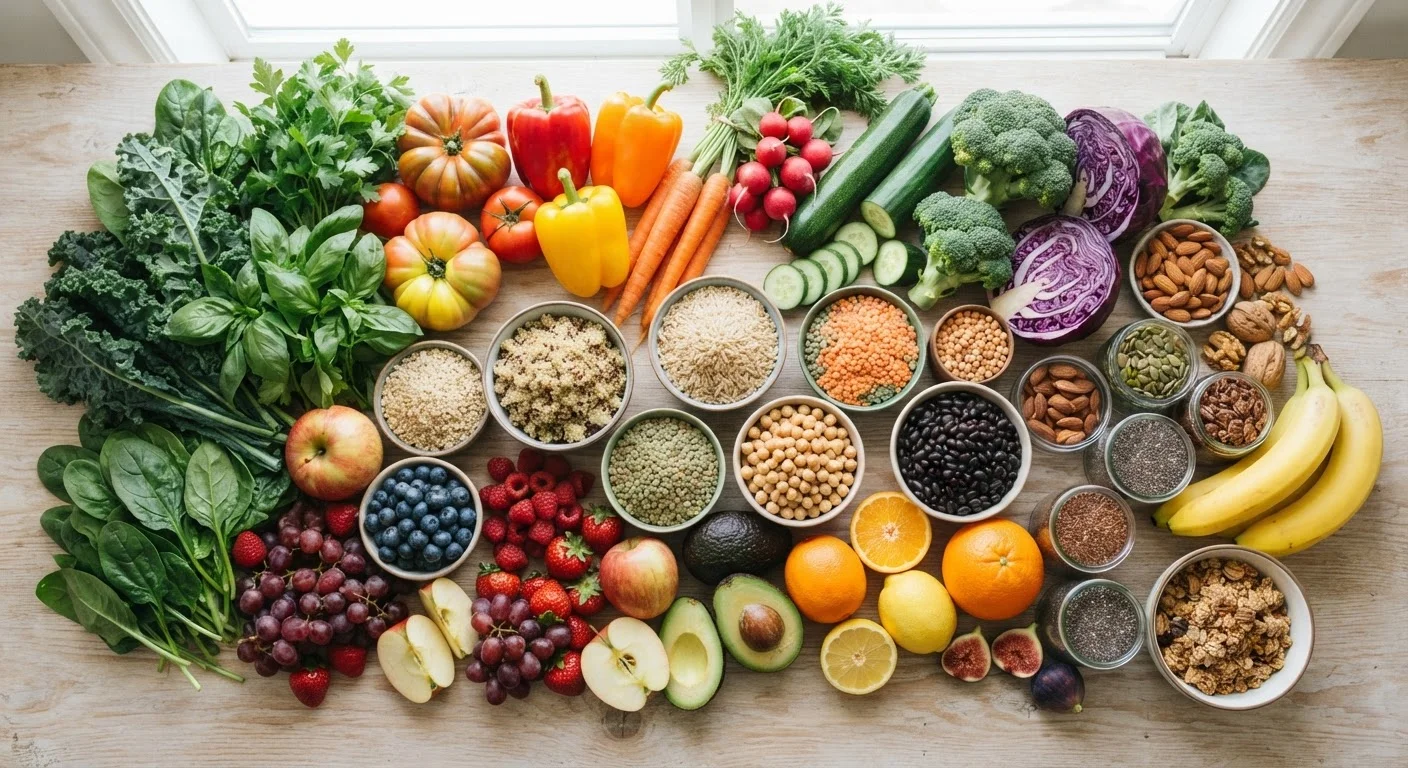
Defining the Pattern: More Than Just Plants
The phrase "plant-based" appears on everything from fast-food packaging to premium grocery products, which has made it genuinely confusing. A whole-food plant-based diet is a specific nutritional framework, not a synonym for vegan, vegetarian, or simply "healthy."
Two criteria define it: the food must come from a plant source, and it must be minimally processed. Both conditions matter equally. A bag of potato chips is technically plant-derived; it is not a whole food. Conversely, tempeh — a fermented soybean product — is processed, but it retains its whole-food protein and fiber structure and is generally considered compatible with WFPB principles.
The foods at the center of this pattern are vegetables, fruits, intact whole grains (such as brown rice, oats, and barley), legumes (beans, lentils, chickpeas), and unsalted nuts and seeds. Refined grains, added sugars, extracted oils, and ultra-processed foods — even plant-derived ones — fall outside the core of the pattern. For a deeper look at how food processing is classified nutritionally, see our guide on whole foods vs. processed foods.
How WFPB Differs from Veganism and Other Labels
Veganism is an ethical and lifestyle position that excludes all animal-derived products. The dietary expression of veganism — avoiding meat, dairy, eggs, and other animal ingredients — overlaps with WFPB, but the two frameworks have distinct priorities.
A person following a vegan diet can regularly consume white bread, refined pasta, processed meat alternatives, sugary beverages, and packaged snack foods without violating any vegan principle. A WFPB framework, by contrast, would consider those foods inconsistent with its emphasis on food quality and minimal processing.
Similarly, WFPB differs from flexitarian eating, which reduces but does not eliminate animal foods. Flexitarian approaches offer more flexibility but make different trade-offs in terms of nutritional composition and research applicability.
~10g/day
Average US dietary fiber intake
The Dietary Guidelines for Americans identify fiber as a nutrient of public health concern, with most adults consuming roughly half the recommended daily amount.
2–3×
Higher fiber intake on WFPB vs. typical Western diets
Research consistently shows that well-planned whole-food plant-based diets provide substantially more dietary fiber than the average American diet, a factor linked to gut health and metabolic markers.
~3%
US adults following fully plant-based diets
Dietary survey data suggests that while interest in plant-based eating is growing, fully plant-based dietary patterns remain a small minority of actual US eating behavior.
Understanding these distinctions matters when interpreting research — studies on vegan diets do not automatically apply to WFPB patterns, and vice versa. For consistent terminology across plant-forward approaches, the Natural Diet Plans Reference Glossary provides useful definitions.
What the Evidence Says
Research on WFPB dietary patterns is substantial, though most large studies use proxy measures — such as adherence to a plant-rich diet index — rather than strict WFPB protocols. With that caveat, the evidence points in consistent directions.
Observational studies and clinical trials associate high-quality plant-based dietary patterns with lower LDL cholesterol, improved blood pressure, and more favorable blood glucose regulation. These associations are explored in depth in Plant-Based Diets and Chronic Disease: What the Research Actually Shows.
“The evidence consistently shows that dietary patterns emphasizing whole plant foods are associated with lower risk of several chronic diseases — but the quality of those plant foods matters as much as their origin.”
— Walter Willett, Professor of Epidemiology and Nutrition, Harvard T.H. Chan School of Public Health
Much of the benefit is attributed to dietary fiber — WFPB diets are typically very high in fiber relative to Western dietary patterns — along with phytonutrients (plant-derived compounds with antioxidant and anti-inflammatory properties), lower saturated fat intake, and higher micronutrient density. These mechanisms are biologically plausible, though demonstrating causation in long-term dietary research remains methodologically challenging.
Nutritional Considerations and Planning
A well-constructed WFPB diet can meet most human nutritional needs, but several nutrients require deliberate attention — particularly when animal foods are fully excluded.
- Vitamin B12: Found reliably only in animal-derived foods and fortified products. Supplementation is widely recommended for those following fully plant-based diets.
- Vitamin D: Synthesis depends on sun exposure, and dietary sources are limited across all eating patterns. Testing and supplementation may be appropriate depending on geography and lifestyle.
- Long-chain omega-3 fatty acids (EPA and DHA): Found primarily in oily fish. Algae-derived omega-3 supplements provide a plant-based source of these fatty acids directly.
- Calcium, iron, zinc, and iodine: Present in plant foods but sometimes at lower bioavailability. Strategic food choices and preparation methods (such as soaking legumes and pairing iron-rich foods with vitamin C) can improve absorption.
For a thorough examination of protein adequacy specifically, see Protein on a Plant-Based Diet: Separating Myth from Nutritional Reality.
Start With Food Groups, Not Restrictions
Rather than focusing on what to eliminate, many nutrition practitioners suggest beginning by adding more intact plant foods to existing meals — an extra serving of legumes, swapping refined grains for whole versions, or increasing vegetable variety. Building a foundation of WFPB staples gradually tends to be more sustainable than an abrupt overhaul. For structured guidance, see Building a Balanced Whole-Food Meal Plan.
This article is for general informational purposes only and does not constitute medical or nutritional advice. Always consult a qualified healthcare professional or registered dietitian before making significant changes to your diet, particularly if you have existing health conditions or specific nutritional needs.
Frequently Asked Questions
No — they overlap but are not identical. Veganism is defined by the ethical exclusion of all animal products, regardless of how processed those foods are. A WFPB diet is defined by food quality: minimally processed plant foods are emphasized, and heavily processed items are limited even if they are technically vegan.
Definitions vary. Many researchers and clinicians define WFPB as entirely plant-derived. Others allow small amounts of minimally processed animal foods, such as fish or eggs. The defining characteristic is the prioritization of whole, plant-based foods — not a strict binary on animal products.
Vitamin B12 is not reliably available from plant foods and typically requires supplementation. Vitamin D, long-chain omega-3 fatty acids (EPA and DHA), calcium, iron, zinc, and iodine also warrant monitoring. A registered dietitian can help assess individual needs and identify appropriate strategies.
Research generally shows that WFPB dietary patterns are associated with lower body mass index compared to omnivorous diets, likely due to higher fiber intake and lower energy density. However, no diet guarantees any specific outcome, and individual factors — activity level, overall calorie balance, metabolic health — all play a role.
Well-planned plant-based diets can be nutritionally adequate across the life cycle, according to major dietetic organizations, but they require careful attention to key nutrients at higher-need stages. Pregnant individuals, young children, and older adults should consult a qualified healthcare professional or registered dietitian before adopting this pattern.
The Mediterranean diet includes moderate amounts of fish, poultry, dairy, and eggs alongside abundant plant foods and olive oil. A WFPB diet minimizes or eliminates animal products and refined oils. Both patterns emphasize whole foods and are associated with health benefits, but they differ in their approach to animal-derived and processed ingredients.
The content on this site is for informational purposes only and is not a substitute for professional advice. Always consult a qualified professional for guidance specific to your situation.