

Our Verdict
Flexitarian eating offers a genuinely useful framework for people looking to improve dietary quality without the rigidity of fully plant-based diets. Its strength lies in accessibility and flexibility, though those same qualities can also limit its effectiveness if food quality is overlooked. The evidence supporting plant-heavy diets is strong, but benefits scale with how substantively animal foods are reduced and whole foods are prioritized.
Best suited to health-conscious adults who want to meaningfully increase plant food intake but find strict vegan or vegetarian approaches socially or practically unsustainable.
What Flexitarian Eating Actually Is
The term flexitarian blends "flexible" and "vegetarian" to describe a primarily plant-based eating pattern that still permits occasional consumption of meat, poultry, fish, dairy, and eggs. Unlike vegetarianism or veganism, it carries no universal definition — no agreed-upon threshold for how much or how little animal food is acceptable. This informality is both its appeal and its limitation.
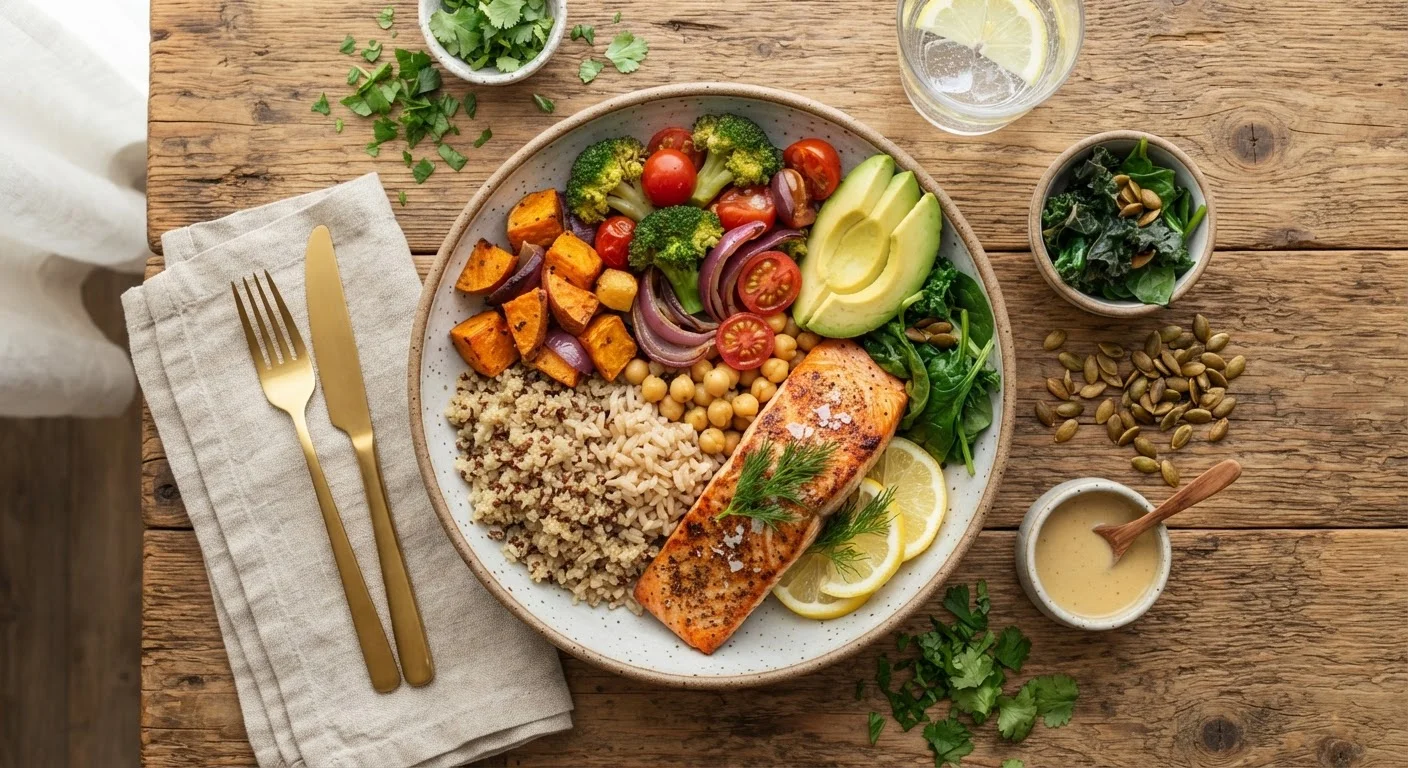
In practice, most flexitarians build their meals around vegetables, legumes, whole grains, nuts, seeds, and fruit, while treating animal products as occasional additions rather than dietary staples. The degree of reduction varies widely from person to person, ranging from a few meatless days per week to consuming animal foods only in social settings.
For a deeper look at how this compares to more structured approaches, see our overview of whole-food plant-based eating.
The Case For Flexitarian Eating
The most compelling argument for flexitarian eating is rooted in well-established nutritional science: diets higher in plant foods are consistently associated with better long-term health outcomes.
Strongly associated with reduced chronic disease risk
Large-scale epidemiological studies, including data from the EPIC cohort and Adventist Health Studies, consistently link higher plant-food intake with lower rates of cardiovascular disease, type 2 diabetes, and colorectal cancer. Even partial shifts toward plant-based eating appear to confer measurable benefit.
Highly adaptable to real-world social contexts
Because no food group is entirely off-limits, flexitarian eating is far easier to maintain at restaurants, family gatherings, and while traveling — settings where strict plant-based diets often create friction or require significant advance planning.
Naturally increases dietary fiber intake
Shifting meal composition toward legumes, vegetables, and whole grains dramatically raises fiber consumption, supporting gut microbiome diversity, satiety, blood glucose regulation, and cardiovascular health — areas where most American adults fall well below recommended intake levels.
Lower environmental footprint than omnivorous diets
Reducing — especially replacing — ruminant meat with plant proteins meaningfully lowers dietary greenhouse gas emissions and water use, even without complete elimination of animal products.
Accessible entry point for dietary change
For people accustomed to conventional omnivorous diets, flexitarian eating provides an achievable and non-punishing starting framework that can evolve over time rather than demanding an immediate, wholesale overhaul.
~17g/day
Average US adult daily fiber intake
The Dietary Guidelines for Americans recommend 25–38g of fiber daily; most US adults consume roughly half that amount, a gap flexitarian eating can meaningfully help close.
~32%
Lower type 2 diabetes risk in semi-vegetarians
A large analysis published in JAMA Internal Medicine found semi-vegetarian dietary patterns associated with meaningfully lower risk of type 2 diabetes compared to omnivorous diets, though effect sizes varied by study design.
Flexibility is a practical advantage that shouldn't be understated. Strict dietary frameworks — even nutritionally sound ones — are abandoned at high rates when they conflict with social contexts, travel, family meals, or cultural traditions. Flexitarian eating reduces those friction points. Research into why people abandon plant-based diets consistently identifies rigidity and social isolation as top barriers to long-term adherence.
From an environmental perspective, reducing — rather than eliminating — meat consumption still produces meaningful reductions in dietary greenhouse gas emissions and land use, particularly when red meat is targeted.
The Case Against Flexitarian Eating
The lack of a formal definition is more than a semantic problem. Without clear parameters, "flexitarian" can justify dietary patterns that are only marginally better than a conventional Western diet — particularly when processed foods, refined carbohydrates, or excessive dairy remain common. The label risks offering a sense of nutritional virtue without the substance to match.
No standardized definition creates accountability gaps
Without agreed-upon parameters, the label is self-applied and self-defined. A person eating processed plant-based alternatives alongside daily red meat might reasonably call themselves flexitarian — which makes the term difficult to study consistently and easy to misapply.
Benefits are highly dependent on food quality
Replacing meat with refined grains, sugary foods, or ultra-processed plant products does not replicate the benefits seen in research on whole-food plant-heavy diets. The health advantages of flexitarian eating are not automatic — they depend on what actually fills the plate.
Risk of underestimating key nutrient gaps
Nutrients including vitamin B12, iron, zinc, long-chain omega-3s, and calcium require deliberate dietary attention as animal food intake decreases. Without active planning, flexitarians may develop subtle deficiencies that go undetected for extended periods.
Less evidence than more defined dietary patterns
Most robust long-term dietary research focuses on clearly defined eating patterns such as Mediterranean, vegetarian, or whole-food plant-based diets. The evidence base specific to flexitarian eating is comparatively limited, making strong outcome claims difficult to substantiate.
May produce slower or smaller health gains than stricter patterns
Studies comparing semi-vegetarian to fully vegetarian or vegan diets generally show a dose-response relationship: the greater the shift away from animal foods toward whole plant foods, the more pronounced the associated health benefits tend to be.
Special Populations Should Seek Guidance
Pregnant individuals, children, older adults, and people managing chronic health conditions have specific nutrient requirements that make self-directed dietary shifts more complex. If you belong to one of these groups and are considering a significant dietary change, consulting a registered dietitian is strongly recommended before adjusting your eating pattern.
There's also a risk of nutritional complacency. People who identify as flexitarian may assume their diet is adequate without actively monitoring key nutrients — iron, zinc, vitamin B12, calcium, and omega-3 fatty acids — that are less bioavailable or abundant in plant sources. For guidance on structuring meals to close these gaps, evidence-based meal planning principles provide a useful starting point.
How It Compares to Other Plant-Forward Approaches
Compared to fully plant-based or vegan diets, flexitarian eating requires less nutritional planning but also delivers less consistent benefits, since outcomes depend heavily on individual choices rather than a defined structure. Compared to an omnivorous Western diet, even a loosely flexitarian approach tends to improve fiber intake, reduce saturated fat, and shift calorie sources toward more nutrient-dense foods.
Plant-based eating involves genuine trade-offs — and flexitarian eating doesn't fully resolve them. It softens some of the practical challenges while preserving some of the risks: namely, that a diet built on plant foods still needs careful construction to be nutritionally complete.
If flexitarian eating resonates as a starting point, the practical next step is often a gradual transition. Our guide on transitioning to whole-food eating incrementally outlines realistic, low-disruption approaches.
This article is for general informational and educational purposes only and does not constitute medical or dietary advice. Consult a qualified healthcare provider or registered dietitian before making significant changes to your diet, especially if you have an existing health condition.
The content on this site is for informational purposes only and is not a substitute for professional advice. Always consult a qualified professional for guidance specific to your situation.