

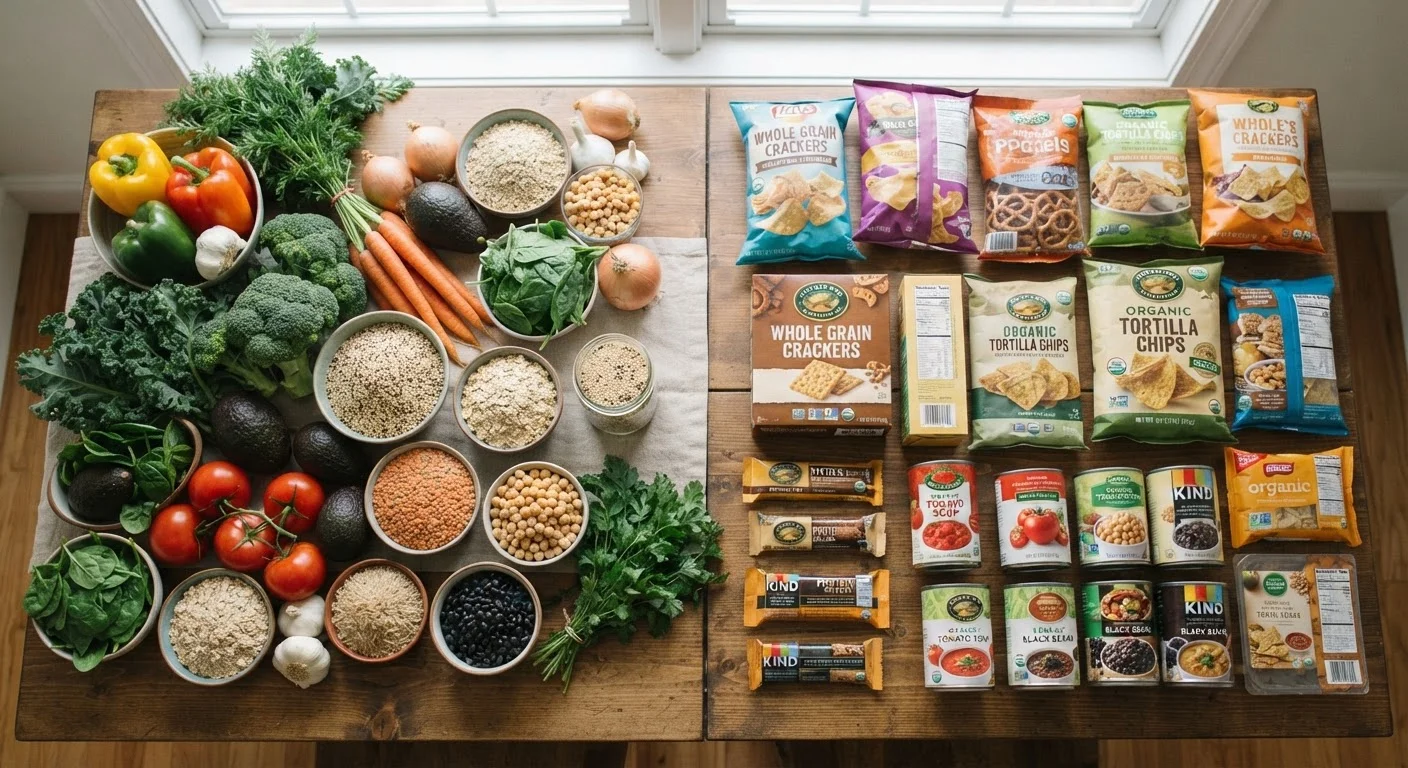
Option A
Whole Foods
Foods in their natural, minimally altered state.
Best for: Maximizing nutrient density, fiber intake, and long-term dietary quality through unrefined, naturally occurring food sources.
Option B
Processed Foods
Foods altered from their original form through industrial or culinary methods.
Best for: Convenience, shelf stability, and accessibility — with nutritional quality varying widely depending on the degree and method of processing.
What Food Processing Actually Means
The term "processed food" is routinely used as a catch-all negative, but it lacks precision. Almost every food we eat has been processed in some way — washing, cooking, fermenting, freezing, or milling all qualify as processing. What matters nutritionally is the degree and nature of that processing.
Researchers and nutrition scientists commonly use the NOVA classification system, developed by epidemiologists at the University of São Paulo, to categorize foods by their level of processing rather than nutrient composition alone. NOVA identifies four groups: unprocessed or minimally processed foods, processed culinary ingredients (like oils and flours), processed foods (such as canned vegetables or cheese), and ultra-processed foods (UPFs) — industrially formulated products made predominantly from extracted or synthesized ingredients, flavors, and additives.
This framework helps clarify why frozen spinach and a cheese puff are not equivalent just because both are "processed." Understanding where foods fall on this spectrum is more actionable than a binary whole-vs-processed framing. For a closer look at how this relates to specific nutrients, see how fortification compares to whole-food nutrition.
| Criterion | Whole Foods | Processed Foods |
|---|---|---|
| Fiber content | Naturally high; intact structure | Often reduced or absent in UPFs |
| Added sugars | None by definition | Common in ultra-processed products |
| Sodium levels | Naturally low | Frequently elevated; varies by type |
| Phytonutrients | Present in full food matrix | Partially or significantly degraded |
| Shelf life | Shorter; requires fresh sourcing | Extended; convenient for storage |
| Preparation time | Variable; some require cooking | Often quick or ready-to-eat |
| Cost per serving | Can vary; staples are affordable | Often low cost; varies widely |
| Ingredient transparency | Single-ingredient; no label needed | Requires label reading to evaluate |
The Nutritional Case for Whole Foods
Whole foods — fruits, vegetables, legumes, whole grains, nuts, seeds, and minimally processed animal products — deliver nutrients in their naturally occurring matrix. This food matrix matters. Fiber, phytonutrients, antioxidants, and micronutrients interact in ways that isolated supplements or fortified products often cannot fully replicate.
Take fiber as a key example. Whole grains retain their bran and germ, providing soluble and insoluble fiber that supports gut microbiome diversity, slows glucose absorption, and contributes to satiety. Refined grain products strip much of this structure away. Similarly, whole fruits contain pectin and polyphenols alongside natural sugars, which modulates glycemic response differently than fruit juice. If you want to understand how carbohydrate structure shapes blood sugar response, our guide to simple vs. complex carbohydrates covers this in depth.
57%
Share of US calories from ultra-processed foods
Research published in BMJ Open estimated that ultra-processed foods account for more than half of daily energy intake among US adults.
28%
Higher all-cause mortality risk with high UPF intake
A large prospective cohort study in JAMA Internal Medicine found elevated mortality risk associated with the highest quartile of ultra-processed food consumption.
Whole foods are also consistent: an apple today has roughly the same nutritional profile as it did a decade ago. UPFs, by contrast, may shift formulations without meaningful label changes — making them harder to assess consistently.
Where Processed Foods Fit in a Realistic Diet
Eliminating all processed foods is neither practical nor necessary for most people. Canned tomatoes, frozen edamame, plain Greek yogurt, and rolled oats are technically processed — yet they consistently appear in the dietary patterns associated with better health outcomes, including Mediterranean and whole-food plant-based diets. The key variable is what processing does to the food, not the fact of processing itself.
The category to genuinely watch is ultra-processed foods. Research, including large cohort studies in Europe and North America, has associated high UPF consumption with increased risk of cardiovascular disease, type 2 diabetes, and all-cause mortality — though establishing causation in dietary research remains methodologically complex. What is clear is that UPFs tend to be calorie-dense, low in fiber, and high in added sugars, sodium, and refined fats.
A more useful approach than avoidance is ingredient literacy. Learning to read a nutrition label effectively gives you a practical tool to evaluate any packaged product — regardless of marketing claims on the front.
Not All Packaged Food Is Ultra-Processed
Many packaged foods — plain canned legumes, frozen vegetables without sauce, natural nut butters, or minimally processed whole-grain products — retain strong nutritional profiles. The NOVA framework and ingredient list are better guides than packaging format alone. A short, recognizable ingredient list is generally a useful signal of lower processing. For those interested in a structured whole-food approach, understanding what a whole-food plant-based diet actually involves offers helpful context.
For those ready to shift their overall eating pattern, incremental strategies for moving toward whole-food eating offer a starting point that doesn't require perfection. And if cost is a concern, whole-food eating on a budget is more achievable than most assume.
This article is for general informational and educational purposes only and does not constitute medical or dietary advice. Consult a qualified healthcare professional or registered dietitian for guidance tailored to your individual health needs.
The content on this site is for informational purposes only and is not a substitute for professional advice. Always consult a qualified professional for guidance specific to your situation.