

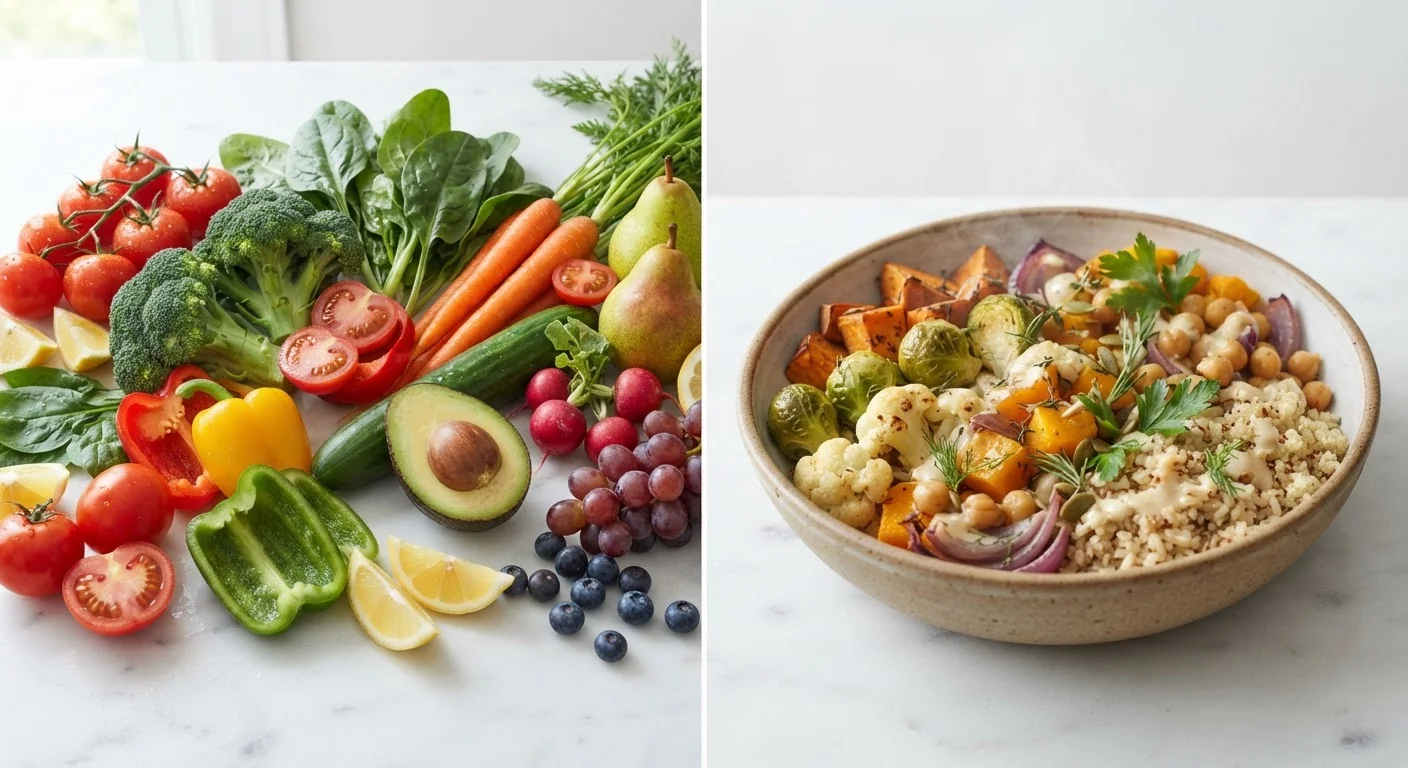
Option A
Raw Food Diet
The unprocessed, enzyme-forward approach to eating.
Best for: Individuals who thrive on high fruit and vegetable intake and want to minimize cooking entirely.
Option B
Cooked Whole-Food Diet
The flexible, evidence-backed foundation for long-term health.
Best for: People seeking a sustainable, nutritionally complete whole-food eating pattern with room for variety.
What Each Approach Actually Means
A raw food diet restricts all foods to those consumed uncooked and unprocessed — typically below 104–118°F (40–48°C) to preserve naturally occurring enzymes. Staples include raw fruits, vegetables, nuts, seeds, sprouted grains, and fermented foods. Animal products are sometimes included (raw dairy, cured fish) but the diet is often plant-exclusive.
A cooked whole-food diet centers on minimally processed, nutrient-dense ingredients — vegetables, legumes, whole grains, fruit, nuts, seeds, and lean proteins — prepared through everyday cooking methods: steaming, roasting, sautéing, or simmering. This framework aligns closely with guidance from major nutrition and public health bodies. For a broader overview of whole-food eating patterns, see the complete guide to evidence-informed whole-food eating.
Both approaches reject ultra-processed foods and prioritize plant diversity. Their key differences lie in how preparation affects nutrient chemistry, digestibility, and real-world practicality.
How Cooking Changes Nutritional Value
The relationship between heat and nutrition is nuanced — cooking simultaneously creates and destroys nutritional value depending on the nutrient and the method used.
| Criterion | Raw Food Diet | Cooked Whole-Food Diet |
|---|---|---|
| Vitamin C retention | Higher (heat-sensitive vitamins preserved) | Moderate loss with high-heat methods |
| Carotenoid bioavailability | Lower (cell walls intact) | Higher (heat releases bound carotenoids) |
| Antinutrient reduction | Minimal — phytates and oxalates intact | Significant reduction through cooking |
| Mineral absorption | Potentially lower due to antinutrients | Generally higher after cooking |
| Digestive tolerance | Variable; can cause bloating in some | Generally easier for most people |
| B12 risk | High (if plant-exclusive) | Moderate (if plant-exclusive) |
| Practical sustainability | Challenging; socially restrictive | High; flexible across most contexts |
| Long-term evidence base | Limited population studies | Extensive epidemiological support |
What cooking enhances: Heat breaks down plant cell walls, releasing bound carotenoids. Lycopene in tomatoes, for example, becomes substantially more bioavailable after cooking with a small amount of fat. Beta-carotene in carrots and sweet potatoes follows a similar pattern. Cooking also deactivates antinutrients — compounds like oxalates, phytates, and lectins — that can bind to minerals and reduce their absorption in the raw state.
What raw preserves: Vitamin C is heat-sensitive and degrades significantly with prolonged cooking. Folate, certain B vitamins, and glucosinolates (sulfur compounds in cruciferous vegetables) are also reduced by high heat. Raw food proponents argue that naturally occurring food enzymes, destroyed above roughly 118°F, support digestion — though current evidence suggests stomach acid inactivates most food enzymes before they reach the small intestine regardless of food preparation.
For context on how food processing more broadly affects nutrient quality, see how to think clearly about food processing.
Nutritional Gaps and Long-Term Sustainability
Long-term adherence to a strict raw food diet introduces meaningful nutritional risk. Research has consistently found lower bone density and reduced serum vitamin B12 and vitamin D in long-term raw food dieters. B12 is virtually absent from plant foods in bioavailable forms — raw or cooked — making supplementation essential for anyone avoiding animal products on either pattern, but the risk is compounded in restrictive raw diets that also exclude fortified foods.
~38%
Lower bone density risk in long-term raw food dieters
Studies including research published in the journal Calcified Tissue International have found lower bone mineral density among long-term raw food diet adherents compared to omnivores.
2–3x
Increase in lycopene bioavailability after cooking tomatoes
Research has shown that cooking tomatoes with a small amount of fat can increase lycopene bioavailability two to threefold compared to raw consumption.
~30%
Vitamin C reduction from prolonged boiling
Boiling vegetables for extended periods can reduce vitamin C content by approximately 30–50%, according to established food science literature; steaming causes less loss.
Iron and calcium adequacy can also be challenging on a raw vegan diet, since cooking improves the bioavailability of both from plant sources by reducing phytate and oxalate content. Protein sufficiency is achievable but requires careful planning around raw nuts, seeds, and sprouted legumes.
A cooked whole-food diet sidesteps many of these gaps by accommodating a broader range of foods — including legumes, whole grains, and diverse proteins — that require cooking to be both palatable and nutritionally accessible. When combined with mindful variety, it aligns well with what long-term dietary pattern research supports for chronic disease prevention. Those interested in supplementing whole foods with fortified options may find value in understanding fortified foods and the trade-offs involved.
Individuals following plant-forward versions of either diet should review considerations covered in plant-based eating trade-offs.
Making a Practical, Informed Choice
Neither approach is inherently superior — the right eating pattern is the one that meets your nutritional needs, fits your lifestyle, and is sustainable over time. For most people, a well-planned cooked whole-food diet offers the broadest nutritional coverage with the least risk of gaps. Raw food principles, however, can be meaningfully integrated into any diet — particularly through large salads, raw snacks, smoothies, and minimal-heat preparations that preserve heat-sensitive vitamins.
If you're considering a significant dietary shift, the practical guide to transitioning toward whole-food eating offers incremental steps that don't require an all-or-nothing approach. For additional guidance on key nutrients and nutrient-dense food choices, explore the Nutrients & Superfoods resource hub.
Before making major changes to your dietary pattern — especially if you have an existing health condition, are pregnant, or are managing a chronic illness — consult a registered dietitian or qualified healthcare provider for personalized guidance.
This article is for general informational and educational purposes only and does not constitute medical or dietary advice. Always consult a qualified healthcare professional before making significant changes to your diet.
The content on this site is for informational purposes only and is not a substitute for professional advice. Always consult a qualified professional for guidance specific to your situation.