

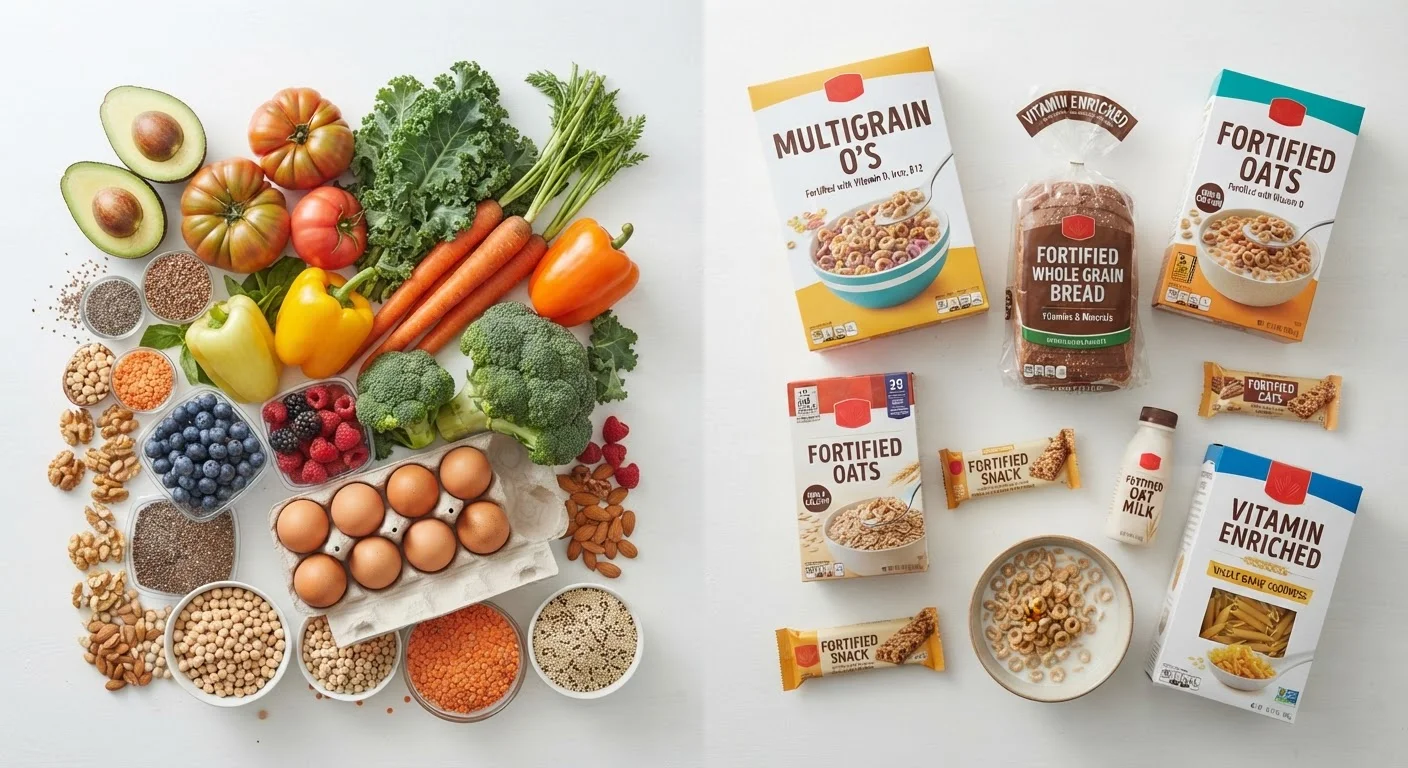
Our Verdict
Whole foods consistently offer a nutritional depth that fortification cannot fully replicate, particularly due to the synergistic relationship between naturally occurring nutrients, fiber, and phytochemicals. However, fortified foods serve a legitimate and evidence-supported role in closing nutrient gaps — especially for populations with restricted dietary variety or elevated needs. A practical, sustainable diet for most adults will draw on both, prioritizing whole foods as the foundation while recognizing that fortification can meaningfully contribute where access or intake falls short.
| Best for | Recommended |
|---|---|
| Those seeking optimal nutrient density and long-term wellness | Whole Foods |
| Individuals with specific deficiencies or limited dietary variety | Fortified Foods |
| Plant-based eaters at risk of B12, iron, or calcium shortfalls | Fortified Foods |
| Budget-conscious households building a nutritious everyday diet | Whole Foods (with selective fortified additions) |
What Fortification Actually Does — and Doesn't Do
Food fortification is the deliberate addition of vitamins or minerals to a food product, typically one that has been refined or processed in ways that strip out naturally occurring nutrients. Classic examples include iodized salt, folic acid in white flour, and vitamin D added to milk. These public health interventions have meaningfully reduced deficiency diseases — folic acid fortification, for instance, is associated with significant declines in neural tube defects in the US since its mandatory introduction in 1998.
However, fortification is a targeted correction, not a nutritional reconstruction. When whole grains are refined into white flour, the process removes not only vitamins and minerals but also fiber, phytochemicals, and the structural food matrix that influences how nutrients behave in the body. Adding back a selection of isolated nutrients restores a fraction of what was removed — and not always in the same form or ratio.
It's also worth noting that fortification levels are set to meet minimum public health thresholds, not to optimize individual nutrition. The nutrient forms used (such as synthetic folic acid versus naturally occurring folate) may behave differently in the body depending on genetic variation and metabolic factors.
Bioavailability: Why the Source of a Nutrient Matters
Bioavailability refers to the proportion of a nutrient that the body can actually absorb and utilize. This is where whole foods often have a measurable advantage. In whole food sources, nutrients exist alongside cofactors — companion compounds that enhance absorption. The vitamin C in bell peppers, for example, occurs alongside bioflavonoids that appear to support its antioxidant activity. Iron in lentils is accompanied by compounds that influence its uptake, and fat-soluble vitamins in whole foods are naturally paired with the dietary fats needed for absorption.
Fortified foods, by contrast, add nutrients into a separate food matrix that may or may not support optimal uptake. Calcium-fortified orange juice provides calcium, but without the cofactors found in dairy or leafy greens that support its use. Synthetic vitamin E (dl-alpha-tocopherol) added to fortified products differs structurally from the natural form (d-alpha-tocopherol) and may be retained differently in tissue.
| Whole Foods | Fortified Foods | |
|---|---|---|
| Nutrient complexity | High — naturally occurring cofactors and phytochemicals | Low — isolated nutrients added to a processed matrix |
| Bioavailability | Generally high due to synergistic food matrix | Variable; depends on nutrient form and food vehicle |
| Fiber content | Naturally present, often substantial | Minimal unless specifically added |
| Consistency of nutrient levels | Varies by growing conditions and season | Standardized and predictable by regulation |
| Suitability for specific deficiencies | Depends on individual food variety and intake | Targeted — useful for closing defined gaps |
| Role in dietary planning | Foundation of a nutrient-dense diet | Supplementary — fills gaps where whole foods fall short |
None of this means fortified nutrients are without value — many are well-absorbed and clinically effective. But bioavailability is a real variable, and it favors whole-food sources more often than food labels suggest. For a deeper look at how to think about food processing on a spectrum, see the spectrum of food processing.
Where Fortified Foods Fill Genuine Gaps
It would be inaccurate to dismiss fortification as nutritionally irrelevant. Several populations have nutrient needs that are genuinely difficult to meet through whole foods alone, and fortified products can play a meaningful role.
- Vitamin B12: Found almost exclusively in animal products, B12 is a critical gap for those following plant-based diets. Fortified plant milks and nutritional yeast are among the most practical dietary sources. Plant-based eaters benefit significantly from reliable B12-fortified options.
- Vitamin D: Synthesized primarily through sun exposure, dietary D is limited even in whole-food diets. Fortified dairy and non-dairy milks provide a consistent, measurable intake.
- Folate: While dark leafy greens are excellent natural sources, mandatory fortification of grain products provides a population-wide safety net, particularly important during reproductive years.
- Iodine: Outside of seafood and dairy, iodine is scarce in the food supply. Iodized salt remains one of the most effective public health nutrition interventions in history.
Reading Labels on Fortified Foods
When evaluating a fortified product, look beyond the nutrient list to the ingredient quality overall. A fortified product high in added sugars or refined starches may deliver certain vitamins but undermine dietary goals in other ways. The goal is for fortification to enhance an otherwise reasonable food, not to redeem a nutritionally poor one.
For practical strategies on building a nutrient-dense diet from whole foods on a realistic budget, see whole-food eating on a budget.
Building a Balanced Nutritional Strategy
The most defensible position in nutrition science is also the most practical: use whole foods as the foundation of daily eating, and treat fortified foods as a complementary tool rather than an equivalent substitute. Whole foods provide nutrient density, fiber, and phytochemicals in combinations that decades of research have not been able to fully replicate through supplementation or fortification alone.
At the same time, rigid exclusion of fortified options ignores real-world constraints — food access, cost, time, and individual health needs all shape what people can reasonably eat. A fortified breakfast cereal consumed daily by someone with limited produce access is not nutritionally equivalent to a bowl of oatmeal with berries, but it is far preferable to an unfortified ultra-processed alternative.
When building a grocery list, prioritizing nutrient density from whole sources — vegetables, legumes, whole grains, eggs, dairy, nuts, and seeds — gives the body the broadest possible nutritional input. A structured approach to nutrient-rich grocery shopping can help translate these principles into consistent weekly habits.
This article is for general informational purposes only and does not constitute medical or dietary advice. Consult a registered dietitian or qualified healthcare professional before making significant changes to your diet, particularly if you have a health condition, nutrient deficiency, or special dietary need.
The content on this site is for informational purposes only and is not a substitute for professional advice. Always consult a qualified professional for guidance specific to your situation.