

What Tadasana Is Actually Asking You to Do
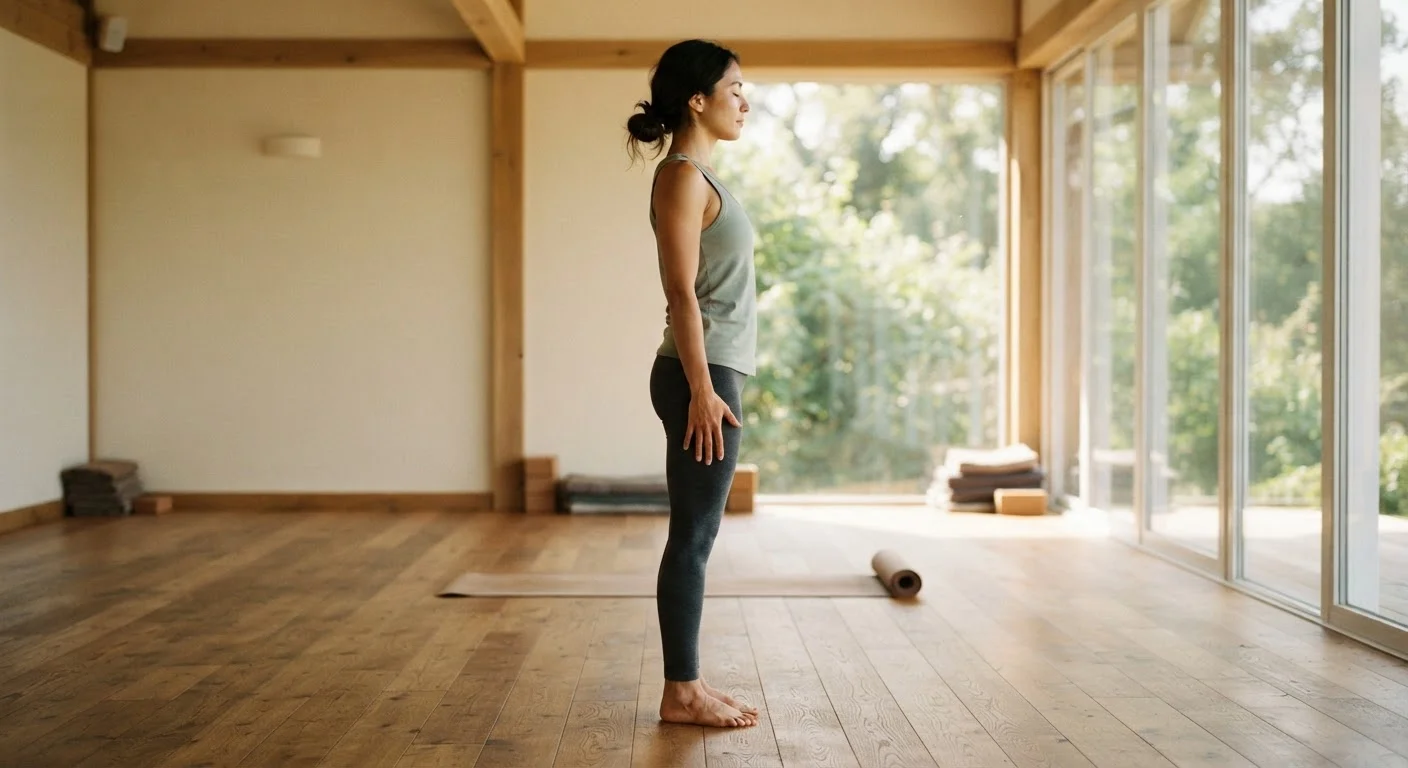
Watch a newcomer step into Mountain Pose and you'll often see one of two things: a slumped, inattentive stance, or an over-corrected rigidity that resembles a soldier at attention. Neither is Tadasana. The pose asks for something subtler — a dynamic, whole-body organization that is as much about awareness as it is about anatomy.
The foundation begins at the feet. Press evenly through four points: the base of the big toe, the base of the little toe, and both sides of the heel. This distributes weight equally and prevents habitual rolling inward or outward at the ankle — a small adjustment with meaningful consequences for the entire kinetic chain above.
From there, the legs engage without locking. A slight activation of the quadriceps lifts the kneecaps and stabilizes the joint, but the knees should never be hyperextended or forced into rigidity. Think of the legs as columns of support, not braces.
Try a Wall Check for Alignment
Stand with your heels, sacrum, mid-upper back, and the back of your head lightly touching a wall. This gives immediate tactile feedback about where your spine deviates from neutral. Notice which points make contact easily and which feel forced — this reveals your habitual postural patterns without requiring a mirror.
The Pelvis, Spine, and Shoulder Story
Much of Tadasana's instructional value lies in what it teaches about spinal neutrality. The goal is neither an exaggerated lumbar arch nor a tucked, flattened pelvis — both extremes compress spinal structures and create compensatory tension elsewhere. A neutral pelvis means the hip points (anterior superior iliac spines) and the pubic bone are roughly in the same vertical plane.
From a neutral pelvis, the natural curves of the spine — lumbar lordosis, thoracic kyphosis, cervical lordosis — are preserved rather than forced away. The sternum lifts gently as the upper back broadens. Shoulders draw slightly back and down without pinching the shoulder blades together aggressively. The crown of the head floats upward, elongating the back of the neck.
This alignment pattern is precisely what makes Tadasana transferable. The most common forward fold errors — rounding the lumbar spine, collapsing through the hips — trace directly back to not having established this spinal blueprint first.
80%
Adults who experience low back pain at some point
According to the National Institute of Neurological Disorders and Stroke, low back pain is one of the most common reasons adults seek medical care, making foundational postural awareness highly relevant.
~30 muscles
Muscle groups active in upright standing posture
Research in posture biomechanics estimates that balanced upright stance engages roughly 30 distinct muscle groups to maintain alignment against gravity.
Breath and Awareness: The Invisible Dimension
What distinguishes Tadasana from ordinary standing is the quality of internal attention it cultivates. In the pose, practitioners are asked to feel the weight of the body, notice asymmetries, observe the breath, and soften unnecessary muscular holding — all simultaneously. This is a skill, not a given.
Breath is particularly important here. Understanding why breath leads movement in yoga begins in poses like Tadasana, where there is no movement to distract from the respiratory cycle. Slow, diaphragmatic breathing in this pose downregulates the nervous system and prepares the body to move mindfully rather than reactively.
This is also where mindful movement principles take root. Interoception — the body's ability to sense its own internal state — is actively practiced when you stand still and genuinely notice what is happening rather than simply waiting for the next instruction.
This article is for general informational and educational purposes only and does not constitute medical advice. Consult a qualified healthcare professional before beginning any new exercise practice, especially if you have an existing health condition or injury.
Frequently Asked Questions
Yes — Tadasana is one of the first poses taught in yoga precisely because it establishes foundational principles. Beginners benefit most from slowing down in this pose and exploring each alignment cue individually rather than trying to apply everything at once.
Both variations are valid. Feet together is the classical version and emphasizes balance challenges. Hip-width apart provides more stability, which is often recommended for beginners or anyone with balance concerns. Choose based on your experience and how your body feels that day.
Even 5–10 breaths in Tadasana with full attention is valuable. Many teachers return to it briefly between standing poses as a reset point. Quality of attention matters far more than duration.
The alignment principles practiced in Tadasana — neutral pelvis, lifted sternum, relaxed shoulders — do reflect healthy postural habits that can carry into daily life. That said, lasting postural change involves multiple factors, and a healthcare professional or physical therapist is the right resource for addressing persistent posture-related pain.
Mild muscular trembling is common when you engage muscles that are underused in everyday standing. It typically decreases as the neuromuscular system adapts over time. If shaking is accompanied by pain, ease out of the pose and consult a yoga teacher or healthcare provider.
The content on this site is for informational purposes only and is not a substitute for professional advice. Always consult a qualified professional for guidance specific to your situation.