

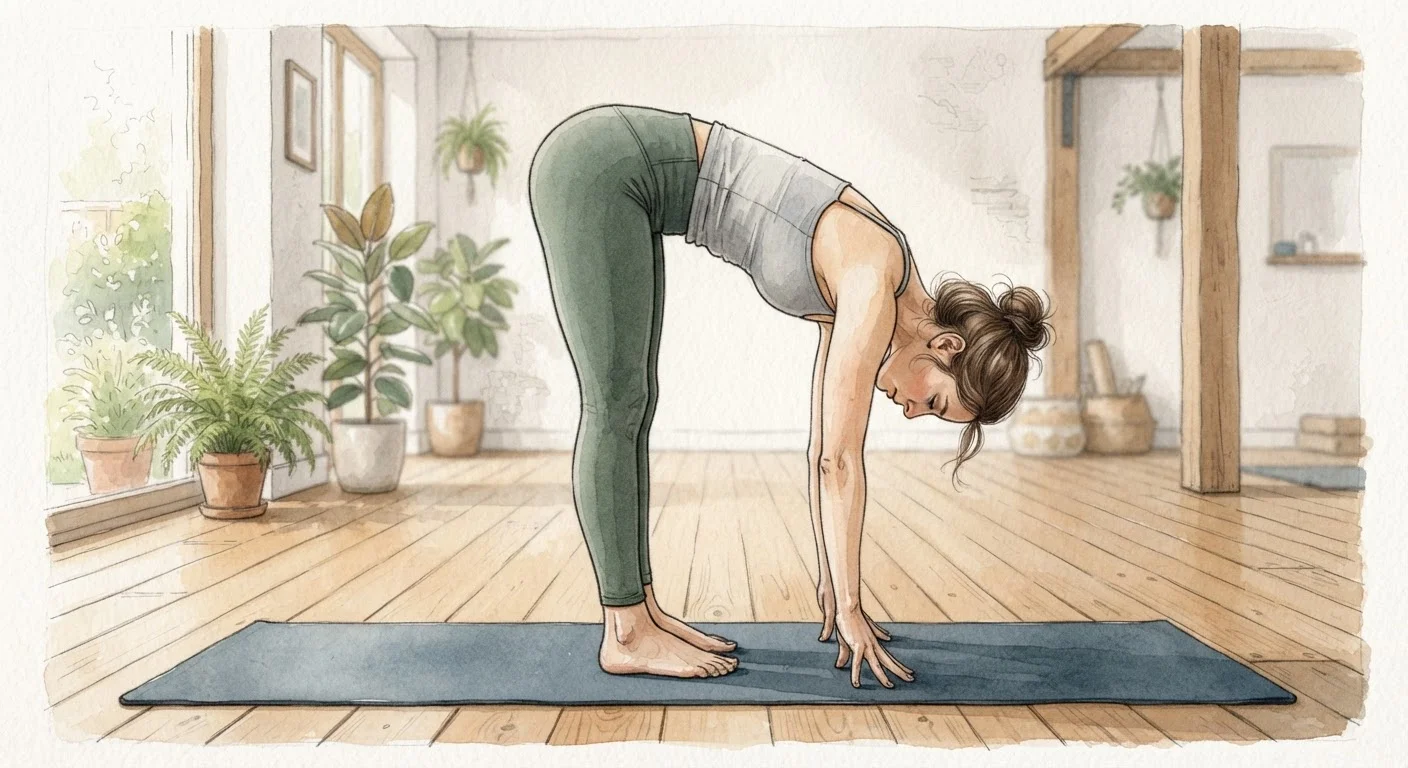
Why Forward Folds Are Deceptively Demanding
Forward folds appear in nearly every yoga style — from Sun Salutations to cool-down sequences. Because they look simple, beginners often push deeper than their bodies are ready for, and experienced practitioners sometimes rely on ingrained habits that quietly accumulate strain. The lower back is particularly vulnerable because the lumbar spine sits at the intersection of hamstring tension, pelvic mobility, and spinal flexion. When any one of these variables is off, the back compensates. Understanding why these errors happen is the first step toward practicing more safely.
Rounding the entire spine from the lumbar region upward instead of hinging at the hips.
Why it happens: Many people equate 'folding forward' with curling the back, especially when hamstrings are tight and limit how far the pelvis can tip. The body compensates by collapsing the lumbar spine into flexion.
Locking or hyperextending the knees in an attempt to achieve straighter legs.
Why it happens: Practitioners often believe fully straight legs equal better form or deeper flexibility, and they snap the knees back to reach that aesthetic without recognizing the joint stress involved.
Pulling forcefully on the feet or ankles to drag the torso closer to the legs.
Why it happens: There is an understandable urge to use arm strength to deepen a pose quickly, particularly in seated folds where leverage is easy to apply.
Tucking the chin aggressively to the chest, which collapses the cervical spine and disrupts the spinal line.
Why it happens: Practitioners sometimes tuck the chin to look inward or because they've been cued to 'relax the neck,' which they interpret as dropping the head as far as possible.
Holding the breath or breathing shallowly during the fold, which increases muscular tension and reduces proprioceptive feedback.
Why it happens: Effort and mild discomfort naturally trigger breath holding. When focused on achieving a shape, practitioners often forget that breath mechanics directly influence how tissue responds to stretch.
Key Adjustments That Make Forward Folds Safer
Correcting forward fold alignment rarely means going deeper — it usually means going smarter. Two foundational adjustments apply across almost every variation, whether you're practicing Uttanasana (Standing Forward Bend) or Paschimottanasana (Seated Forward Bend).
Initiate From the Hips, Not the Waist
Before folding, practice a hip hinge: send the sit bones back and upward as you tip the torso forward. This anterior pelvic tilt keeps the lower back's natural curve intact during the early range of motion. Think of the pelvis as a bowl you're tilting forward rather than a spine you're collapsing downward.
Let the Knees Bend Generously
A soft, generous bend in the knees is not a compromise — it is a technique. When the knees bend, the hamstrings release their pull on the sit bones, allowing the pelvis to rotate forward freely. Over time, as hamstring flexibility increases, practitioners can gradually work toward straighter legs without sacrificing spinal integrity.
Sharp or Radiating Pain Is a Stop Signal
A gentle pulling sensation in the hamstrings or mild muscular effort is normal in forward folds. However, sharp pain in the lower back, or any sensation that radiates down the leg, is a signal to come out of the pose immediately. These symptoms may indicate nerve involvement or disc irritation. Consult a qualified healthcare provider before returning to practice.
Use Props Without Hesitation
Blocks under the hands in a standing fold, or a strap around the feet in a seated fold, reduce the distance between you and the floor so the spine doesn't have to round to bridge the gap. Props are not training wheels — they are precision tools that allow the body to work in its optimal range.
This article is for informational purposes only and is not a substitute for personalized guidance from a qualified yoga teacher or healthcare professional. If you experience lower back pain during yoga, please consult a healthcare provider before continuing practice.
The content on this site is for informational purposes only and is not a substitute for professional advice. Always consult a qualified professional for guidance specific to your situation.