

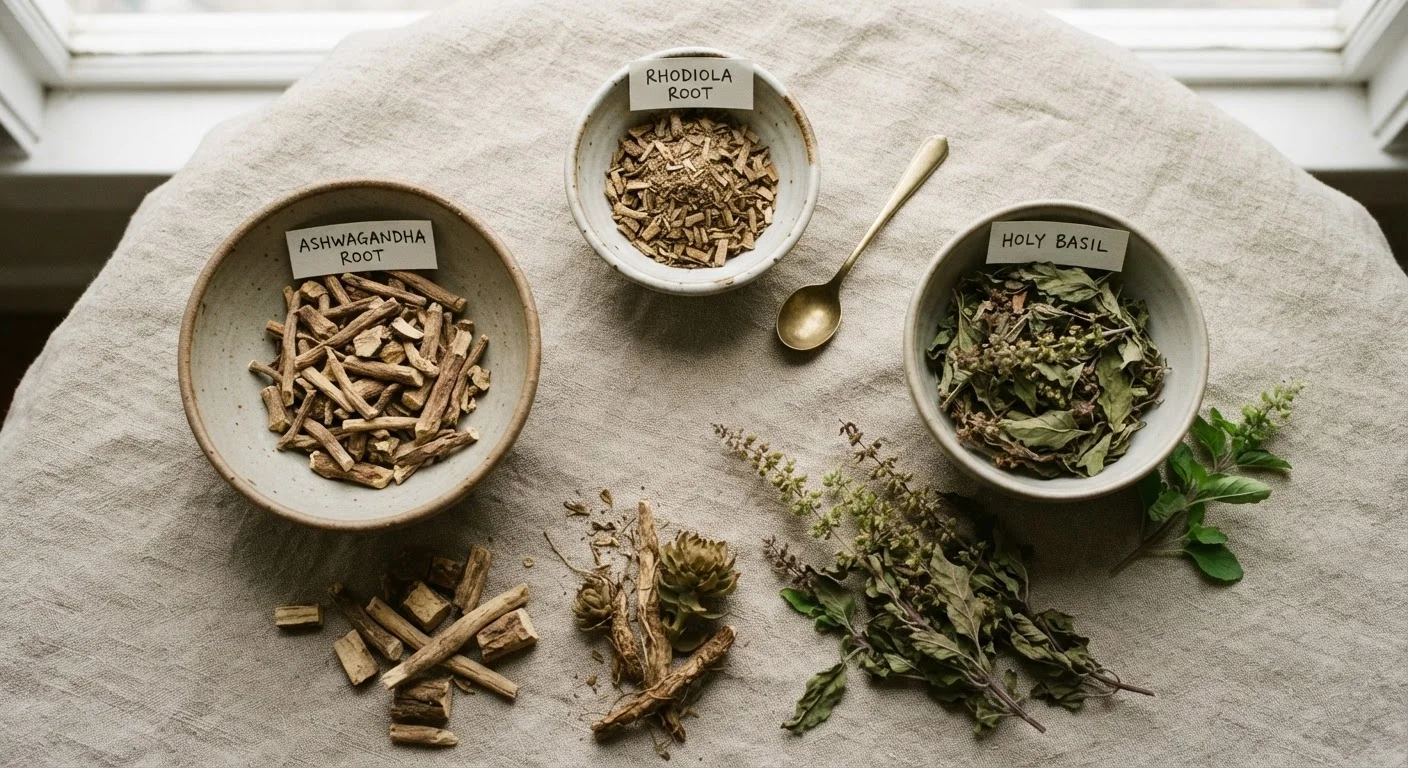
What Are Adaptogens?
The word adaptogen refers to a specific class of botanical (and occasionally fungal) substances proposed to help the body maintain stability — often called homeostasis — in response to physical, chemical, or biological stressors. Unlike stimulants, which push the body toward a heightened state, adaptogens are theorized to modulate the stress response in both directions: dampening an overactive system or supporting an underactive one.
To formally qualify as an adaptogen under the criteria first articulated by Soviet pharmacologist Nikolai Lazarev and later refined by Israel Brekhman, a substance must: (1) be non-toxic at normal doses, (2) produce a nonspecific increase in resistance to stress, and (3) have a normalizing effect on body physiology regardless of the direction of the pathological shift. These criteria remain widely referenced, though researchers continue to debate and refine them.
It is worth noting that adaptogen is not a regulatory classification recognized by the U.S. Food and Drug Administration (FDA). Most adaptogens are sold as dietary supplements — a category with far less pre-market oversight than pharmaceuticals.
Adaptogens Are Not Regulated as Medicines
In the United States, adaptogenic herbs are sold as dietary supplements, not drugs. This means they are not evaluated by the FDA for safety or effectiveness before reaching store shelves. No adaptogen is approved to treat, cure, or prevent any disease. Consumers bear significant responsibility for verifying product quality and appropriateness for their own health context — ideally in consultation with a knowledgeable healthcare provider.
A Brief History: From Folk Medicine to Sports Science
Long before the word adaptogen existed, many of the plants now labeled as such had centuries of documented use in traditional systems. Ashwagandha (Withania somnifera) appears in Ayurvedic texts dating back more than 3,000 years. Rhodiola rosea was described in ancient Greek medical writings. Eleuthero (Eleutherococcus senticosus), sometimes called Siberian ginseng, was documented in Chinese medicine for similar purposes.
The modern scientific chapter began in the 1940s–1960s when Soviet researchers, motivated partly by Cold War competitive pressures in athletics and space exploration, began systematically testing plant extracts for performance-enhancing properties without the toxicity profile of stimulants. Brekhman's extensive work on eleuthero in the 1960s produced some of the earliest controlled studies and coined the pharmacological framework still used today.
Western interest surged significantly in the 1990s and again in the 2010s as functional medicine and wellness culture expanded. Today, adaptogens appear in everything from herbal capsules to beverages — a commercial proliferation that has outpaced the underlying evidence base.
$8.5B+
Global adaptogen market size (projected)
Market research firms have projected the global adaptogen market to exceed $8.5 billion by the mid-2020s, reflecting rapid commercial expansion.
3,000+ years
Ashwagandha's documented traditional use
Ashwagandha appears in Ayurvedic texts dating back more than three millennia, making it one of the most historically documented herbs in this category.
~60%
U.S. adults reporting high stress levels
The American Psychological Association's annual Stress in America surveys have consistently found a majority of U.S. adults report significant stress, driving interest in natural management strategies.
How Adaptogens Are Studied
Research into adaptogens spans multiple methodologies, each with distinct strengths and limitations. In vitro (cell culture) and animal studies have identified plausible mechanisms — including modulation of the hypothalamic-pituitary-adrenal (HPA) axis, cortisol regulation, and antioxidant activity. These findings generate hypotheses but cannot directly inform human dosing or efficacy claims.
Human clinical trials exist for several adaptogens, particularly ashwagandha and rhodiola, but many are small, short-duration, and use varying extract standardizations — making cross-study comparisons difficult. A 2012 systematic review published in Planta Medica and subsequent reviews have acknowledged both promising signals and the need for larger, longer, methodologically rigorous trials.
For readers wanting a deeper look at the specific evidence landscape, see our detailed breakdown of adaptogenic herbs and stress research.
When evaluating adaptogen research, prioritize studies that specify the extract standardization used — a 'rhodiola' study using 3% rosavins is not directly comparable to one using a whole-herb powder.
Bioactive compound content varies dramatically by preparation method, making extract standardization a critical variable that determines whether study results are meaningful for a given product.
Look for supplements that have undergone third-party testing (USP, NSF International, or Informed Sport) to improve confidence that what is on the label is actually in the bottle.
Independent analyses have repeatedly found discrepancies between labeled and actual ingredient content in the unregulated supplement market, making third-party verification a practical quality filter.
Commonly Discussed Adaptogenic Herbs
The following herbs are among the most studied and widely discussed in the adaptogen literature. Evidence strength varies considerably across them.
- Ashwagandha (Withania somnifera): Among the most clinically studied adaptogens. Multiple randomized controlled trials suggest potential benefits for perceived stress, cortisol levels, and sleep quality in healthy adults under stress. Generally considered well-tolerated at studied doses, though rare liver-related adverse events have been reported in the literature.
- Rhodiola rosea: Scandinavian and Russian research suggests possible effects on mental fatigue and cognitive performance under stress conditions. Evidence quality is moderate; most trials are small.
- Eleuthero (Eleutherococcus senticosus): The original focus of Soviet adaptogen research. Traditional use is extensive; robust modern human trials are comparatively limited.
- Holy Basil (Ocimum tenuiflorum / Tulsi): Deeply rooted in Ayurvedic tradition. Emerging research explores antioxidant and stress-modulating properties, though human evidence remains preliminary.
- Panax ginseng: Among the most researched herbal medicines globally. Evidence suggests potential cognitive and fatigue-related benefits; quality and type of ginsenoside content vary significantly by preparation.
For a broader map of herbs studied for stress and anxiety, including non-adaptogen options, explore our research-grounded herbal overview.
Practical Considerations Before You Start
Even botanicals with favorable safety profiles carry real considerations that deserve careful attention before use.
Drug interactions: Several adaptogens, including ashwagandha and Panax ginseng, may interact with thyroid medications, immunosuppressants, blood thinners, and sedatives. This is not a theoretical concern — it is a documented pharmacological reality. Always disclose supplement use to your prescribing clinician.
Supplement quality: Because dietary supplements are not evaluated for efficacy or consistency by the FDA before sale, extract potency and ingredient accuracy vary widely across products. Third-party certification programs (such as USP or NSF International) can offer some quality assurance.
Special populations: Individuals who are pregnant, breastfeeding, managing autoimmune conditions, or taking multiple medications should exercise particular caution. Consult a qualified healthcare provider before use — general wellness guidance does not apply uniformly across health contexts.
Expectations: Adaptogens are not fast-acting drugs. Most proposed effects in human trials emerged after weeks of consistent use. They are supportive tools within a broader lifestyle framework, not standalone interventions.
If you are new to managing stress holistically, this foundational guide to natural stress management provides helpful context on where adaptogens fit within the bigger picture.
Integrating Adaptogens into a Broader Wellness Plan
Adaptogens are best understood as one potential layer within a well-constructed wellness approach — not a replacement for sleep, movement, nutrition, or professional mental health support. The existing evidence base supports modest, contextual benefits for stress physiology in otherwise healthy adults, particularly when lifestyle foundations are already in place.
If you are exploring the stress management space more broadly, the evidence consistently points to multi-modal approaches: combining adequate sleep hygiene, regular physical activity, dietary patterns that support metabolic health, and stress-processing practices such as mindfulness or cognitive behavioral techniques. Adaptogens may complement these strategies for some individuals.
For a nuanced look at what the science actually supports — and where meaningful uncertainty remains — see our balanced assessment of adaptogens and stress.
This article is for general informational and educational purposes only and does not constitute medical advice. Always consult a qualified healthcare professional before starting any supplement, particularly if you have a health condition, are pregnant, or are taking medications.
The content on this site is for informational purposes only and is not a substitute for professional advice. Always consult a qualified professional for guidance specific to your situation.