

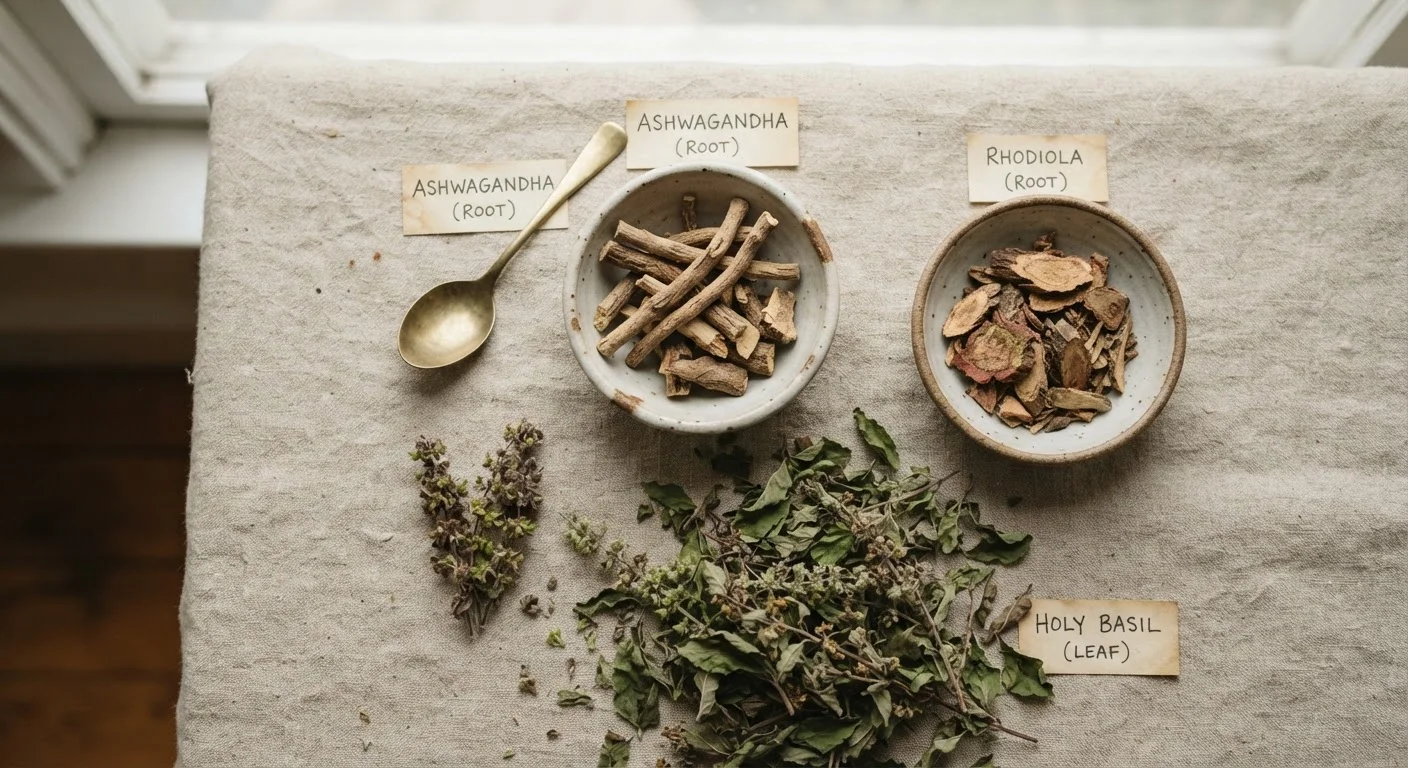
What 'Adaptogen' Actually Means — and What It Doesn't
The term adaptogen was coined in the 1940s by Soviet pharmacologist Nikolai Lazarev to describe substances that might help organisms resist various stressors without causing harm. It is a functional category, not a regulatory or clinical designation. No government health authority — including the U.S. Food and Drug Administration — officially classifies herbs as adaptogens for medical purposes.
This distinction matters. When a product is marketed as an adaptogen, that label reflects a tradition of use and a hypothesis about mechanism, not a confirmed therapeutic claim. Understanding this framing helps readers engage critically with both enthusiastic wellness content and dismissive skepticism. For a broader orientation to the field, see The Complete Guide to Adaptogens.
Myth
Adaptogens are proven stress cures backed by the same evidence as pharmaceutical drugs.
Fact
Most adaptogen research consists of small, short-term trials. Promising findings exist, but the evidence base does not yet meet the standard required for approved medical treatments.
Clinical trials for adaptogens are often limited by small participant numbers, short durations, and inconsistent outcome measures. While some studies on ashwagandha and rhodiola show statistically significant effects on stress markers, the overall body of evidence is still considered preliminary by most regulatory and medical bodies. Enthusiasm in wellness media frequently outpaces the science. Adaptogens and Stress: Weighing What They Can and Cannot Do explores these limitations in depth.
Myth
Because they are natural herbs, adaptogens have no meaningful side effects or drug interactions.
Fact
Adaptogenic herbs can cause side effects and interact with medications, including thyroid drugs, immunosuppressants, and certain antidepressants.
The 'natural equals safe' assumption is one of the most pervasive — and potentially harmful — misconceptions in wellness culture. Biologically active plant compounds exert real physiological effects, which is precisely why they may be helpful and why they can also pose risks. Ashwagandha, for instance, has been linked in case reports to liver enzyme elevation in some individuals. Rhodiola's mild stimulatory properties may amplify or interfere with certain psychiatric medications. Context, health status, and concurrent medications all affect individual risk.
Myth
All adaptogens work the same way and can be used interchangeably for stress.
Fact
Different adaptogens have distinct proposed mechanisms, differing research profiles, and are associated with contrasting effects — ashwagandha is generally calming while rhodiola tends to be activating.
Treating adaptogens as a single interchangeable category ignores meaningful pharmacological differences. Ashwagandha (Withania somnifera) is believed to modulate the HPA (hypothalamic-pituitary-adrenal) axis in ways associated with reduced cortisol and improved sleep quality. Rhodiola rosea, by contrast, is more often associated with improved mental stamina and reduced fatigue, with a different receptor profile. Choosing between them without understanding these differences — or using them simultaneously without professional guidance — is not evidence-informed practice.
Myth
Taking an adaptogen supplement guarantees a standardized, reliable dose of active compounds.
Fact
Herbal supplement potency and purity vary considerably between products because they are regulated as food supplements, not drugs, in the United States.
Unlike pharmaceutical drugs, dietary supplements in the U.S. do not require pre-market proof of efficacy or standardized potency verification from the FDA. The concentration of active constituents — such as withanolides in ashwagandha — can differ significantly between brands and even between batches of the same product. Consumers seeking consistency may wish to look for products that have undergone third-party testing for identity, purity, and potency, though even this does not guarantee clinical equivalence to the preparations used in research trials.
Myth
Adaptogens alone are sufficient to manage clinically significant stress, anxiety, or burnout.
Fact
Adaptogenic herbs may complement a broader stress management approach, but they are not a replacement for psychological support, lifestyle interventions, or medical care when warranted.
Chronic stress with significant functional impairment — affecting sleep, relationships, or work — often requires multimodal support. Evidence-based approaches including cognitive behavioral therapy, structured sleep habits, regular physical activity, and social connection have substantially stronger research support than any adaptogenic herb. Herbs may play a supportive role within a broader plan, but positioning them as a primary or standalone solution for serious stress or anxiety is not supported by current evidence and may delay appropriate care. Complementary strategies such as time in natural environments also show physiological benefits — see Nature Exposure and Stress Relief for more.
Reading the Evidence: What Studies Show and Where Gaps Remain
Ashwagandha (Withania somnifera) has the most substantial human clinical trial base among commonly discussed adaptogens. Several randomized controlled trials suggest it may reduce self-reported stress and lower salivary cortisol in adults experiencing chronic stress — though most trials are short-term and involve small sample sizes. Rhodiola rosea has similarly promising small-trial data around fatigue and cognitive performance under stress. Holy basil (Ocimum tenuiflorum) has a deep history in Ayurvedic medicine, but human trial data remains limited compared to laboratory and animal research.
~80%
Ashwagandha cortisol reduction in one trial
A randomized, double-blind study published in the Indian Journal of Psychological Medicine (Chandrasekhar et al., 2012) reported approximately 27.9% reduction in serum cortisol vs. placebo, with 80% of participants reporting reduced stress scores.
< 30
Participants in many adaptogen RCTs
A substantial proportion of published randomized controlled trials on adaptogens involve fewer than 30 participants per arm, a scale that limits the generalizability of findings.
Varies widely
Withanolide content across commercial ashwagandha products
Independent analyses have found meaningful variation in the concentration of withanolides — ashwagandha's primary active compounds — across commercially available supplements.
None of these herbs has been evaluated in the large, long-term, independently replicated trials that form the backbone of pharmaceutical approval. This doesn't invalidate the existing research, but it does mean conclusions should be provisional. For a side-by-side look at ashwagandha and rhodiola specifically, see Ashwagandha and Rhodiola: Two Adaptogens, Two Very Different Stress Responses.
Safety, Interactions, and Who Should Proceed with Caution
Adaptogenic herbs are generally well tolerated in healthy adults at commonly studied amounts, but 'natural' does not mean universally safe. Ashwagandha belongs to the nightshade family and has been associated with rare cases of liver injury in case reports; individuals with thyroid disorders or autoimmune conditions should exercise particular caution, as some adaptogens may stimulate immune activity. Rhodiola may have mild stimulant-like properties that could interact with certain antidepressants or anxiolytics.
Special Populations: Consult a Professional First
If you are pregnant, breastfeeding, managing a thyroid condition, taking immunosuppressant medications, or using antidepressants or anti-anxiety drugs, do not begin any adaptogenic supplement without speaking to a qualified healthcare provider. Herb-drug interactions in these contexts can be clinically significant. This guidance is especially important because adaptogens are often perceived as low-risk due to their natural origin.
People who are pregnant, breastfeeding, taking prescription medications, or managing a chronic health condition should consult a qualified healthcare professional before using any adaptogenic supplement. This population-specific guidance is not overcautious — herb-drug interactions are real and sometimes clinically significant. For a broader look at how traditional use maps to current evidence, Herbs Traditionally Used for Stress and Anxiety offers a grounded overview.
Product quality adds another layer of complexity. Herbal supplements in the U.S. are regulated as food products, not drugs, meaning potency, purity, and standardization are not federally verified before sale. Third-party testing certifications from independent organizations can provide some additional assurance, though they are not mandatory.
This article is for general informational purposes only and does not constitute medical advice. Always consult a qualified healthcare professional for guidance specific to your health situation.
The content on this site is for informational purposes only and is not a substitute for professional advice. Always consult a qualified professional for guidance specific to your situation.