

Our Verdict
Adaptogens occupy a genuinely interesting middle ground — more than folk remedy, less than proven medicine. For some people, herbs like ashwagandha or rhodiola may offer a modest, complementary buffer against everyday stress, particularly when paired with solid sleep, movement, and emotional support practices. The evidence, however, is still maturing, and caution around quality, interactions, and individual variation is warranted.
Best suited to health-conscious adults looking for a complementary, nature-based addition to an already strong wellness foundation — not as a standalone stress treatment or replacement for professional care.
What Adaptogens Are — and What the Term Actually Means
The word adaptogen was coined in Soviet pharmacology during the mid-20th century to describe plant substances believed to help the body adapt to physical and psychological stress without causing harm. To qualify, a substance was expected to be non-toxic at normal doses, produce a non-specific resistance to stress, and support overall physiological balance rather than targeting one system alone.
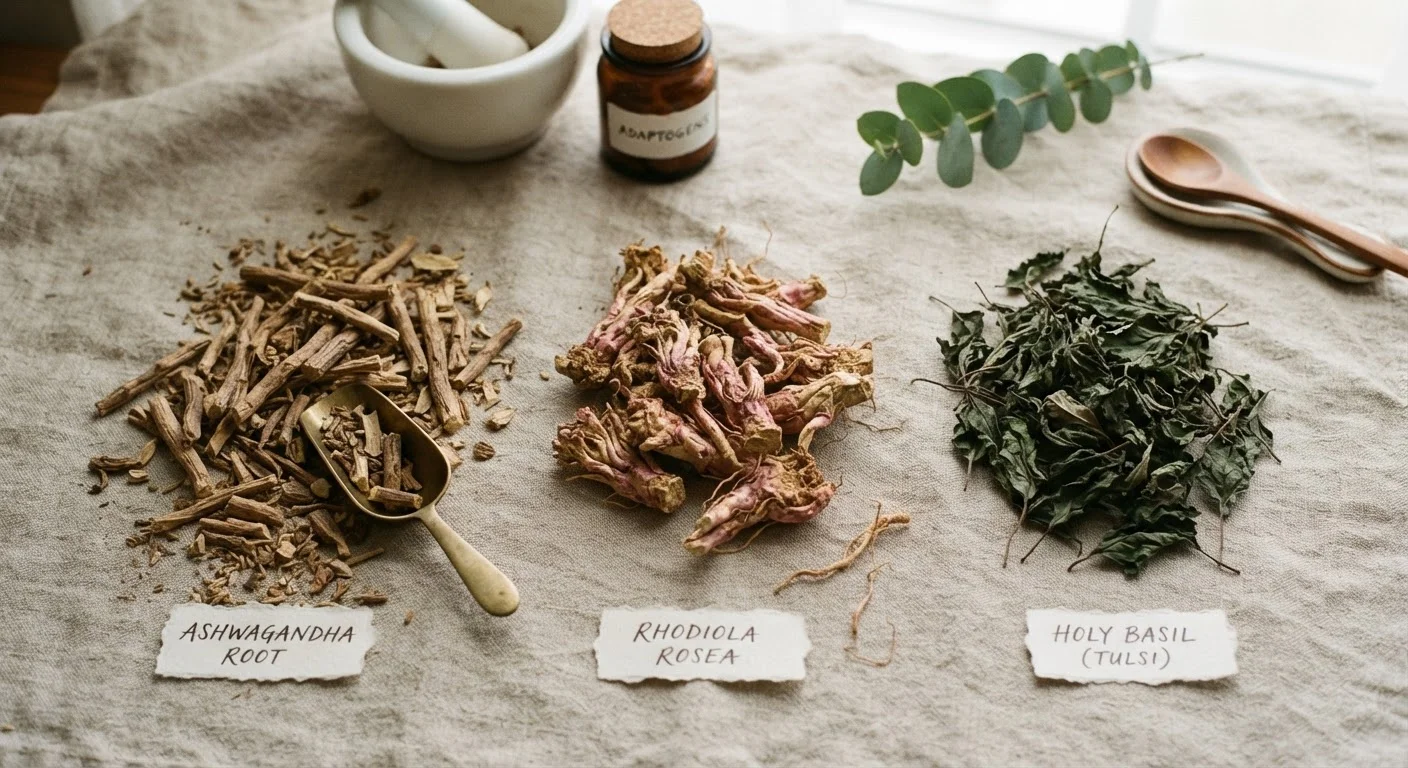
Today, the most widely discussed adaptogens include ashwagandha (Withania somnifera), rhodiola rosea, holy basil (Ocimum tenuiflorum), eleuthero, and schisandra. For a deeper look at the history and science behind these plants, see The Complete Guide to Adaptogens.
It is important to note that adaptogen is not a regulated medical or pharmacological classification in the United States. The term is used loosely across wellness marketing and research literature alike, which makes critical evaluation essential.
The Potential Benefits: Where Evidence Lends Support
When researchers have studied adaptogens under controlled conditions, several have produced encouraging results — particularly around perceived stress, cortisol regulation, and mental fatigue.
Ashwagandha shows measurable cortisol-lowering effects
Several randomized controlled trials have reported statistically significant reductions in serum cortisol and perceived stress among adults taking standardized ashwagandha extract compared to placebo, suggesting a plausible physiological mechanism.
Rhodiola may reduce mental fatigue under stress
Clinical studies have found rhodiola rosea associated with improved cognitive performance and reduced fatigue in people exposed to stressful conditions, which may be relevant for those experiencing stress-related burnout.
Generally well-tolerated at studied doses
In published trials, commonly studied adaptogens such as ashwagandha and rhodiola have shown favorable short-term safety profiles, with adverse events generally mild and infrequent compared to placebo groups.
Long history of traditional use in multiple cultures
Adaptogens like holy basil and eleuthero have centuries of documented use in Ayurvedic and traditional Chinese medicine systems, which — while not equivalent to clinical proof — has informed the hypotheses driving current research.
May complement lifestyle-based stress practices
When used alongside sleep hygiene, exercise, and mindfulness, some adaptogens may provide an additional layer of physiological support, according to emerging integrative medicine perspectives.
Ashwagandha is among the most studied. Multiple randomized trials have found that standardized ashwagandha root extracts were associated with reductions in self-reported stress and anxiety scores compared to placebo, along with measurable decreases in serum cortisol. Rhodiola rosea has shown promise in studies examining cognitive performance and fatigue under stressful conditions — useful context explored further in Adaptogenic Herbs and Stress: Separating Established Research from Emerging Claims.
Holy basil has a long history in Ayurvedic tradition and some early clinical work suggests it may support mood and stress tolerance, though the evidence base here is thinner than for ashwagandha or rhodiola.
~240mg/day
Ashwagandha dose studied in stress trials
A 2019 randomized, double-blind trial published in Medicine found this dose of ashwagandha root extract associated with significant reductions in stress scores and cortisol compared to placebo over 60 days.
~60%
Reported reduction in stress scores (ashwagandha vs placebo)
In a 2012 double-blind RCT published in the Indian Journal of Psychological Medicine, participants receiving ashwagandha reported approximately 44–60% greater reductions in stress scale scores than placebo recipients.
The Limitations and Risks: What the Evidence Cannot Yet Confirm
Enthusiasm for adaptogens should be balanced against real and important caveats. The research field, while growing, is still characterized by small sample sizes, short study durations, variable extract standardization, and limited independent replication.
Most studies are small and short in duration
The majority of published adaptogen trials involve fewer than 100 participants and run for eight to twelve weeks, making it difficult to draw conclusions about long-term effectiveness or safety with confidence.
Supplement quality is inconsistent and largely unregulated
In the US, herbal supplements do not require pre-market approval, meaning the amount of active compounds in a commercial product may differ significantly from what is listed on the label.
Potential interactions with medications
Some adaptogens, including ashwagandha and eleuthero, have documented or theoretically possible interactions with thyroid medications, immunosuppressants, and central nervous system sedatives — underscoring the need for professional guidance.
Effects are modest compared to established interventions
The stress-reducing effects observed in adaptogen studies are generally modest in magnitude and not consistently comparable to those produced by evidence-based behavioral interventions like cognitive-behavioral therapy or structured exercise programs.
The term 'adaptogen' lacks regulatory or scientific consensus definition
Because 'adaptogen' has no standardized legal or pharmacological definition in the US, the label is sometimes applied to products with little or no supporting evidence, making consumer navigation difficult.
Limited safety data for special populations
Research on adaptogen use during pregnancy, breastfeeding, childhood, or among people with serious chronic illness is scarce, and existing traditional cautions warrant conservative professional guidance in these groups.
Perhaps the most significant practical concern is supplement quality. Because dietary supplements in the US are not subject to the same pre-market approval process as pharmaceuticals, the concentration of active compounds in commercial adaptogen products can vary substantially. Third-party testing organizations exist to verify label claims, but their use by manufacturers is voluntary.
For a broader comparison with other herbal approaches, Herbs Traditionally Used for Stress and Anxiety maps traditional use against current evidence across multiple plant remedies.
Adaptogens Are Not a Replacement for Professional Care
Chronic or severe stress, anxiety disorders, and burnout can have serious health consequences and often benefit from professional mental health support. Adaptogens, however promising in early research, are not approved treatments for any diagnosed mental health condition. If stress is significantly affecting your daily functioning, relationships, or physical health, please speak with a licensed healthcare or mental health professional.
How to Approach Adaptogens Thoughtfully
If you are curious about incorporating adaptogens, the most responsible approach starts with a conversation with your healthcare provider — particularly if you are pregnant, nursing, managing a chronic health condition, or taking any prescription medications. Some adaptogens have documented interactions with immunosuppressants, thyroid medications, and sedatives.
Adaptogens are most appropriately viewed as one potential layer within a broader stress-management approach — not a primary intervention. Lifestyle factors like consistent sleep, regular physical activity, social connection, and evidence-based practices such as mindfulness or cognitive-behavioral techniques have substantially stronger and more consistent research support for stress and anxiety than any herb currently does.
When selecting a product, look for those that have undergone independent third-party testing for purity and potency. Start with the lowest reasonable dose and observe how your body responds over several weeks, since adaptogens are generally thought to work gradually rather than acutely.
This article is for general informational purposes only and does not constitute medical advice. Please consult a qualified healthcare professional before making any changes to your health routine, starting supplements, or if you have concerns about stress, anxiety, or any other health condition.
The content on this site is for informational purposes only and is not a substitute for professional advice. Always consult a qualified professional for guidance specific to your situation.