

Why These Myths Persist — and Why They Matter
Home workout myths are rarely invented from nothing. Most stem from a partial truth — gyms do offer more equipment variety, heavier loads, and structured classes — stretched into an absolute claim that training at home is fundamentally inferior. That leap is what causes the real harm, because it convinces people to delay or abandon fitness habits that could genuinely serve them.
The fitness industry has historically centered gyms as the default setting for 'serious' training, which means the cultural baseline many people inherit is one that marginalizes home exercise as a compromise. Understanding where these beliefs come from helps you evaluate them critically rather than accepting them as given.
Myth
You can't build real muscle without a gym and heavy weights.
Fact
Muscle growth is driven by progressive overload, not the source of resistance — bodyweight exercises can provide sufficient stimulus when difficulty is increased over time.
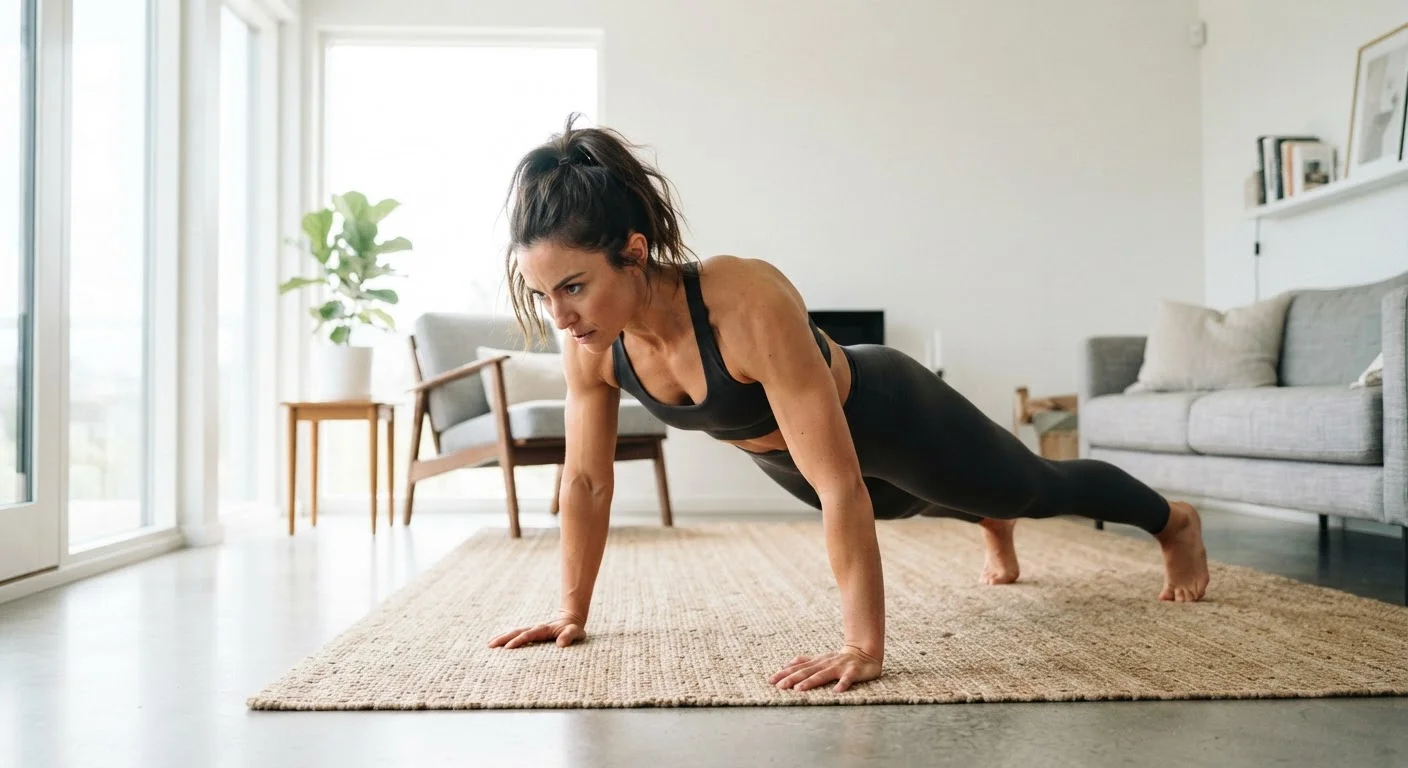
Hypertrophy (muscle growth) occurs when muscles are exposed to progressively greater mechanical tension. Research consistently shows that bodyweight exercises — push-ups, pull-ups, pistol squats, dips — can generate this tension effectively when you systematically increase reps, reduce rest, change leverage, or advance to harder variations. The key principle is progression, not proximity to a barbell. Starting with standard push-ups and advancing to archer or single-arm variations follows the same logic as adding weight to a bench press.
Myth
Cardio is the only effective way to burn fat at home.
Fact
Resistance training — including bodyweight circuits — raises resting metabolic rate and contributes meaningfully to fat loss alongside, or even instead of, steady-state cardio.
Fat loss is primarily governed by a sustained energy deficit over time. While cardio burns calories during activity, strength-oriented training builds lean muscle tissue, which increases the calories your body burns at rest. High-intensity bodyweight circuits also produce an elevated post-exercise oxygen consumption (EPOC) effect — sometimes called the 'afterburn' — that extends calorie expenditure for hours. A home routine that mixes bodyweight strength work with movement-based intervals covers both bases without a single piece of cardio equipment.
Myth
Short home workouts aren't long enough to make a real difference.
Fact
Well-structured sessions of 20–30 minutes can drive strength, endurance, and cardiovascular adaptations comparable to longer, less focused workouts.
Workout quality and consistency outperform raw duration. Studies on high-intensity interval training (HIIT) and resistance circuit formats have repeatedly shown that shorter, denser sessions — those with minimal rest and compound movements — produce measurable improvements in aerobic capacity, muscular endurance, and body composition. The limiting factor for most people is adherence, not session length. A 25-minute home workout you complete five days a week is more productive than a 90-minute gym session you attend once. See how to structure your sessions from the start for practical guidance.
Myth
Home workouts are only for beginners — serious athletes need a gym.
Fact
Many elite athletes and coaches use bodyweight and minimal-equipment training as a core part of advanced programming, not just a beginner stepping stone.
Gymnasts, martial artists, military personnel, and professional sports teams routinely program advanced bodyweight movements — one-arm push-ups, human flags, pistol squats, handstand progressions — that demand extraordinary strength and body control. The notion that home training 'maxes out' at an intermediate level underestimates the difficulty ceiling of bodyweight exercise. That said, specific goals like maximal powerlifting totals do require barbells; the point is that home training is far from a dead end for the majority of fitness objectives.
Myth
Without equipment, you can't effectively train your legs at home.
Fact
Unilateral and loaded bodyweight leg exercises — pistol squats, Bulgarian split squats, Nordic hamstring curls — create substantial lower-body demand without any equipment.
Bilateral squats with only bodyweight become relatively easy once a baseline level of strength is established, which can give the impression that leg training at home hits a ceiling. However, progressing to single-leg variations dramatically increases the load on each leg, and adding tempo (slow eccentric phases) or isometric holds intensifies the stimulus further. Plyometric options like jump squats and split jumps also develop power and cardiovascular capacity simultaneously. Learn how to spot and break through progression plateaus before assuming the programming has failed.
For a balanced perspective on what home training genuinely offers versus what it doesn't, explore the real trade-offs of training at home — the picture is more nuanced than either camp admits.
Building Real Progress From Your Living Room
Correcting these myths is only useful if it translates into action. The principles that make gym training effective — progressive overload, adequate volume, consistent frequency, and sufficient recovery — apply identically at home. What changes is how you implement them, not whether they work.
~72%
Adults who cite time as their main barrier to exercise
According to multiple survey analyses cited by public health researchers, perceived lack of time is consistently the top-ranked barrier to physical activity among U.S. adults.
20–30 min
Session length shown effective for fitness gains
Research on HIIT and resistance circuit protocols demonstrates meaningful cardiovascular and strength adaptations from sessions in this duration range when intensity is maintained.
Progressive overload at home looks like: moving from two-legged to single-leg exercises, slowing the lowering phase of a movement, reducing rest periods, or increasing total weekly sets. None of these require purchasing equipment. What they do require is intentional planning — which is exactly what a structured beginner's home routine helps you build from day one.
Consistency remains the most powerful variable. Practical strategies for staying on track during busy periods matter more than finding a perfect program. And if you want a comprehensive framework that takes you from first session to long-term habit, the complete guide to home-based fitness covers every stage of the journey.
This article is for general informational and educational purposes only and is not a substitute for professional medical or fitness advice. If you have an existing health condition, injury, or are new to exercise, consult a qualified healthcare or fitness professional before beginning any training program.
The content on this site is for informational purposes only and is not a substitute for professional advice. Always consult a qualified professional for guidance specific to your situation.