

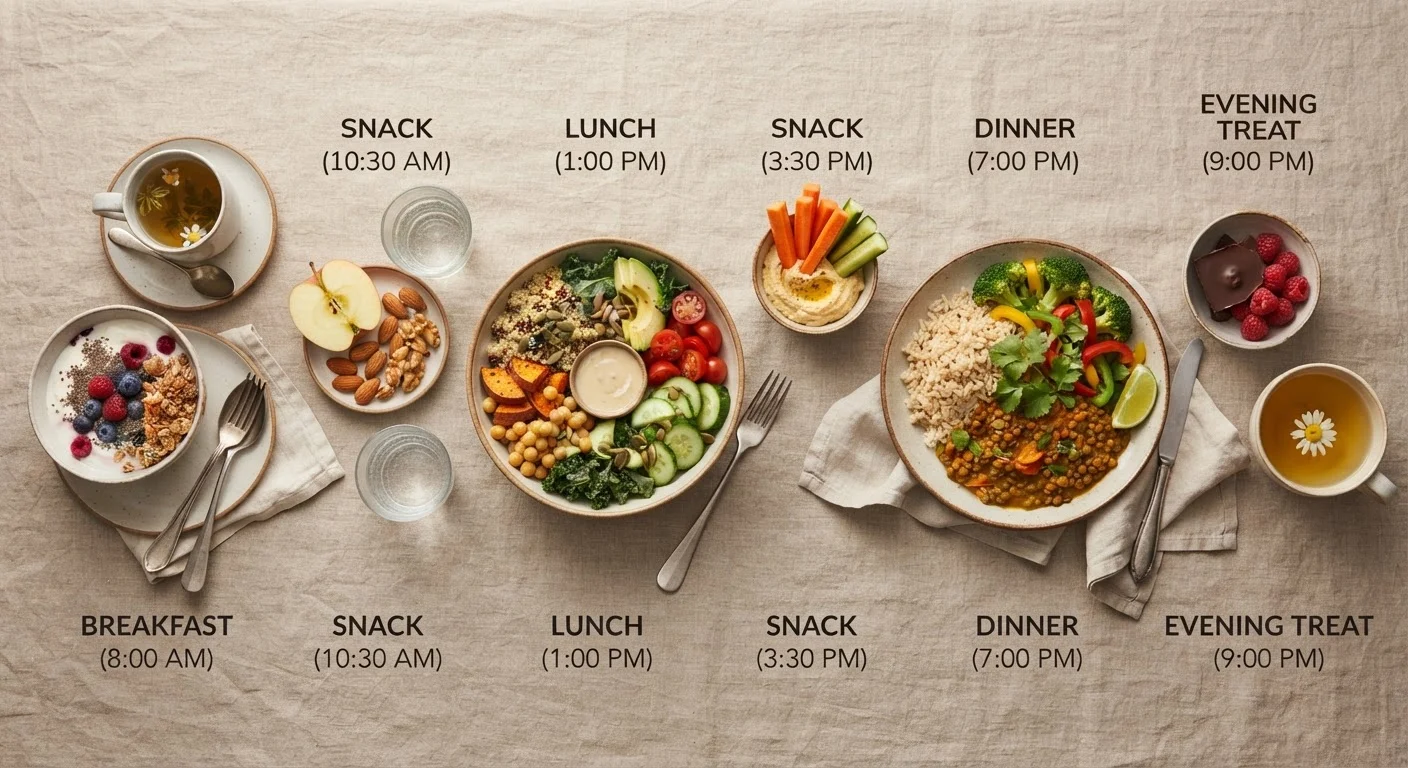
Why Patterns Matter More Than Individual Meals
Nutrition science consistently shows that no single food or meal determines health outcomes. What shapes long-term wellbeing is the cumulative pattern of what you eat across days, weeks, and months. A breakfast skipped, a lunch heavy in refined carbohydrates, or an occasional dessert carries far less weight than the overall dietary rhythm you maintain.
Large prospective studies — including research underlying the Dietary Guidelines for Americans — assess diet quality as a pattern, not a snapshot. The Healthy Eating Index, for example, scores overall dietary quality across food groups rather than penalizing or rewarding individual choices. This framing matters practically: it reduces the cognitive burden of perfection and shifts focus toward gradual, durable improvement.
For a deeper look at how consistency outperforms intensity in wellness outcomes, the principle applies as directly to nutrition as it does to exercise or sleep.
When assessing your diet, review a full week rather than a single day. A genuinely varied, nutrient-dense week is a more reliable signal of dietary quality than any individual meal.
Dietary assessment tools used in clinical nutrition research consistently evaluate patterns over multiple days because day-to-day variation is normal and expected — not a cause for concern.
If you tend to undereat vegetables during busy weekdays, batch-prepare a base of roasted or raw vegetables on weekends so the option is always accessible without added effort.
Reducing the friction of healthy choices is a well-supported behavior-change principle — people consistently choose what is most convenient, regardless of intention.
How Food Choices Accumulate Across the Day
Think of daily nutrition as a running ledger. Each meal and snack contributes — or detracts — from the day's total supply of macronutrients, vitamins, minerals, fiber, and phytonutrients. A morning that under-delivers on protein, for instance, can often be compensated by a legume-rich lunch. A vegetable-light day can be partially offset by a fiber-dense dinner.
However, this flexibility has limits. Some nutrients — particularly fat-soluble vitamins (A, D, E, K) and minerals like calcium and magnesium — are best absorbed when consistently present in the diet rather than crammed into occasional large doses. Regularity of intake, not just total weekly volume, supports optimal absorption for many micronutrients.
~10x
Fiber gap: typical intake vs. recommended
Dietary fiber intake among U.S. adults averages around 16 grams per day — well below the 25–38 gram guideline range, according to data cited by the Academy of Nutrition and Dietetics.
Less than 1 in 10
U.S. adults meeting vegetable intake guidelines
CDC surveillance data has consistently shown that fewer than 10% of American adults consume the recommended daily amount of vegetables.
3–5 years
Timeframe for dietary patterns to measurably shift biomarkers
Epidemiological research on dietary pattern changes, including Mediterranean diet adherence studies, suggests meaningful biomarker improvements emerge over multi-year sustained changes.
This is why building a balanced whole-food meal plan remains a practical foundation: it distributes nutrient delivery across the day rather than relying on correction after the fact.
The Role of Meal Timing in Daily Nutrition
When you eat interacts with how your body processes what you eat. Circadian biology — the body's internal 24-hour clock — influences insulin sensitivity, digestive enzyme secretion, and metabolic rate. Research suggests that eating in alignment with daylight hours, with a larger proportion of calories earlier in the day, may support metabolic efficiency for many people, though individual responses vary.
Irregular eating patterns — skipping meals, eating very late at night repeatedly, or going long stretches without food — can disrupt both energy regulation and appetite-signaling hormones like ghrelin and leptin. These disruptions don't cause harm from a single irregular day, but sustained inconsistency may make it harder to regulate hunger and sustain energy across the day.
For a nuanced look at what evidence actually supports on this topic, see nutrient timing myths and what research supports. And if you're interested in how consistent meal scheduling affects digestion and energy day-to-day, eating at regular times explores the practical dimensions in detail.
Building Consistency Without Rigidity
Rigidity is one of the most common failure points in dietary change. When a plan demands perfection, any deviation feels like failure — triggering abandonment rather than adjustment. Nutritional patterns that hold up over years share a different quality: they are flexible within a structure.
This means establishing anchor habits — a regular source of vegetables at lunch, a protein-inclusive breakfast, adequate hydration throughout the day — that remain stable across varying circumstances. Around these anchors, the specifics can shift without the underlying pattern collapsing.
The behavioral science concept of habit stacking is useful here. Linking a new nutritional behavior to an existing routine — preparing vegetables while dinner cooks, for example — reduces the decision effort required. How small routines compound explains why this mechanism is so effective for building lasting change.
Long-lived dietary cultures, such as those described in the Okinawan dietary pattern, demonstrate that dietary longevity depends on cultural consistency, not caloric precision.
Practical Steps to Strengthen Your Daily Dietary Pattern
Improving daily nutrition doesn't require an overhaul. Small, sustained shifts — applied consistently — move the cumulative ledger in a meaningful direction over time. The following framework focuses on pattern-level changes rather than meal-by-meal prescriptions.
- Add before subtracting: Rather than removing foods first, focus on consistently adding vegetables, legumes, whole grains, or fruit. Crowding out less nutrient-dense options naturally follows.
- Anchor nutrient density to every eating occasion: Even a snack is an opportunity for fiber, protein, or micronutrients. Pairing fruit with a small handful of nuts, for example, adds nutritional value without restructuring a meal.
- Track patterns, not perfection: A simple weekly reflection — How many days did I include vegetables at most meals? Did I stay hydrated? — builds awareness without obsession.
- Plan your grocery shop around nutrient gaps: A structured grocery list framework can help ensure the raw materials for consistent, nutrient-rich eating are actually in the kitchen.
- Connect daily habits to broader lifestyle patterns: Nutrition doesn't operate in isolation. Daily habits that support overall wellness — including sleep, stress management, and movement — interact with how the body uses the nutrients you consume.
Consistency, applied with flexibility, is the defining characteristic of dietary patterns associated with long-term wellbeing. There is no single perfect day of eating — only the ongoing practice of choosing nourishment across each day's opportunities.
This article is for general informational and educational purposes only and does not constitute medical or dietary advice. Consult a qualified healthcare professional or registered dietitian for guidance tailored to your individual health needs.
The content on this site is for informational purposes only and is not a substitute for professional advice. Always consult a qualified professional for guidance specific to your situation.