

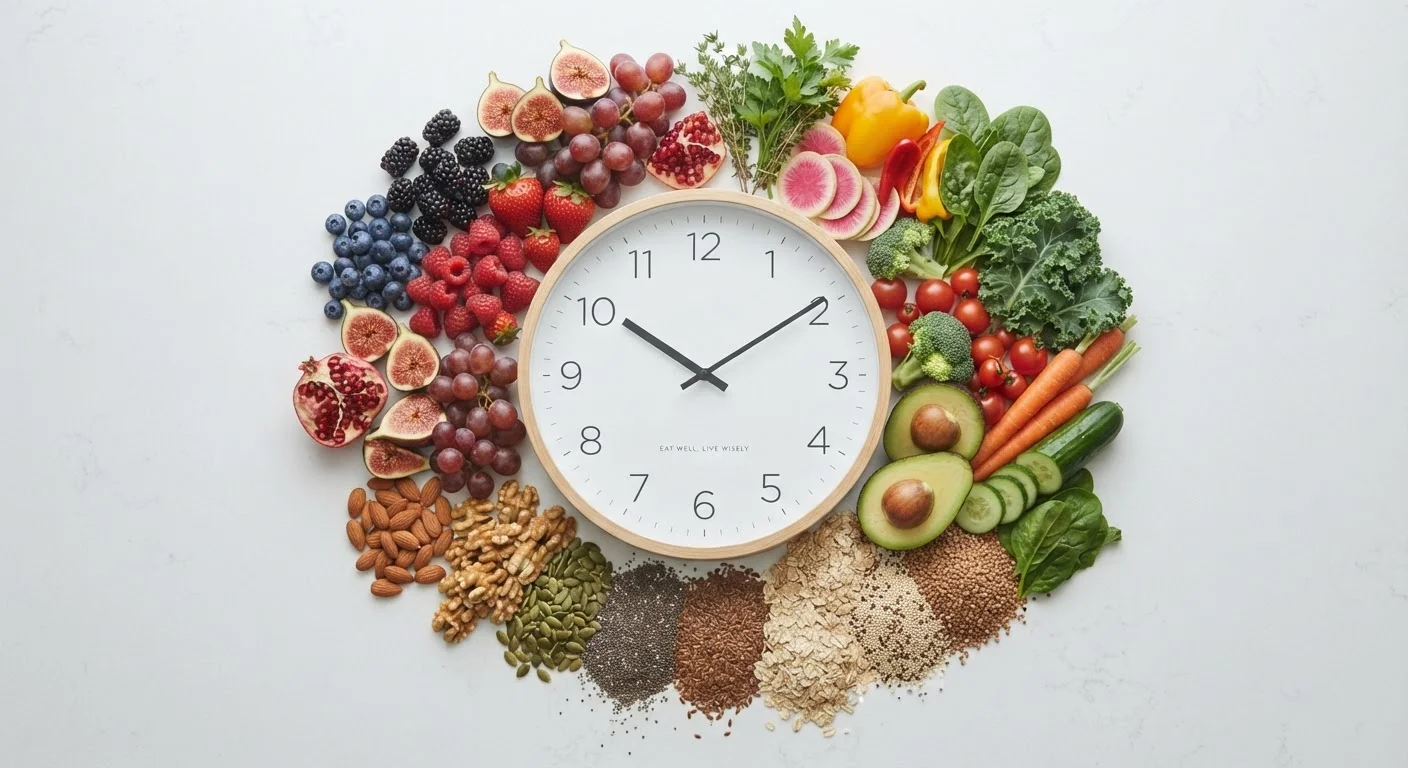
Why Nutrient Timing Became a Wellness Obsession
Walk through any health store or scroll a fitness forum and you'll encounter confident prescriptions: take vitamin D with your fattiest meal, consume protein within 30 minutes of exercise, avoid iron and calcium together. Some of this advice has a kernel of truth; much of it is overstated. Understanding what the evidence actually supports — and where it stops — helps you make smarter decisions without unnecessary complexity.
The appeal of nutrient timing is understandable. The idea that a simple scheduling tweak could dramatically boost absorption feels empowering and precise. But nutrition science rarely works that cleanly. For a deeper look at how single-meal decisions compare to long-term patterns, see how food choices stack up over time.
Myth
You must consume protein within 30 minutes of exercise or you'll miss the muscle-building window entirely.
Fact
The so-called 'anabolic window' is considerably wider than 30 minutes — current evidence suggests several hours around training, and total daily protein intake matters far more than precise timing.
The concept of a narrow post-workout window emerged from early studies often conducted on fasted participants or elderly subjects, conditions that don't reflect typical training scenarios. More recent meta-analyses, including work published in the Journal of the International Society of Sports Nutrition, indicate that when total protein intake is adequate across the day, the urgency of immediate post-workout consumption is substantially reduced. Distributing protein relatively evenly across meals appears at least as beneficial for muscle protein synthesis as clustering it around training.
Myth
Eating carbohydrates at night causes them to be stored as fat because your metabolism slows while you sleep.
Fact
Metabolic rate does decrease modestly during sleep, but the body's use of carbohydrates for energy and glycogen replenishment continues. Total caloric intake and dietary composition over time are the primary drivers of body composition, not the clock.
Research comparing identical diets consumed earlier versus later in the day shows mixed results, with effect sizes generally small in controlled conditions. Basal metabolic rate decreases by roughly 15% during sleep — a modest shift that does not fundamentally change how carbohydrates are processed. The more clinically relevant factor is whether overall energy intake aligns with expenditure over days and weeks, not the hour at which a particular meal is eaten.
Myth
Taking multiple vitamins and minerals together at the same time always reduces absorption due to competition.
Fact
Nutrient competition at intestinal absorption sites is real but applies primarily to high supplemental doses of specific mineral pairs — it is rarely a concern with food sources or standard multivitamin doses.
The most documented competition occurs between non-heme iron and calcium at high supplemental doses, and between zinc and copper in supplemental contexts. However, at levels provided by food and typical multivitamins, the body's absorptive systems generally handle multiple nutrients simultaneously without clinically significant interference. Concerns about widespread multi-nutrient competition are largely extrapolated from high-dose supplement studies and overapplied to everyday eating situations.
Myth
Fat-soluble vitamins are absorbed equally well regardless of whether you take them with food.
Fact
Fat-soluble vitamins (A, D, E, K) require the presence of dietary fat for efficient intestinal absorption; taking them without fat meaningfully reduces uptake, particularly for supplemental forms.
Fat-soluble vitamins are incorporated into micelles in the small intestine — a process dependent on bile salts secreted in response to dietary fat. Studies on vitamin D supplements specifically show that co-ingestion with fat increases serum 25-hydroxyvitamin D levels compared to fasted ingestion. This is a genuinely evidence-supported timing recommendation, unlike many others in the nutrient timing space. A small amount of fat — even a tablespoon of olive oil or a handful of nuts — is sufficient to facilitate this process.
Myth
Drinking coffee or tea with meals has no effect on how well your body absorbs nutrients from food.
Fact
Polyphenols in coffee and tea — particularly tannins — can significantly inhibit non-heme iron absorption when consumed alongside iron-rich meals.
This interaction is well-documented in controlled studies. Tannins form insoluble complexes with non-heme iron in the gut, reducing its bioavailability by a substantial margin. For individuals with adequate iron stores, this is unlikely to be clinically meaningful. However, for people at risk of iron deficiency — including menstruating individuals, vegetarians, and those with absorption disorders — spacing tea and coffee consumption away from iron-rich meals is a practical, evidence-based strategy. Heme iron from animal sources is less affected by this interaction.
Where Timing Genuinely Does Matter
While sweeping nutrient-timing rules tend to crumble under scrutiny, a handful of specific interactions are well-supported and worth knowing about.
Fat-soluble vitamins (A, D, E, K): These require dietary fat for absorption via intestinal lymphatic transport. Taking a vitamin D supplement with a fat-containing meal — even a small amount of fat — meaningfully improves its uptake compared to taking it fasted. This is one of the cleaner timing recommendations in nutrition science.
Iron and enhancers or inhibitors: Non-heme iron (from plant sources) is highly sensitive to co-consumed foods. Vitamin C consumed in the same meal can increase non-heme iron absorption substantially, while calcium, polyphenols in tea and coffee, and phytates in unprocessed grains can reduce it. What you eat alongside iron-rich foods can genuinely shift how much iron your body actually captures.
Calcium and magnesium supplements: High-dose calcium and magnesium share intestinal transporters, so taking very large amounts simultaneously may reduce absorption of both. Staggering supplement timing is a reasonable practical strategy — though food sources of these minerals don't typically compete at physiologically significant levels.
~33%
Increase in vitamin D absorption with fat
A study in the Journal of the Academy of Nutrition and Dietetics found that taking vitamin D supplements with a fat-containing meal increased absorption by approximately one-third compared to a fat-free meal.
Up to 67%
Reduction in non-heme iron absorption from tea
Research published in the American Journal of Clinical Nutrition documented that consuming black tea with a meal could reduce non-heme iron absorption by up to 67% compared to water.
3–5 hours
Effective protein synthesis window post-exercise
Current sports nutrition research suggests muscle protein synthesis remains elevated for at least three to five hours post-workout, challenging the strict 30-minute 'anabolic window' concept.
These nuances are meaningful but narrow. They apply mainly to specific supplement forms or high-dose scenarios, not to the broad timing rules often promoted in wellness content. For a grounded look at what evidence says about meal frequency more broadly, see meal timing and eating frequency.
Applying the Evidence Without Overthinking It
The most defensible takeaway from nutrient timing research is also the least glamorous: consistency and dietary quality dwarf scheduling effects for the vast majority of nutrients. The body has remarkable regulatory mechanisms — including upregulating absorption when stores are low — that buffer against imperfect timing.
Practical steps grounded in actual evidence include taking fat-soluble vitamin supplements with a meal containing fat, spacing high-dose calcium and magnesium supplements if you use both, and consuming vitamin C-rich foods alongside plant-based iron sources. For athletes, distributing protein intake evenly across meals appears beneficial for muscle protein synthesis, but the obsessive focus on a narrow post-workout window is not supported by current research.
Don't Let Timing Rules Replace Dietary Quality
Focusing heavily on nutrient timing at the expense of overall diet quality is a common and counterproductive trade-off. No scheduling strategy compensates for a diet consistently low in essential vitamins, minerals, or macronutrients. Before optimizing timing, ensure the foundational dietary pattern is nutritionally adequate. If you are managing a diagnosed deficiency or a condition affecting nutrient metabolism, work with a healthcare provider rather than relying on general timing guidelines.
Claims that go well beyond this — that specific meal times will "supercharge" nutrient uptake, that eating late at night fundamentally ruins absorption, or that rigid supplement schedules are necessary for healthy adults — are not supported by robust evidence. Many popular healthy eating claims follow this pattern: a grain of scientific truth amplified into an oversimplified rule.
If you have specific health conditions, take medications that affect nutrient metabolism, or manage deficiencies under medical care, timing guidance from your healthcare provider or a registered dietitian is far more relevant than general wellness advice. Consistent meal timing may also support digestion and energy regulation — but that's a separate question from absorption optimization.
This article is for general informational and educational purposes only and does not constitute medical or nutritional advice. Consult a qualified healthcare professional or registered dietitian before making changes to your diet, supplement regimen, or health practices.
The content on this site is for informational purposes only and is not a substitute for professional advice. Always consult a qualified professional for guidance specific to your situation.