

Start here
Why Habits Matter More Than Diets
Next
The Mindset Shift That Makes Change Stick
Build on it
Shaping Your Food Environment
Take action
Practical Starting Points for Better Eating
Go further
Meal Planning Without Overwhelm
Why Habits Matter More Than Diets
The word "diet" typically implies a defined period of restriction — a start date, an end date, and a set of rules to follow in between. Habits, by contrast, are the quiet, automatic behaviors that shape what ends up on your plate day after day, regardless of whether you're following a formal plan.
Decades of behavioral research support what many people have learned through personal experience: short-term dietary interventions rarely produce lasting change. What does produce lasting change is the slow accumulation of consistent behaviors — choosing water over soda most days, cooking at home more often than not, defaulting to vegetables as part of most meals.
This is not about perfection. It's about direction. Exploring whole-food dietary approaches can help you understand what a sustainable eating pattern might look like for your life, rather than someone else's program.
Dietary pattern
The overall combination of foods and drinks consumed regularly over time, as opposed to individual meals or nutrients. Research consistently links dietary patterns — rather than single foods — to long-term health outcomes.
Habit loop
A behavioral cycle consisting of a cue, a routine response, and a reward. Understanding this loop helps explain why eating behaviors are automatic and how they can be intentionally reshaped.
Food environment
The physical and social context that influences what foods are available, visible, and easy to access. Your kitchen, workplace, and neighborhood all form part of your food environment.
Nutrient density
A measure of how much nutritional value (vitamins, minerals, fiber, protein) a food provides relative to its calorie content. Whole foods like vegetables, legumes, and whole grains tend to be high in nutrient density.
Flexible restraint
An approach to eating guided by general principles rather than strict rules, allowing for occasional deviations without abandoning the overall pattern. Associated with more sustainable dietary behavior than rigid restriction.
Decision fatigue
The deterioration in decision-making quality that occurs after making many choices. In dietary contexts, it often leads to defaulting to convenient, less nutritious options later in the day when mental energy is lower.
The Mindset Shift That Makes Change Stick
One of the most reliable predictors of dietary change failure is an all-or-nothing mindset — the belief that eating one "bad" meal derails your entire effort. Nutritional science does not support this framing. Overall dietary patterns across weeks and months matter far more than individual meals.
A more productive approach is what researchers sometimes describe as a flexible restraint orientation: having general guiding principles rather than rigid rules, and returning calmly to those principles after any deviation. This is cognitively easier to maintain and less likely to trigger the abandonment spiral that strict rules often produce.
Practical reframing strategies include:
- Thinking in terms of "mostly" rather than "always" or "never"
- Treating setbacks as data points, not moral failures
- Anchoring new habits to existing routines (e.g., adding a vegetable to a meal you already cook regularly)
- Measuring progress over weeks, not individual days
This connects naturally to broader daily habit formation principles — dietary change rarely happens in isolation from the rest of your lifestyle.
Shaping Your Food Environment
Environmental design is one of the most underused tools in dietary behavior change. The core insight from behavioral nutrition is straightforward: convenience drives choice. People consistently eat more of whatever is easy to access and visible, and less of what requires effort to obtain.
Applying this principle at home involves a few structural changes:
- Countertop visibility: Keep a bowl of fruit or pre-washed vegetables at eye level. Reserve less-prominent spots for foods you want to eat less frequently.
- Refrigerator organization: Place prepared vegetables, cut fruit, and ready-to-eat nutritious options at the front of shelves rather than hidden in drawers.
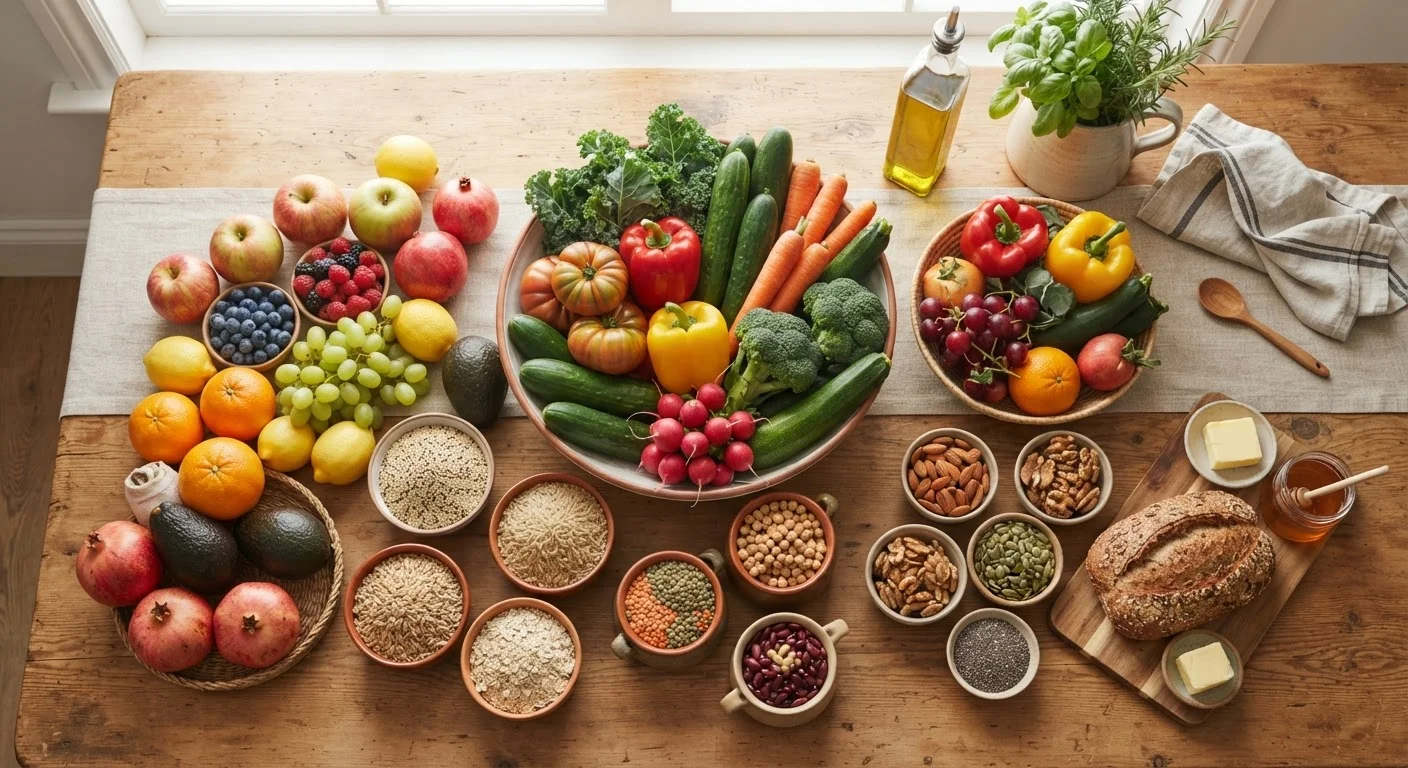
- Pantry composition: Stock whole-grain staples, legumes, canned fish, and nuts as the default. These provide nutritional density without requiring daily fresh shopping.
- Plate and bowl sizing: Research suggests smaller serving vessels modestly reduce portion sizes without conscious effort for many people.
None of these changes require willpower in the moment — they're decisions made once that quietly influence hundreds of future choices. For a structured approach to stocking your kitchen, our nutrient-rich grocery list framework offers a practical starting point.
Start With One Environmental Change
Rather than redesigning your entire kitchen at once, pick one structural change this week — for example, moving a fruit bowl to your countertop or rearranging your refrigerator shelf. Small environmental shifts compound over time and require no ongoing willpower to maintain.
Practical Starting Points for Better Eating
Broad dietary goals like "eat healthier" are too vague to act on reliably. Specific, concrete behaviors are far more actionable. Below are evidence-supported starting points that work within most lifestyles:
- Add before you subtract: Focus first on adding vegetables, legumes, whole grains, and fruit rather than immediately restricting less nutritious foods. Addition habits tend to be easier to form and create natural displacement.
- Build a default breakfast: Mornings with low decision energy benefit from a go-to meal that's already nutritionally sound — for example, oatmeal with fruit and nuts, or eggs with vegetables.
- Understand what a balanced plate looks like: Our guide on what a balanced plate actually looks like breaks down proportions and food groups clearly, without rigid rules.
- Learn to read labels: Understanding nutrition labels without getting lost in the numbers helps you make informed decisions at the store rather than relying on front-of-pack marketing.
This article is for general informational and educational purposes only and is not a substitute for professional medical or dietary advice. Consult a qualified healthcare provider before making significant changes to your diet, especially if you have an existing health condition.
Meal Planning Without Overwhelm
Meal planning does not have to mean preparing every meal for the week on Sunday afternoon. For most people, a lighter approach works just as well: deciding in advance what you'll cook for dinner on most nights, keeping a short list of reliable go-to meals, and ensuring your pantry supports those choices.
Effective low-effort planning typically involves:
- A rotating meal repertoire: A set of 8–12 meals you know how to make well and enjoy. This eliminates daily decision-making while maintaining variety across weeks.
- Batch-cooked staples: Cooking a large batch of a versatile staple — grains, legumes, roasted vegetables — provides a ready base for multiple meals throughout the week.
- A consistent shopping day: Linking grocery shopping to a specific day each week ensures you have what you need before hunger and convenience pressure hits.
For those interested in exploring dietary patterns with built-in structure, options like the Nordic diet illustrate how seasonal whole-food principles can translate into a practical eating framework. Similarly, building a gut-friendly eating pattern shows how thoughtful food choices can support digestive health over time.
The goal of meal planning is not control — it's reducing friction so that nourishing choices become the default, not the exception.
Planning Looks Different for Everyone
There is no single correct way to plan meals — the right approach is the one that fits your schedule, cooking confidence, and household. Some people thrive with detailed weekly plans; others do better with a loose list of five dinner ideas. Experiment to find what reduces stress rather than adding it.
Frequently Asked Questions
Research suggests habit formation varies widely — commonly cited estimates range from a few weeks to several months, depending on the complexity of the behavior and individual factors. Consistency matters more than speed. Focus on repeating a behavior in a stable context rather than aiming for a fixed timeline.
Generally, no. Dietary science consistently supports an overall eating pattern approach over eliminating single foods. Whole foods, variety, and moderation form the foundation. Restrictions may be appropriate for specific medical conditions — always consult a healthcare professional in those cases.
Adding one additional serving of vegetables or fruit per day is a widely recommended and low-barrier starting point. This builds a positive addition habit rather than focusing on restriction, which tends to be more sustainable for most people.
Meal planning is a tool, not a requirement. However, evidence suggests that planning meals in advance is associated with higher diet quality and lower food stress. Even loose weekly planning — knowing what dinners you'll prepare — can reduce reliance on less nutritious convenience options.
Your food environment strongly influences behavior through visibility and accessibility. Studies show that people eat more of whatever food is most visible and easy to reach. Placing nutritious foods at eye level and reducing the prominence of less nutritious options can meaningfully shift daily choices.
Yes — nutritious eating does not require expensive specialty foods. Staples like legumes, frozen vegetables, oats, eggs, and seasonal produce offer strong nutritional value at lower cost. See our guide on <a href="/diet-nutrition/healthy-eating-basics/eating-well-on-a-budget-principles-that-hold-up-in-a-real-kitchen">eating well on a budget</a> for practical strategies.
The content on this site is for informational purposes only and is not a substitute for professional advice. Always consult a qualified professional for guidance specific to your situation.