

Why Seated Poses Deserve Your Attention
In many yoga classes, seated poses are treated as transitions — something to move through on the way to a peak posture. That framing undersells them considerably. Seated poses are where practitioners learn the two skills that determine long-term progress: structural integrity and patient breath awareness.
Unlike standing postures, seated poses remove the balancing challenge and allow you to focus entirely on how your pelvis tilts, how your spine stacks, and how your breath moves through a compressed or lengthened torso. These are not small details. They are the foundation on which every forward fold, hip opener, and twist in your practice is built.
If you spend long hours at a desk, the connection between seated yoga and how your body feels daily is direct — see why prolonged sitting affects your body for context on why targeted hip and spinal work matters off the mat too.
The six poses below are sequenced to progressively open the hips, lengthen the posterior chain, and introduce axial rotation — building the precise physical literacy your practice needs.
Dandasana (Staff Pose)
Dandasana is the seated equivalent of Tadasana — a master alignment pose from which all other seated postures originate. Sit with legs extended, feet flexed, and hands pressed firmly into the mat beside your hips.
The immediate challenge for most people is anterior pelvic tilt: tight hamstrings pull the pelvis into a posterior tuck, causing the lower back to round. Sitting on a folded blanket elevates the hips enough to restore the natural lumbar curve. From there, focus on pressing through the heels, engaging the quadriceps, and lifting through the crown of the head.
Staff pose teaches the spine to find and hold its neutral position — a skill every seated forward fold depends on.
Dandasana trains spinal neutrality — the single most transferable skill in seated yoga.
Baddha Konasana (Bound Angle Pose)
Bring the soles of the feet together and let the knees drop toward the floor. Hold the feet or ankles and sit tall before considering any forward lean. Baddha Konasana targets the hip adductors and external rotators — muscles that govern how freely the pelvis tilts in all forward folds.
Avoid pressing the knees toward the floor with your hands. Instead, focus on rooting the sitting bones and lengthening upward through the spine. Knees will descend naturally over weeks of consistent practice as the inner groin releases.
This pose is particularly valuable for practitioners who experience tightness in wide-legged postures or difficulty sitting cross-legged comfortably.
Releasing the inner groin in Baddha Konasana unlocks hip mobility across almost every seated posture.
Paschimottanasana (Seated Forward Bend)
Return to the Staff Pose foundation, inhale to lengthen the spine, and exhale to hinge forward from the hips — not the waist. Reach for the shins, ankles, or feet without rounding the upper back to close the gap.
Paschimottanasana stretches the entire posterior chain: hamstrings, calves, and the erector spinae muscles along the spine. The common error is leading with the head in an attempt to look flexible. Instead, prioritize a long spine over maximum reach. A strap looped around the feet allows you to maintain this length without straining.
With each exhale, allow the belly to draw softly toward the thighs rather than collapsing the chest. This breath pattern massages the abdominal organs and trains diaphragmatic coordination under mild compression.
In Paschimottanasana, a long spine matters far more than how far you reach.
Sukhasana (Easy Seat) with Spinal Elongation
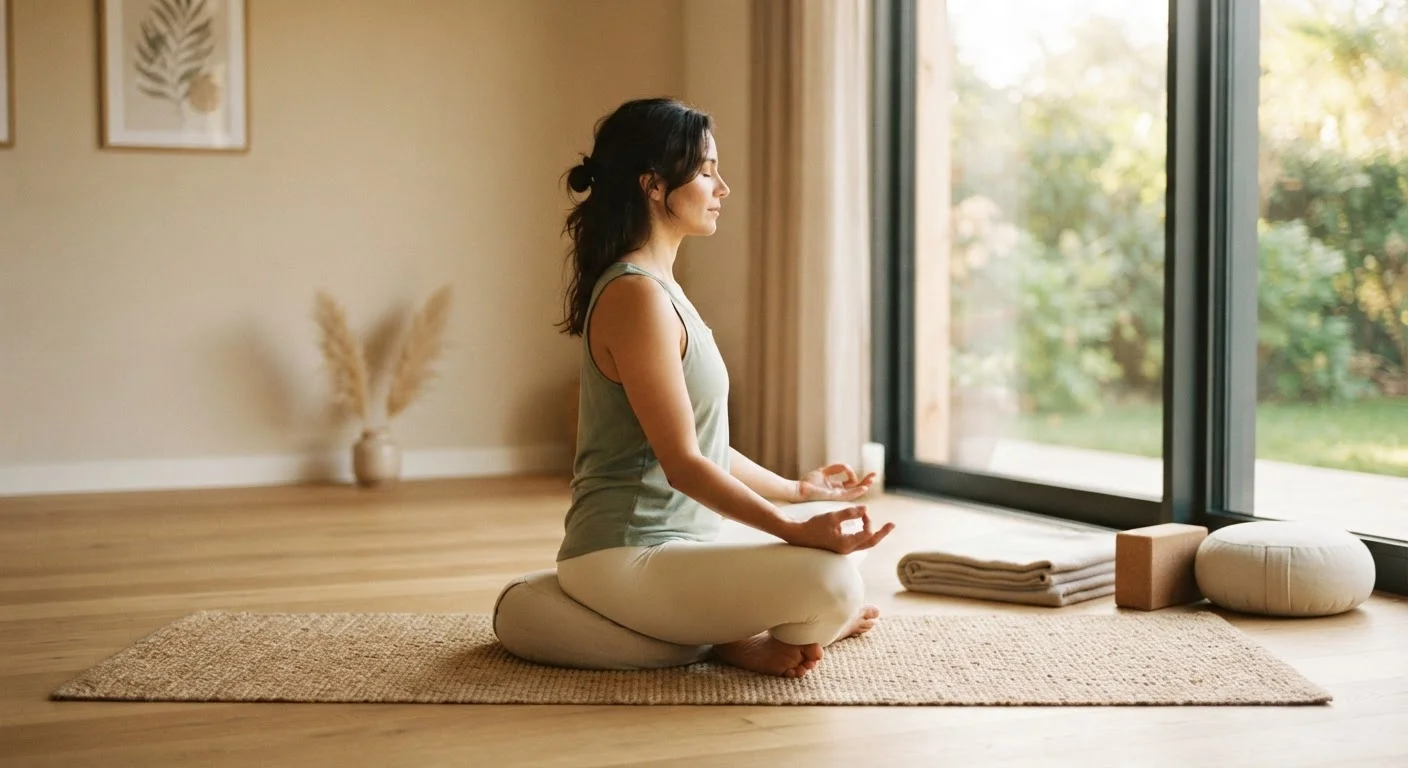
Often dismissed as simply sitting cross-legged, Sukhasana practiced with intention is a powerful alignment and awareness tool. Sit with shins crossed, feet below opposite knees, and hips elevated on a block or blanket if the knees rise above the hip crease.
Place hands on knees, close the eyes, and focus on two actions: rooting the sitting bones downward and lifting the crown of the head upward. These opposite-direction actions create axial extension — a decompression of the lumbar and thoracic vertebrae that most people rarely experience in daily life.
Hold for 8–12 slow breaths, then switch the crossing of the legs. This asymmetry awareness is foundational for understanding how one hip may be tighter than the other.
Sukhasana develops the axial length that keeps the spine safe in every forward fold and twist.
Upavistha Konasana (Wide-Angle Seated Forward Fold)
From Staff Pose, open the legs to a wide V-shape — typically between 90 and 120 degrees for beginners. Flex the feet, engage the quadriceps, and sit tall before any attempt to fold forward. The inner thighs and hamstrings are the primary targets; the adductors along the inner legs often limit range significantly here.
Walk the hands forward along the floor, maintaining length in the spine. If the pelvis immediately tips backward as you fold, place a blanket under the hips. Avoid forcing the legs wider than comfortable — the stretch should be felt as a steady pull, not a sharp sensation.
This pose builds the hip and hamstring mobility essential for lateral forward folds, splits preparation, and many intermediate hip-opening postures.
Consistent practice of Upavistha Konasana progressively opens the adductors without straining the inner knee.
Ardha Matsyendrasana (Half Lord of the Fishes — Seated Twist)
Sit in Staff Pose, bend the right knee and place the right foot flat on the floor outside the left thigh. Inhale to lengthen the spine, then exhale and twist to the right, hooking the left elbow outside the right knee or simply resting the hand there. Keep both sitting bones grounded.
Seated twists mobilize the thoracic spine and decompress the intervertebral discs when performed with correct alignment. The key technical point: the twist begins in the thoracic spine, not the neck. Turning the head comes last, as the final expression of rotation already established lower in the spine.
Hold for five to eight breaths, allowing the inhale to create space and the exhale to deepen the rotation gently. Repeat on the left side. This pose completes the foundational sequence by addressing rotational mobility — the dimension most often neglected in flexibility training.
Spinal twists work from the thoracic spine outward — turning the head last deepens the rotation safely.
Bringing It All Together
Each of these poses addresses a specific structural pattern: posterior pelvic tilt, hip external rotation, hamstring extensibility, adductor release, spinal rotation, and lateral lengthening. Practiced together two to four times per week, they create cumulative change in both tissue mobility and body awareness.
Sequence These Poses Intentionally
Practice these six poses in the order listed: Staff Pose establishes baseline alignment, Bound Angle and Wide-Angle open the hips, Seated Forward Bend lengthens the posterior chain, Easy Seat refines axial awareness, and the twist concludes with rotational mobility. This progression warms tissues in the right order and reduces the risk of overstretching. Hold each posture for at least five slow breaths to allow the nervous system — not just the muscles — to release.
Breath is not optional in any of these postures. If you find yourself holding your breath to stay in a shape, that is the body's signal to ease back. For a deeper exploration of how breath can anchor and deepen your seated practice, explore pranayama-informed techniques for stillness.
These poses also complement dynamic sequences well. Once your pelvis moves freely and your spine articulates cleanly in stillness, transitions like those in Sun Salutation A become noticeably more controlled and safe.
This article is for general informational and educational purposes only and does not constitute medical advice. If you have an existing injury, chronic condition, or are new to physical activity, consult a qualified healthcare professional or certified yoga instructor before beginning any new movement practice.
The content on this site is for informational purposes only and is not a substitute for professional advice. Always consult a qualified professional for guidance specific to your situation.