

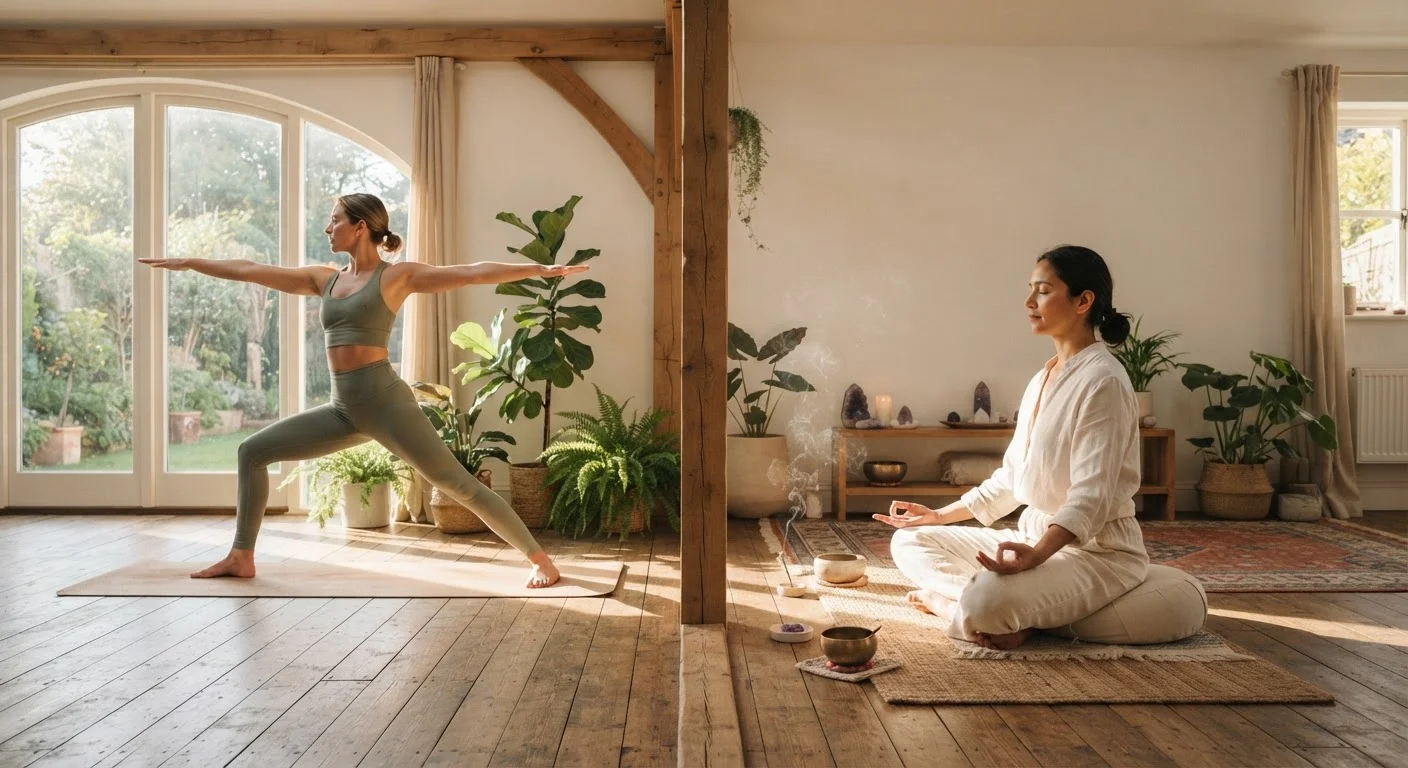
Option A
Active Movement (Yoga & Mindful Motion)
The embodied, kinesthetic path to awareness.
Best for: Those who learn through the body first — building focus, flexibility, and nervous system regulation through intentional physical practice.
Option B
Still Awareness (Seated Meditation & Contemplation)
The quiet, observational path to inner clarity.
Best for: Those seeking to cultivate deep attention, emotional equanimity, and a stable relationship with their own thoughts and sensations.
What Each Practice Actually Does
Active movement practices — principally yoga, but also Tai Chi and Qigong — use coordinated breath and intentional physical posture to engage the body's neuromuscular system while simultaneously cultivating present-moment awareness. The movement itself is the meditation object. Practitioners track sensation, breath rhythm, and alignment rather than abstract thought, creating a form of embodied mindfulness that is particularly accessible for people who find stillness uncomfortable early in their practice.
Still awareness practices — seated meditation, body-scan techniques, loving-kindness, and breath-focused contemplation — ask the practitioner to remain physically quiet while directing attention inward. The nervous system gradually downregulates, and practitioners develop what contemplative traditions call metacognitive awareness: the capacity to observe thoughts and emotions without being captured by them. Explore the major meditation traditions to understand the wide range of approaches available within this category.
Both practices share a foundational goal — greater self-awareness and reduced reactivity — but they reach it through different entry points. Movement addresses the body first; stillness addresses attention directly. Understanding this distinction helps practitioners make deliberate choices rather than defaulting to whichever feels easier.
The Case for Active Movement
Yoga and mindful movement offer a compelling on-ramp into contemplative practice because the body provides constant, tangible feedback. A practitioner noticing tension in the shoulders during Warrior II receives immediate, grounded information about their present state — no abstract philosophical framework required. This makes active movement especially valuable for beginners, for those recovering from sedentary patterns (see how even modest movement shifts health outcomes), and for anyone whose stress tends to manifest physically as muscle tension or shallow breathing.
Research in exercise physiology and psychoneuroimmunology consistently associates regular moderate physical movement with improved mood, better sleep architecture, and reduced markers of physiological stress — though the precise mechanisms and individual variation remain active areas of study. Yoga specifically has been studied for its effects on the autonomic nervous system, with some evidence pointing toward a shift toward parasympathetic dominance following consistent practice.
| Criterion | Active Movement | Still Awareness |
|---|---|---|
| Primary entry point | Physical body and breath | Attention and cognition |
| Accessibility for beginners | High — tangible, immediate feedback | Moderate — requires patience with discomfort |
| Nervous system effect | Regulated arousal, parasympathetic support | Deep downregulation, sustained calm |
| Emotional regulation | Indirect, via body awareness | Direct, via metacognitive observation |
| Physical health benefits | Strength, flexibility, circulation | Modest; primarily cognitive and emotional |
| Time required | Typically 20–60 minutes per session | Effective in 5–20 minutes daily |
| Equipment or space needed | Mat, comfortable clothing, open floor space | A chair or cushion; minimal setup |
| Best combined with | Seated meditation to consolidate focus | Movement to prepare the body and mind |
Movement practice also builds interoceptive awareness — sensitivity to internal bodily states — which is increasingly recognized as foundational to emotional regulation. Practitioners who develop this capacity often find seated meditation becomes more productive over time, because they can locate and work with physical sensations that previously went unnoticed.
The Case for Still Awareness
Seated meditation asks something of practitioners that movement cannot fully replicate: the willingness to remain with experience as it is, without changing it. This is where genuine attentional training occurs. Research on mindfulness-based interventions — including Mindfulness-Based Stress Reduction (MBSR) and Mindfulness-Based Cognitive Therapy (MBCT) — has demonstrated associations with reduced rumination, improved emotional regulation, and changes in brain regions involved in attention and self-referential thinking. These findings should be read as promising rather than definitive, as study methodologies vary considerably.
Still awareness practice is also uniquely suited to working with habitual thought patterns. Because the body is quiet, the practitioner's relationship to mental content becomes the primary subject of inquiry. For those dealing with anxious thinking, repetitive worry, or difficulty with emotional reactivity, this direct engagement with the mind can offer insights that movement-based practice may not surface as efficiently. Learn more about the strengths and limits of these tools for emotional regulation.
~8 weeks
Duration for measurable attention improvements
Several MBSR clinical trials have observed meaningful changes in self-reported stress and attention measures after approximately eight weeks of consistent practice.
~65%
Adults reporting stress reduction from yoga
A national survey by Yoga Alliance and Yoga Journal found a majority of yoga practitioners cited stress relief as a primary motivating benefit.
2-in-1
Mind-body benefits from integrated sequencing
Practitioners who combine movement and seated stillness in one session report engagement of both physical and attentional dimensions within a single practice window.
It is worth noting that some people find prolonged stillness dysregulating rather than calming, particularly those with trauma histories or certain anxiety presentations. This is not a failure of the practice — it is important clinical information. Anyone experiencing distress during meditation is encouraged to speak with a qualified mental health professional before continuing.
Building a Practice That Integrates Both
The most durable mind-body routines tend to use movement and stillness in sequence rather than treating them as alternatives. A common and well-supported approach involves beginning with active movement — yoga, stretching, or movement-based meditation forms like Qigong or walking meditation — to discharge physical restlessness and begin narrowing attention, then transitioning into a period of seated stillness while the nervous system is already primed.
Structuring a morning routine that integrates both practices is one practical way to explore this sequencing. Even ten minutes of mindful movement followed by five minutes of seated breath awareness can build meaningful consistency over weeks and months.
Tracking genuine progress matters too. Rather than measuring flexibility gains or minutes logged, look for subtler indicators: steadier reactions to daily stress, improved sleep, or a growing ability to notice emotional states before acting on them. Signs that your mind-body practice is actually working can help you calibrate realistic expectations.
Finally, balance is not a fixed ratio. Life phases — high work demand, illness, grief, new parenthood — appropriately shift how much movement versus stillness a practice contains. Flexibility in the practice structure is itself a form of mindfulness.
This article is for general informational and educational purposes only and does not constitute medical advice. Consult a qualified healthcare professional before beginning any new physical or mental health practice, particularly if you have an existing health condition.
The content on this site is for informational purposes only and is not a substitute for professional advice. Always consult a qualified professional for guidance specific to your situation.