

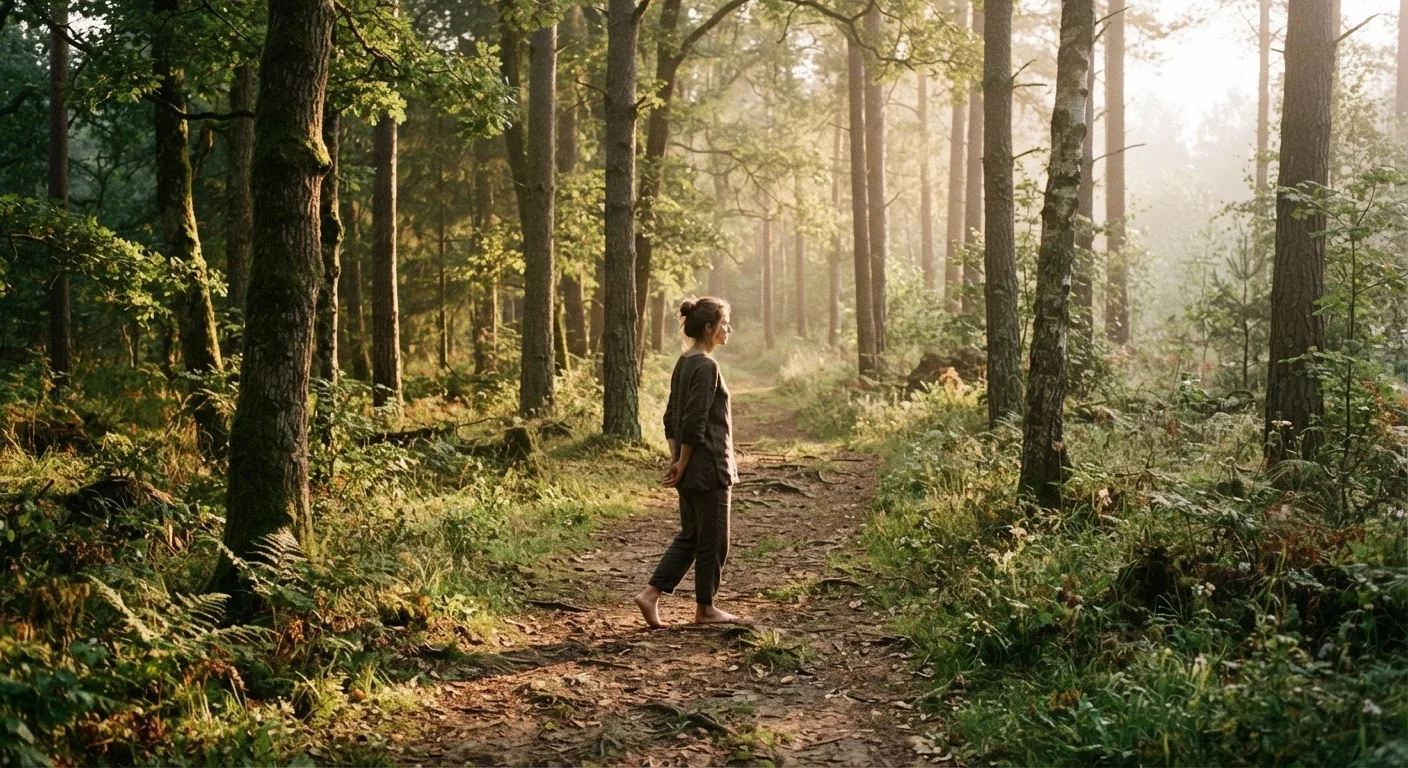
Why Movement Can Be the Meditation
For many people, the instruction to "sit still and clear your mind" creates more tension than it relieves. If that resonates, you are not broken — you may simply be better suited to a different entry point into meditative awareness. Starting a meditation practice when your mind won't sit still is a challenge shared by a significant portion of practitioners, and movement-based forms exist precisely to meet that challenge.
Movement meditation is not a shortcut or a compromise. Traditions including Zen Buddhism, Taoist practice, and mindfulness-based clinical frameworks all recognize conscious movement as a vehicle for the same qualities cultivated in seated practice: sustained attention, present-moment awareness, and a calmer relationship to thought and sensation. The body becomes the anchor, and the shifting experience of walking, flowing, or breathing with movement becomes the object of focus.
This article introduces five well-documented movement-based meditation forms, how each works, and who tends to benefit most from each approach. For a broader look at how these traditions compare, see how yoga, Tai Chi, and Qigong approach mind-body connection.
Walking Meditation (Mindfulness-Based)
Rooted in Buddhist Vipassana tradition and widely incorporated into secular mindfulness programs, walking meditation transforms an ordinary activity into a structured practice of attention. Practitioners typically walk slowly — far more slowly than everyday pace — in a small area or designated path, directing awareness to the precise sensations of each step: the heel lifting, the foot traveling, the sole making contact with the ground.
Attention is not fixed on a destination. When the mind wanders, practitioners gently return focus to the physical sensations of walking. Some teachers layer breath awareness alongside footfall; others work with internal labeling (silently noting "lifting, moving, placing"). Research in clinical mindfulness contexts suggests walking meditation may support stress reduction and mood regulation, though findings vary and more large-scale studies are ongoing.
Best suited for: Beginners who find seated practice frustrating, individuals with back or joint discomfort from prolonged sitting, and practitioners seeking a bridge between formal sitting and everyday mindfulness.
Walking meditation turns each footstep into a deliberate act of present-moment awareness.
Qigong
Qigong (pronounced "chee-gong") is a Chinese mind-body practice with roots in Taoist philosophy and traditional Chinese medicine. It combines slow, intentional movement sequences with coordinated breathing and focused internal attention — often on the concept of qi (life energy) and its flow through the body. Sequences vary widely: some are done standing, some seated, and some in a walking pattern.
Unlike aerobic exercise, Qigong emphasizes softness, continuity, and inward attention over physical exertion. Many styles involve repetitive, flowing movements performed with a quality of relaxed alertness. A growing body of peer-reviewed research — including systematic reviews published in journals such as The Journal of Alternative and Complementary Medicine — suggests Qigong practice may support balance, stress response, and quality of life in various populations, though evidence quality remains mixed and individual results differ.
Best suited for: Older adults, those recovering from illness, people interested in East Asian philosophy, and practitioners seeking a low-impact daily movement ritual.
Qigong pairs flowing movement with breath and inward attention, emphasizing softness over exertion.
Kinhin (Zen Walking Meditation)
Kinhin is the formal walking meditation of Zen Buddhism, traditionally practiced between periods of seated meditation (Zazen). Practitioners move in a slow, clockwise circle, often holding hands clasped at the chest, stepping forward incrementally — typically advancing one full step per complete breath cycle. The pace can vary by lineage, from extremely slow to a brisker, more energized walk.
The meditative quality of Kinhin comes from maintaining the same quality of mind cultivated in Zazen: alert, non-grasping presence. Movement is not a break from meditation but a continuation of it in a different physical form. Attention rests on breath, posture, and the physical sensation of movement simultaneously.
Best suited for: Practitioners with existing Zen or seated meditation experience, those interested in embodied continuity of practice, and people who find that even brief periods of movement help them re-enter deeper stillness afterward.
In Kinhin, walking is not a break from Zen meditation — it is the meditation continued in motion.
Mindful Yoga (Asana as Meditation)
While yoga asana (physical postures) is often practiced as exercise, it can be approached as movement meditation when taught and practiced with meditative intent. This means moving between postures slowly and attentively, synchronizing breath with movement, and directing awareness inward rather than toward appearance or performance.
Styles such as Yin Yoga, slow Hatha, and trauma-sensitive yoga sequences are particularly compatible with a meditative frame. The practitioner treats each posture as an opportunity to observe sensation, breath, and the quality of attention — returning awareness to the present moment whenever the mind drifts, just as in seated practice. For those interested in how breath deepens this process, pranayama-informed techniques for deeper stillness offer useful complementary tools.
Best suited for: Yoga practitioners wishing to deepen the meditative dimension of their existing practice, individuals drawn to embodied awareness, and those who benefit from clear physical structure during meditation.
When asana is practiced with meditative intent, every posture becomes an anchor for present-moment awareness.
Labyrinth Walking
Labyrinth walking is a contemplative practice with cross-cultural roots found in traditions ranging from medieval Christian pilgrimage to Indigenous ceremonial contexts. A labyrinth — unlike a maze — has a single, winding path that leads to the center and back out again, removing the cognitive task of navigation and freeing attention for inward reflection.
Practitioners walk the path at their own pace, often without a prescribed technique, allowing whatever thoughts, feelings, or sensations arise to simply be present. Some use the walk with a specific intention or question in mind; others approach it as open awareness practice. Labyrinths are found in hospitals, retreat centers, parks, and religious sites across the US, and portable canvas versions exist for indoor use.
Best suited for: Those drawn to ritual or symbolic practice, people processing grief or significant life transitions, and practitioners who benefit from externally bounded structure without rigid technique requirements.
A labyrinth's single winding path removes navigational effort, freeing the mind for pure inward attention.
Finding Your Moving Practice
None of these forms requires prior athletic ability or meditation experience. Most are learnable at any age and adaptable for different physical capacities, though anyone managing a chronic condition, injury, or balance concern should consult a qualified healthcare professional before beginning. A trained instructor — whether in person or through a reputable program — can make a meaningful difference in learning correct alignment and technique safely.
Start With Short, Consistent Sessions
When beginning any movement-based practice, shorter sessions practiced regularly tend to be more effective than occasional long ones. Even ten to fifteen minutes of intentional walking or Qigong several times a week can build the attentional habit over time. Prioritize quality of attention over duration, and increase gradually as the practice becomes familiar.
If you already have a seated or breath-based practice, movement forms pair naturally rather than compete. Understanding the distinct roles of active movement and still awareness can help you decide how to balance both within a cohesive routine. And for those building from scratch, building a unified yoga and meditation practice from the ground up offers a practical framework for integrating movement and stillness together.
This article is for general informational and educational purposes only and does not constitute medical advice. Always consult a qualified healthcare provider before beginning a new movement or meditation practice, particularly if you have any existing health conditions.
The content on this site is for informational purposes only and is not a substitute for professional advice. Always consult a qualified professional for guidance specific to your situation.