

Why Sequencing Matters in a Combined Practice
Yoga and meditation are complementary disciplines, but placing them in the right order — and allowing adequate transitions between them — is what transforms a collection of good habits into a coherent practice. Movement prepares the nervous system and body for stillness; breathwork bridges the two. Without this intentional sequencing, practitioners often report feeling either too activated to meditate after vigorous yoga, or too stiff and distracted when meditating without any prior movement.
The classic structure used across many yoga traditions moves from gross (body) to subtle (breath) to subtler still (awareness). This isn't arbitrary — it reflects how the human nervous system naturally calms and focuses. Understanding the distinct roles of each phase also helps you adapt intelligently on days when time or energy is limited. For a thorough look at how much yoga versus meditation should feature in your overall routine, see balancing active movement and still awareness.
Consult a Professional Before Starting
This article provides general educational information, not medical advice. If you have any health conditions, injuries, or concerns about starting a new physical or contemplative practice, please consult a qualified healthcare provider before beginning. Special care is advised for those who are pregnant, elderly, or managing chronic conditions.
What you will need
Yoga Mat
Provides a stable, cushioned surface for movement and seated meditation.
Meditation Cushion or Folded Blanket
Supports an upright seated posture during breathwork and meditation phases.
Timer or Meditation App
Keeps each phase of the routine to its intended duration without clock-watching.
Journal or Notebook
Optional for brief post-meditation reflection or intention-setting at the close of practice.
Step-by-Step Morning Practice
The following steps outline a repeatable morning structure that works for most experience levels. The total time can range from 20 to 45 minutes depending on how long you spend in each phase. Adjust segment lengths as needed, but try to preserve the order — it is the sequence, not the duration, that creates the most benefit.
Set your space and intention before you begin
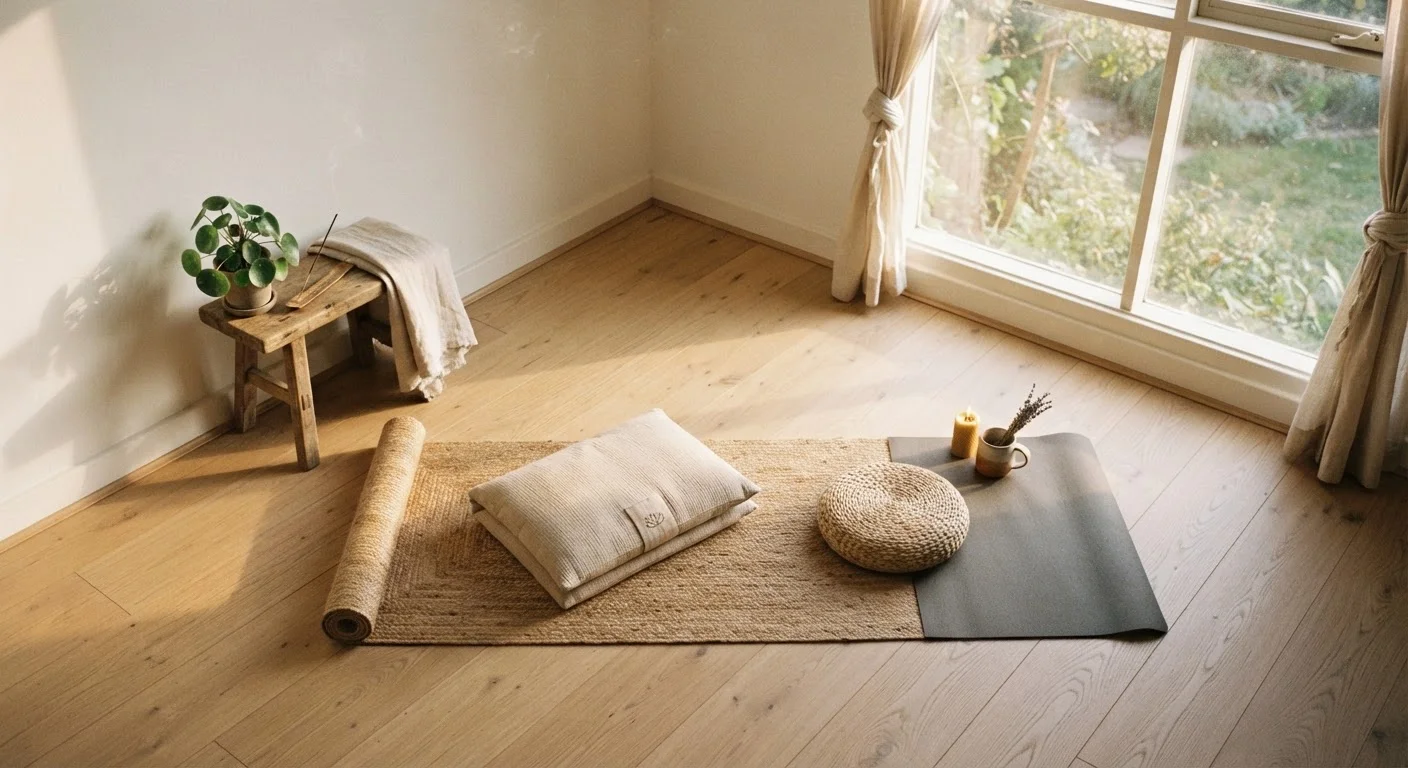
Before touching your mat, take 60 seconds to prepare your environment. Dim harsh lights, open a window if weather allows, and remove obvious distractions — phone notifications, cluttered surfaces, anything that signals the workday. A consistent, low-stimulus environment helps the nervous system shift into a receptive state more quickly. For practical guidance on creating a dedicated space, see setting up a home meditation space. Then sit quietly for a moment and set a loose intention: not a goal, but a quality you'd like to bring to the day — steadiness, patience, clarity.
Open with 5 minutes of seated breathwork (Pranayama)
Begin in a comfortable seated position — cross-legged on a cushion or in a chair with feet flat on the floor. Spend the first minute simply observing your natural breath without changing it. Then shift to a deliberate technique: a basic ratio breath (inhale for 4 counts, exhale for 6 counts) is accessible for most people and gently activates the parasympathetic nervous system. Maintain this for 3–4 minutes. Pranayama — the yogic practice of breath regulation — serves as a bridge between sleep physiology and alert wakefulness. Starting here, rather than jumping straight into movement, primes the body and mind for what follows. For a broader overview of breathwork styles, explore the Yoga Fundamentals hub.
Move through a structured yoga sequence (10–25 minutes)
After breathwork, transition to your movement phase. A well-structured sequence typically follows this arc: warm-up (spinal mobility, gentle joint circles), building postures (standing poses, strength-oriented shapes), and cooling down (forward folds, supine stretches). The length of this phase depends on your available time — even 10 focused minutes is effective. Choose poses that match your morning energy rather than forcing a challenging practice when your body is still waking up. For help structuring this segment, see our guide on building a morning yoga sequence. Always close the movement phase with at least 2 minutes in Savasana (lying flat, fully relaxed). Skipping this rest is more costly than it appears — learn why Savasana matters.
Transition mindfully into seated meditation (5–10 minutes)
After Savasana, slowly bring yourself up to a seated position. Pause for a full minute in stillness before formally beginning meditation — this transition moment is often overlooked but is critical for continuity of awareness. Once seated, choose a meditation style suited to your goals: breath-focused awareness, body scan, or open monitoring (non-directive awareness of whatever arises). Set a timer so you are not preoccupied with time. Research in contemplative neuroscience suggests that even brief, consistent meditation sessions may support attentional regulation and emotional balance over time, though individual results vary. For a deeper look at different meditation techniques, explore the Meditation Practices hub.
Close with a brief reflection and transition ritual
End the session with 1–2 minutes of deliberate closing. You might silently revisit the intention you set at the start, take three slow breaths, or write a single sentence in a journal. This closing ritual marks the boundary between practice and the rest of your day — without it, the benefits of stillness can dissipate quickly once external demands arrive. Avoid checking your phone immediately after practice. Give yourself at least 5 minutes before re-engaging with screens or news.
Avoid Forcing Stillness After Intense Movement
Transitioning abruptly from vigorous yoga to deep meditation can create tension rather than calm. Always include a wind-down phase — such as Savasana or gentle seated stretching — before moving into formal meditation. Rushing this transition is one of the most common mistakes in combined practices.
Start Smaller Than You Think You Should
If you're new to combined practice, begin with just 5 minutes of breathwork, 10 minutes of movement, and 5 minutes of seated stillness. Sustainable habits are built through repetition, not ambition. You can expand duration once the structure feels natural.
For readers who are entirely new to combining these practices, building a unified yoga and meditation practice from the ground up offers a thorough starting framework. If you're also interested in how other morning habits can complement this practice, morning routine habits that set an active tone for the day is worth reading alongside this guide.
This article is for general informational and educational purposes only and does not constitute medical advice. Always consult a qualified healthcare professional before starting any new physical or wellness practice, particularly if you have existing health conditions.
The content on this site is for informational purposes only and is not a substitute for professional advice. Always consult a qualified professional for guidance specific to your situation.