

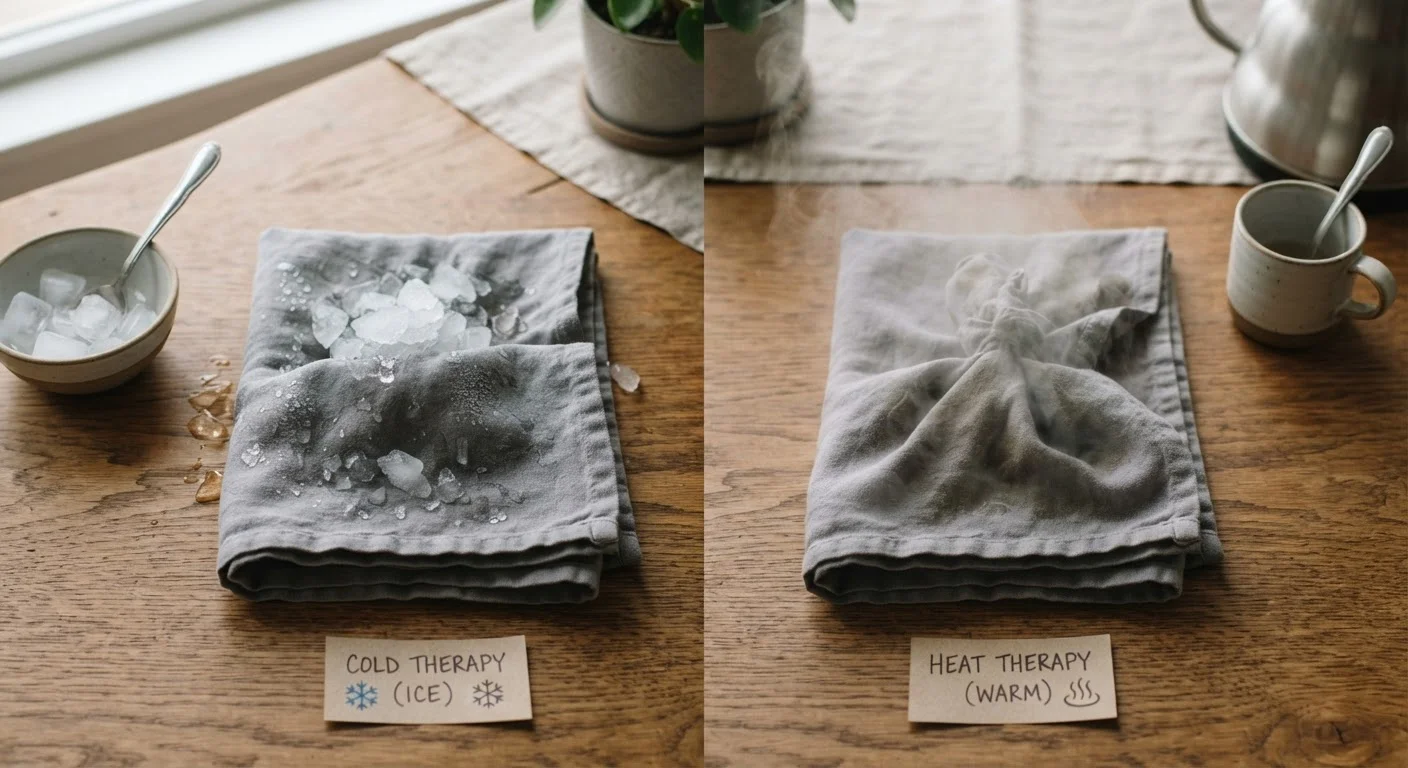
Option A
Cold Compress
The acute-injury first responder.
Best for: Best for fresh injuries, acute swelling, bruising, and localized inflammation in the first 24–72 hours.
Option B
Warm Compress
The tension-relief and chronic-pain soother.
Best for: Best for muscle stiffness, chronic aches, tension, and improving flexibility before activity.
How Each Compress Affects the Body
Cold and warm compresses work through fundamentally different physiological mechanisms, which is why using the wrong one at the wrong time can actually worsen discomfort rather than ease it.
Cold compresses trigger vasoconstriction — the narrowing of blood vessels near the skin's surface. This slows blood flow to the affected area, limits the release of inflammatory chemicals, and reduces swelling. Cold also slows nerve conduction velocity, which is why it produces a numbing effect that can blunt acute pain signals. This is the basis of cryotherapy, widely used in sports medicine for acute soft-tissue injuries.
Warm compresses produce the opposite effect: vasodilation, or the widening of blood vessels. Increased circulation brings oxygen and nutrients to tired or tense tissue, helps clear metabolic byproducts from muscle, and promotes relaxation of muscle fibers and connective tissue. Heat also stimulates sensory receptors that can compete with and reduce the perception of chronic, dull pain — a phenomenon explained in part by the gate control theory of pain.
| Criterion | Cold Compress | Warm Compress |
|---|---|---|
| Primary mechanism | Vasoconstriction; reduces blood flow | Vasodilation; increases blood flow |
| Effect on swelling | Reduces acute swelling | May worsen acute swelling if used too early |
| Effect on muscle tension | Minimal to none | Relaxes muscle fibers and stiffness |
| Pain relief type | Numbs sharp, acute pain | Soothes dull, chronic aching |
| Best timing | First 24–72 hours post-injury | After inflammation subsides; chronic pain |
| Common materials | Ice pack, frozen peas, cold cloth | Warm towel, heating pad, warm water bottle |
| Key risk if misused | Frostbite or skin damage | Burns or worsened acute swelling |
For a broader look at how these mechanisms fit into a holistic strategy, see Holistic Pain Management: A Beginner's Overview of Natural Approaches.
When to Use Each — Practical Guidance
The single most useful rule of thumb in compress therapy is timing relative to injury onset. Most clinical guidance supports cold therapy in the first 24 to 72 hours following an acute injury such as a sprain, strain, or bruise. After that initial window — once active inflammation has subsided — warmth typically becomes more beneficial for recovery.
Cold Compress: Appropriate Scenarios
- Fresh sprains, strains, or muscle tears
- Acute joint swelling or post-exercise soreness within the first day
- Bruising or blunt-trauma injuries
- Headaches localized to the temples or forehead
- Active inflammatory flare-ups (e.g., gout or inflamed bursae — but always confirm with a clinician)
Warm Compress: Appropriate Scenarios
- Chronic muscle tension, especially in the neck, shoulders, or lower back
- Stiffness from conditions such as osteoarthritis (note: individual responses vary)
- Delayed-onset muscle soreness (DOMS) more than 48 hours after exercise
- Preparing stiff joints or muscles before gentle movement or stretching
Contrast Therapy: Alternating Hot and Cold
Some practitioners use alternating cold and warm applications — known as contrast therapy — to stimulate circulation and reduce post-exercise soreness. While this approach has a long tradition in sports recovery, the scientific evidence is mixed and the technique is not appropriate for acute injuries. Anyone considering contrast therapy should seek guidance from a physical therapist or sports medicine professional before trying it.
If you exercise regularly, understanding how warmth fits into your broader routine matters. The article Warming Up and Cooling Down at Home: What Actually Matters explores how thermal preparation and recovery fit together.
Safe Application and Important Cautions
Both modalities are generally safe for most adults when applied correctly, but misuse carries real risks including frostbite, burns, and worsening of underlying conditions.
General Safety Guidelines
- Always use a barrier: Wrap ice packs or heat packs in a thin cloth or towel — never apply directly to bare skin.
- Limit application time: Most sources recommend sessions of 15 to 20 minutes, with adequate rest time between applications.
- Check the skin regularly: Remove the compress if skin becomes excessively red, white, blistered, or numb.
- Avoid use over open wounds, rashes, or areas with reduced sensation (common in peripheral neuropathy or diabetes).
People with circulatory conditions, diabetes, Raynaud's phenomenon, or skin sensitivities should consult a healthcare provider before using compress therapy of any kind. The same applies to pregnant individuals and older adults, whose skin may be more vulnerable to temperature extremes.
For those interested in complementary natural approaches to pain, Natural Compounds Studied for Pain Relief: What the Research Actually Shows provides a research-grounded overview of herbal and plant-based options.
This article is for general informational and educational purposes only and does not constitute medical advice. Always consult a qualified healthcare professional before beginning any new treatment or if you have any concerns about your health condition.
The content on this site is for informational purposes only and is not a substitute for professional advice. Always consult a qualified professional for guidance specific to your situation.