

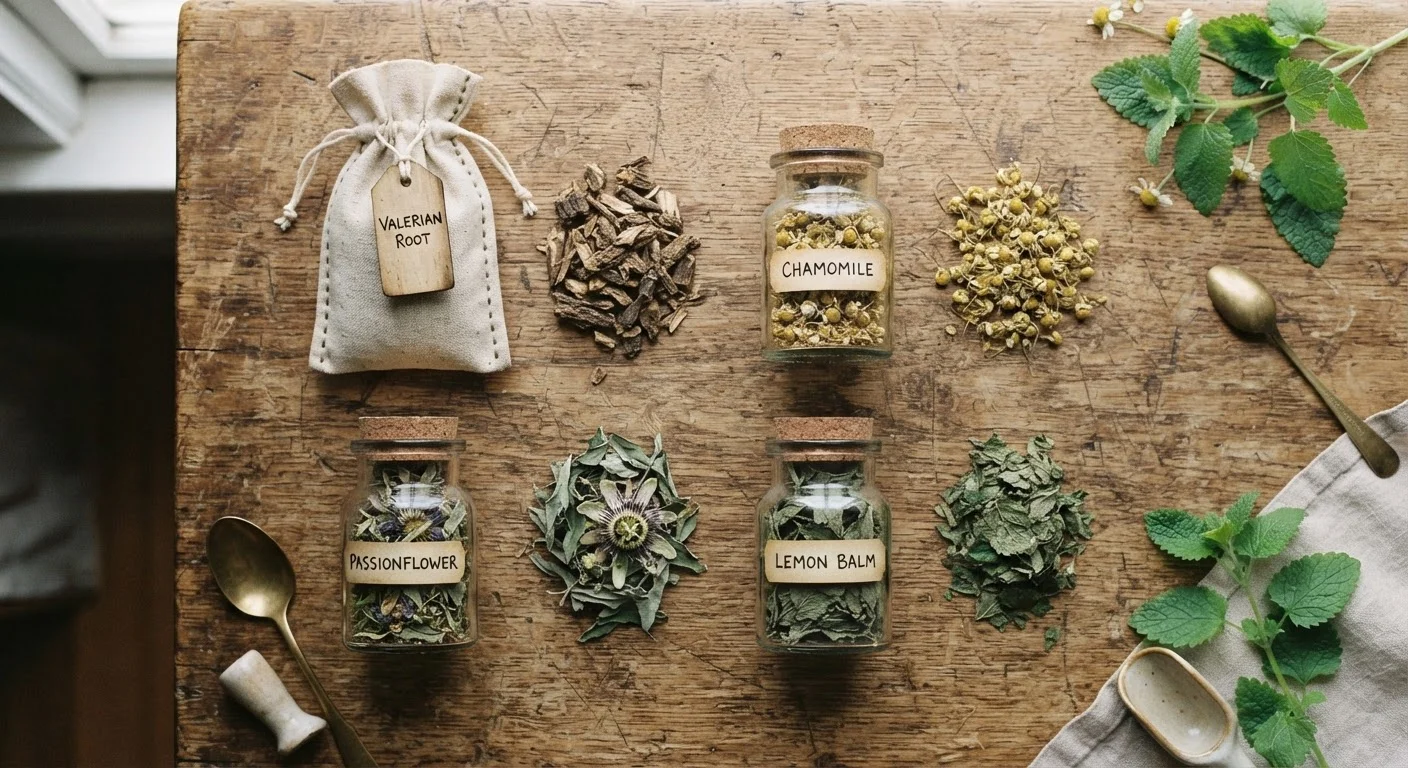
Why Herbs and Sleep Research Go Hand in Hand
Poor sleep is one of the most commonly reported health concerns in the United States, and many adults turn to natural options before — or alongside — conventional interventions. Certain herbs have been used across cultures for centuries to encourage relaxation and ease the transition into sleep. Modern researchers have begun examining these traditional claims, producing a growing (if still developing) body of evidence.
Understanding what that research actually shows — and where its limits lie — helps readers make more informed choices. The herbs featured here are among those most frequently studied in clinical and preclinical settings. This is general health education, not medical advice; always consult a qualified healthcare professional before adding any herbal supplement to your routine, particularly if you take medications or have an existing health condition. For a broader view of how herbs intersect with relaxation and stress, see our overview of herbs studied for stress and anxiety.
Valerian Root (Valeriana officinalis)
Valerian is arguably the most extensively studied herbal candidate for sleep support in Western research. Several randomized controlled trials have examined its effects on sleep onset and quality, with findings that are promising but inconsistent. Some studies report modest improvements in subjective sleep quality and reduced time to fall asleep, while others find no significant difference from placebo.
Researchers believe valerian may interact with gamma-aminobutyric acid (GABA) receptors — the same pathways targeted by some conventional sleep medications — though the exact mechanisms are not fully established. Because findings are mixed, it is premature to call valerian definitively effective, but it remains one of the better-studied options available.
Valerian is one of the most studied herbal sleep aids, though its evidence base remains mixed.
Passionflower (Passiflora incarnata)
Passionflower has a long history of use in traditional North American and European herbal medicine for anxiety and restlessness. Preliminary research — including at least one small randomized trial — suggests it may support sleep quality, with participants reporting improved sleep scores compared to placebo. Like valerian, passionflower is thought to influence GABA activity in the brain.
The overall evidence base for passionflower is still limited. Most studies are small, and robust large-scale trials are lacking. It is sometimes combined with other herbs such as valerian or lemon balm in commercial formulations, which makes it difficult to isolate its individual contribution in mixed-formula research.
Passionflower shows early promise for sleep quality, but large-scale evidence remains limited.
Lemon Balm (Melissa officinalis)
Lemon balm is a member of the mint family that has been used since ancient times to ease nervous tension and promote calm. Several studies, often conducted in combination with valerian or other herbs, have suggested that lemon balm may help reduce anxiety-related sleep disturbances. A handful of studies using lemon balm alone have shown modest positive effects on mood and relaxation that could indirectly support sleep.
As with many herbal studies, methodological limitations — including small sample sizes and short durations — mean conclusions should be tentative. Lemon balm is generally considered well-tolerated in healthy adults, though individual responses vary.
Lemon balm may reduce anxiety-related sleep disturbances, though study designs limit firm conclusions.
Chamomile (Matricaria chamomilla)
Chamomile tea is one of the most widely consumed herbal preparations for winding down before bed. Its reputation for promoting relaxation is supported by a modest body of research. The compound apigenin, found in chamomile, is believed to bind to benzodiazepine receptors in the brain — potentially contributing to mild sedative effects.
Clinical trials specifically on chamomile and sleep have shown encouraging results for sleep quality in specific populations, including older adults and postpartum women, though sample sizes have been small. Chamomile is broadly considered safe for most adults, though those with ragweed allergies should be aware of potential cross-reactivity. For a deeper dive into chamomile alongside other botanicals, explore our research-grounded overview of stress and anxiety herbs.
Chamomile's apigenin content may support mild sedation, with encouraging findings in small clinical trials.
Lavender (Lavandula angustifolia)
Lavender is most commonly studied as an aromatherapy agent rather than an oral supplement for sleep. Multiple studies — including some conducted in clinical settings such as intensive care units and general wards — have found that lavender inhalation may improve subjective sleep quality and reduce nighttime wakefulness. The mechanism is thought to involve the nervous system's response to inhaled linalool, one of lavender's primary active compounds.
An oral lavender preparation has also been studied and shown promise for anxiety in some European trials, though its regulatory status and availability differ between countries. Lavender aromatherapy is one of the more accessible and well-tolerated approaches, though effects are generally subtle. Pairing it with broader evidence-informed evening wind-down rituals may enhance its usefulness.
Lavender aromatherapy has shown consistent modest improvements in subjective sleep quality across multiple studies.
Ashwagandha (Withania somnifera)
Ashwagandha is an adaptogenic herb rooted in Ayurvedic tradition and has gained significant research attention in recent years. While it is primarily studied for its effects on stress and cortisol levels, several trials have specifically measured sleep outcomes. A notable randomized controlled trial found that participants taking ashwagandha root extract reported improvements in sleep quality, sleep onset latency, and morning alertness compared to placebo.
The working hypothesis is that by modulating the stress response and cortisol regulation, ashwagandha may indirectly support more restorative sleep. Evidence quality is improving, but most trials are still relatively short and conducted in specific populations. As with all adaptogens, effects may vary significantly between individuals.
Ashwagandha may support sleep indirectly by modulating stress and cortisol levels.
Putting Herbal Sleep Aids in Context
The herbs reviewed here represent the most-researched candidates in the natural sleep space, but no herbal remedy has been definitively proven to treat insomnia as defined by clinical standards. Most studies involve small sample sizes, short durations, and subjective outcome measures like self-reported sleep quality — all of which limit the strength of conclusions that can be drawn.
Combine Herbal Support with Good Sleep Habits
Research consistently suggests that behavioral strategies — consistent sleep schedules, reducing light exposure in the evening, and limiting caffeine — form the foundation of good sleep. Herbal supplements may complement these habits but are unlikely to compensate for their absence. Consider exploring how diet and meal timing also influence sleep quality as part of a whole-picture approach.
Herbal supplements are also not regulated the same way pharmaceutical drugs are in the US, meaning potency and purity can vary between products. If you explore this area, working with a knowledgeable practitioner can help you navigate options more safely. For a complementary perspective, our overview of natural sleep aids including melatonin and magnesium covers additional commonly used supplements. Pairing any herbal approach with consistent evidence-informed sleep hygiene habits tends to yield more meaningful results.
This article is for informational and educational purposes only and does not constitute medical advice. It is not a substitute for professional medical evaluation, diagnosis, or treatment. Always seek the guidance of a qualified healthcare provider with any questions you may have regarding a medical condition or supplementation.
The content on this site is for informational purposes only and is not a substitute for professional advice. Always consult a qualified professional for guidance specific to your situation.