

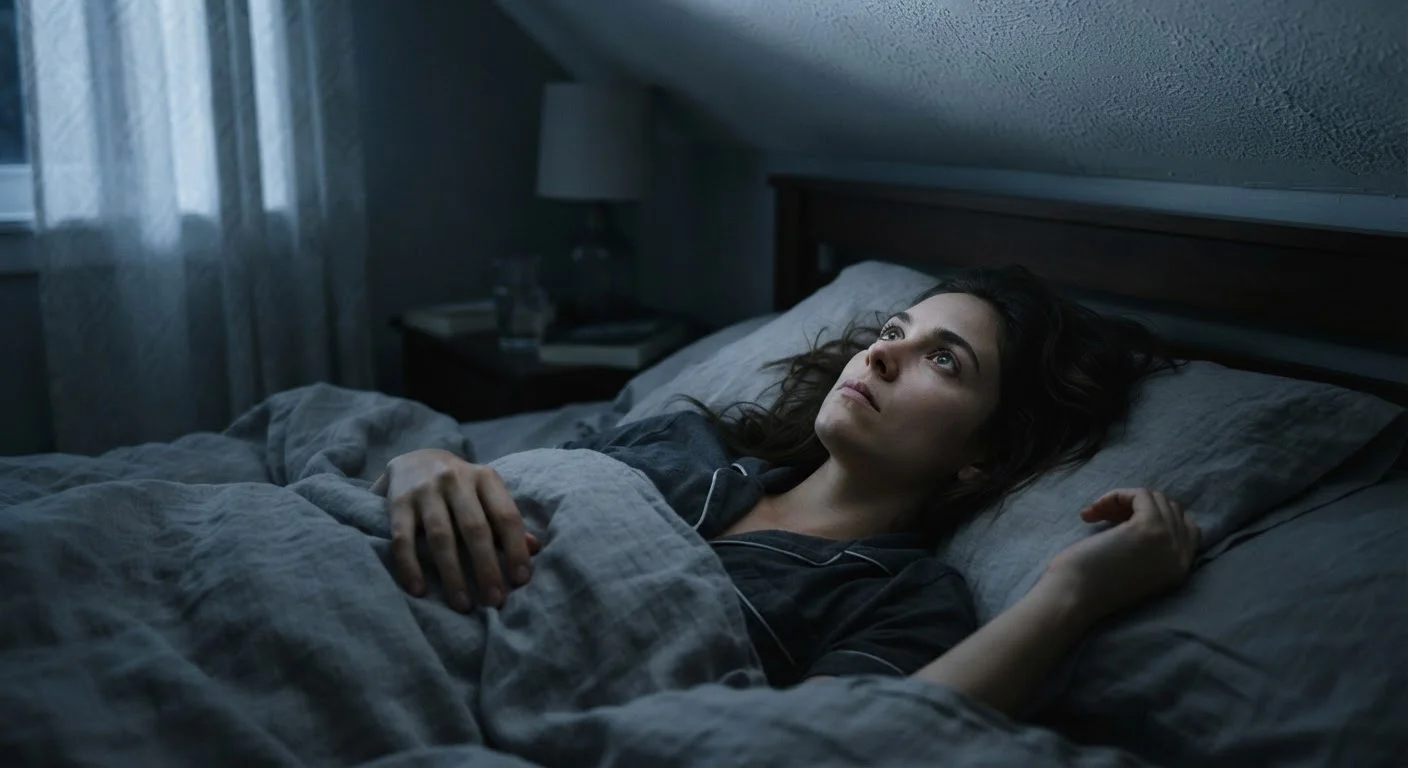
The Cycle That Compounds in the Dark
Most people understand that a stressful day can produce a restless night. What is less widely recognized is how chronic anxiety creates a self-sustaining loop that operates largely below conscious awareness — quietly eroding sleep quality over weeks and months, often long after the original stressor has passed.
The mechanism is rooted in the body's threat-response system. Chronic anxiety keeps the hypothalamic-pituitary-adrenal (HPA) axis — the hormonal pathway governing stress responses — in a state of low-grade activation. Elevated cortisol in the evening delays the natural drop in core body temperature and suppresses melatonin release, both of which are necessary signals for the brain to shift into sleep mode. The result is a nervous system that struggles to downshift at bedtime, regardless of how tired the person feels.
For a broader look at how stress physiology interacts with rest, see the bidirectional relationship between sleep and stress.
~40%
Adults with anxiety disorders reporting insomnia
Research published in peer-reviewed sleep medicine journals consistently finds that insomnia co-occurs in a substantial proportion of people with generalized anxiety disorder.
2–3×
Increased anxiety risk after chronic sleep loss
Studies in sleep science suggest that individuals with chronic sleep insufficiency face notably elevated risk of developing clinical anxiety symptoms compared to those with adequate rest.
70–80%
CBT-I response rate in clinical trials
Meta-analyses of Cognitive Behavioral Therapy for Insomnia report meaningful improvement in sleep onset, sleep duration, and daytime function in the majority of participants.
Hyperarousal: The Overlooked Driver
Clinicians often describe the core problem not as worry itself, but as hyperarousal — a state of elevated physiological and cognitive activation that makes the transition to sleep difficult and sleep architecture fragmented once it begins. People experiencing this often report lying in bed feeling exhausted but wired, or waking at 3 a.m. with a racing mind they cannot slow.
Hyperarousal has two dimensions that reinforce each other:
- Somatic hyperarousal: Elevated heart rate, muscle tension, shallow breathing, and heightened sensitivity to environmental stimuli like sound or light.
- Cognitive hyperarousal: Repetitive, intrusive thoughts — often rehearsing past events or anticipating future ones — that the prefrontal cortex struggles to suppress when fatigued.
Sleep deprivation makes both worse. A tired brain has reduced capacity to regulate the amygdala's threat signals, meaning tomorrow's worries feel more vivid and pressing tonight. This is why chronic stress and poor sleep are so difficult to separate — the biology overlaps almost entirely.
Evidence-Informed Approaches That Interrupt the Loop
Breaking the anxiety-sleep cycle requires addressing both sides simultaneously — calming the nervous system and rebuilding trust in sleep itself. The following approaches have meaningful research support:
Cognitive Behavioral Therapy for Insomnia (CBT-I)
CBT-I is consistently recommended by major sleep medicine bodies as a first-line intervention for chronic insomnia. It targets the thought patterns — such as catastrophizing about sleeplessness — and behavioral habits that perpetuate the cycle. Techniques include stimulus control (reserving the bed only for sleep) and sleep restriction therapy (temporarily consolidating sleep to rebuild drive). For a detailed comparison of approaches, see cognitive behavioral approaches versus sleep hygiene alone.
Diaphragmatic Breathing and Progressive Muscle Relaxation
Both techniques work by directly activating the parasympathetic nervous system — the body's rest-and-digest counterpart to the stress response. Slow, diaphragmatic breathing at around five to six breaths per minute has been shown in multiple studies to reduce heart rate variability markers associated with anxiety. Progressive muscle relaxation (systematically tensing and releasing muscle groups) addresses the somatic component of hyperarousal.
Daytime Anxiety Management
Addressing anxiety during waking hours — through structured worry time, mindfulness practice, or physical movement — reduces the accumulated arousal load that peaks at bedtime. It is worth reviewing daily habits that quietly undermine sleep quality to identify behaviors that may be amplifying the cycle without obvious signs.
Try a 'Worry Window' Before Bed
Set aside 15–20 minutes in the early evening — not close to bedtime — to write down current worries and one small action you could take for each. This practice externalizes anxious thoughts and gives the mind a sense of closure, reducing the likelihood that unresolved concerns will surface once the lights go out. Keeping a notepad by the bed for any stray thoughts that arise at night can reinforce the same effect.
This article is for general informational purposes only and does not constitute medical advice. If anxiety or sleep disruption is significantly affecting your daily functioning, please consult a qualified healthcare professional.
Frequently Asked Questions
Anxiety activates the body's fight-or-flight system, raising cortisol and adrenaline levels that keep the nervous system on high alert. This state of hyperarousal is physiologically incompatible with the relaxation needed to initiate sleep. The brain also tends to revisit unresolved worries at night when external distractions disappear.
Yes. Research consistently shows that even partial sleep deprivation increases activity in the amygdala — the brain's emotional alarm system — while reducing the prefrontal control that moderates worry. This means that insufficient sleep can generate or intensify anxiety independently of any external stressor.
Cognitive Behavioral Therapy for Insomnia (CBT-I) is a structured program that targets the thought patterns and behaviors — not just sleep hygiene habits — that perpetuate insomnia. It includes techniques like sleep restriction, stimulus control, and cognitive restructuring. Multiple clinical trials support it as a first-line treatment for chronic insomnia, including cases driven by anxiety.
Several evidence-informed lifestyle strategies can help, including diaphragmatic breathing, progressive muscle relaxation, consistent sleep-wake schedules, and reducing evening stimulant use. Mindfulness-based practices have also shown benefit in reducing pre-sleep cognitive arousal. These work best as part of a broader approach and do not replace professional care when needed.
There is no universal timeline, as individual responses vary widely. Structured approaches like CBT-I typically show meaningful improvement within four to eight weeks. Lifestyle changes may show gradual benefit sooner, but persistence matters — sporadic effort rarely interrupts a well-established cycle.
If sleep disruption or anxiety is affecting your work, relationships, or physical health — or has persisted for more than a few weeks — it is worth speaking with a qualified healthcare provider. A professional can rule out underlying conditions and help you access treatments with the strongest evidence base.
The content on this site is for informational purposes only and is not a substitute for professional advice. Always consult a qualified professional for guidance specific to your situation.