

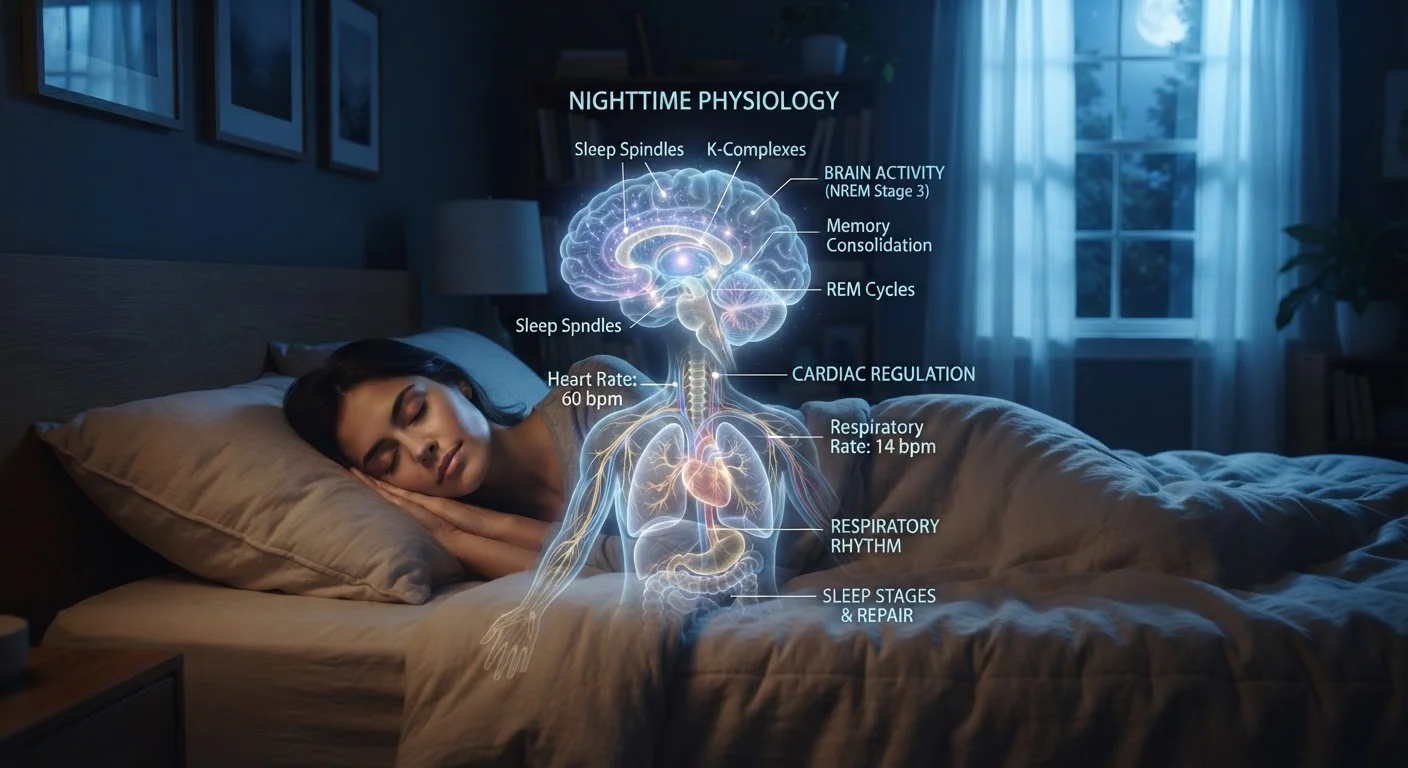
Sleep Is Active Biology, Not Passive Rest
Most people think of sleep as the body simply powering down. In reality, the moment you fall asleep, an intricate sequence of biological events begins. Heart rate slows, body temperature drops, and the brain shifts into patterns of electrical activity that support processes impossible to complete during wakefulness.
These events are organized into repeating sleep cycles, each containing distinct stages with different physiological roles. Understanding what those stages do — and why each matters — reframes sleep not as lost time, but as the foundation of physical and mental health. For a detailed breakdown of how each stage is defined, see Sleep Stages Decoded.
4–6
Sleep cycles completed each night
Each roughly 90-minute cycle contains both NREM and REM stages, each serving distinct physiological functions.
~70%
Of daily growth hormone released during deep sleep
Research indicates the largest single pulse of growth hormone secretion occurs during slow-wave sleep in the early part of the night.
2x
Higher infection risk with under 6 hours of sleep
A study published in Sleep found that individuals sleeping fewer than 6 hours per night were more than twice as likely to develop a cold when exposed to a rhinovirus compared to those sleeping 7 or more hours.
Tissue Repair and Hormonal Surges
Within the first hour or two of sleep, the body enters deep NREM sleep — specifically stage 3, often called slow-wave sleep. This is when the pituitary gland releases its largest daily pulse of growth hormone (HGH). Growth hormone signals muscles, bones, and connective tissue to repair micro-damage accumulated during the day.
Protein synthesis — the process of building and restoring cells — also accelerates during deep sleep. This is why athletes and physically active individuals who consistently shortchange sleep often experience slower performance gains and prolonged soreness. The repair work simply doesn't get done. For a thorough look at sleep's role in physical recovery, visit Your Complete Guide to Sleep and Physical Recovery.
Protect Your First Two Hours of Sleep
Deep slow-wave sleep — when growth hormone is released and cellular repair peaks — is most concentrated in the first half of the night. Going to bed at a consistent time helps ensure you don't miss this window. Even if total sleep time stays the same, delayed sleep onset can reduce the proportion of restorative deep sleep you receive.
The Brain Takes Out the Trash
One of sleep science's more striking recent findings involves the glymphatic system — a network of fluid-filled channels surrounding blood vessels in the brain. During sleep, cerebrospinal fluid circulates through this system, flushing out metabolic waste products that accumulate while the brain is active.
Among the waste cleared is beta-amyloid, a protein fragment that accumulates in the brains of people with Alzheimer's disease. While research is still evolving, the evidence that this clearing process depends on sleep has drawn significant scientific attention. The brain's cells appear to contract slightly during sleep, creating wider channels for fluid to flow — a mechanism that doesn't function as efficiently during wakefulness.
Memory, Emotion, and REM Sleep
REM (Rapid Eye Movement) sleep, which dominates the later cycles of the night, is closely tied to memory consolidation and emotional regulation. During REM, the hippocampus — a brain region central to memory — replays recent experiences and transfers information to longer-term cortical storage. This is why sleep after learning consistently improves recall compared to staying awake for the same period.
REM sleep also processes emotional experiences. The brain revisits emotionally significant events in a neurochemical environment with reduced levels of norepinephrine, a stress-related neurotransmitter. Researchers propose this allows the emotional tone of memories to be modulated — potentially explaining why we often feel more settled about upsetting events after a night's sleep.
The interplay between NREM and REM stages across the full night is explored in depth in The Science Behind Sleep Cycles and Why Deep Sleep Matters.
Immune Activity and Metabolic Regulation
The immune system is also highly active during sleep. Levels of certain cytokines — proteins that coordinate immune responses — rise during sleep, supporting the body's ability to fight infection and respond to inflammation. Studies have consistently found that people who sleep fewer hours are more susceptible to common infections, though this relationship is complex and influenced by many factors.
Metabolic regulation is similarly tied to sleep. Hormones governing appetite — particularly ghrelin and leptin — are calibrated during sleep. Sleep deprivation is associated with elevated ghrelin (which stimulates hunger) and reduced leptin (which signals fullness), a pattern that may contribute to increased caloric intake when sleep is chronically insufficient.
To explore what the research says about sleep and immune resilience specifically, see Sleep and Immune Function.
This article is for general informational purposes only and does not constitute medical advice. Consult a qualified healthcare professional for guidance on sleep disorders, health conditions, or any personal medical concerns.
Frequently Asked Questions
During sleep, the body repairs tissues, releases growth hormone, consolidates memories, and clears waste from the brain via the glymphatic system. The immune system also ramps up activity, producing cytokines that support defense and recovery. These processes are distributed across NREM and REM sleep stages.
Deep sleep — also called slow-wave sleep — triggers the largest nightly surge of growth hormone, which signals muscles and tissues to repair and rebuild. It also tends to be the most restorative stage for physical energy. Missing deep sleep can slow recovery from exercise and illness.
The glymphatic system is a brain-wide network of channels that flushes out metabolic byproducts, including proteins associated with neurodegeneration. Research suggests it is most active during sleep, particularly in non-REM stages, when brain cells appear to shrink slightly to allow fluid to flow more freely.
Yes. REM sleep appears to play a significant role in emotional processing. During REM, the brain replays emotionally significant experiences in a neurochemical environment low in stress hormones, which may help reduce the emotional charge of difficult memories. Insufficient REM is associated with heightened emotional reactivity.
Most adults complete four to six sleep cycles per night, each lasting roughly 90 minutes. Early cycles are weighted toward deep NREM sleep, while later cycles contain longer periods of REM. This is why cutting sleep short disproportionately reduces REM sleep.
Research suggests that while extra sleep on weekends may reduce short-term sleepiness, it does not fully restore all the cognitive and biological benefits of consistent nightly sleep. Irregular sleep timing can also disrupt circadian rhythms, creating further downstream effects on metabolism and alertness.
The content on this site is for informational purposes only and is not a substitute for professional advice. Always consult a qualified professional for guidance specific to your situation.