

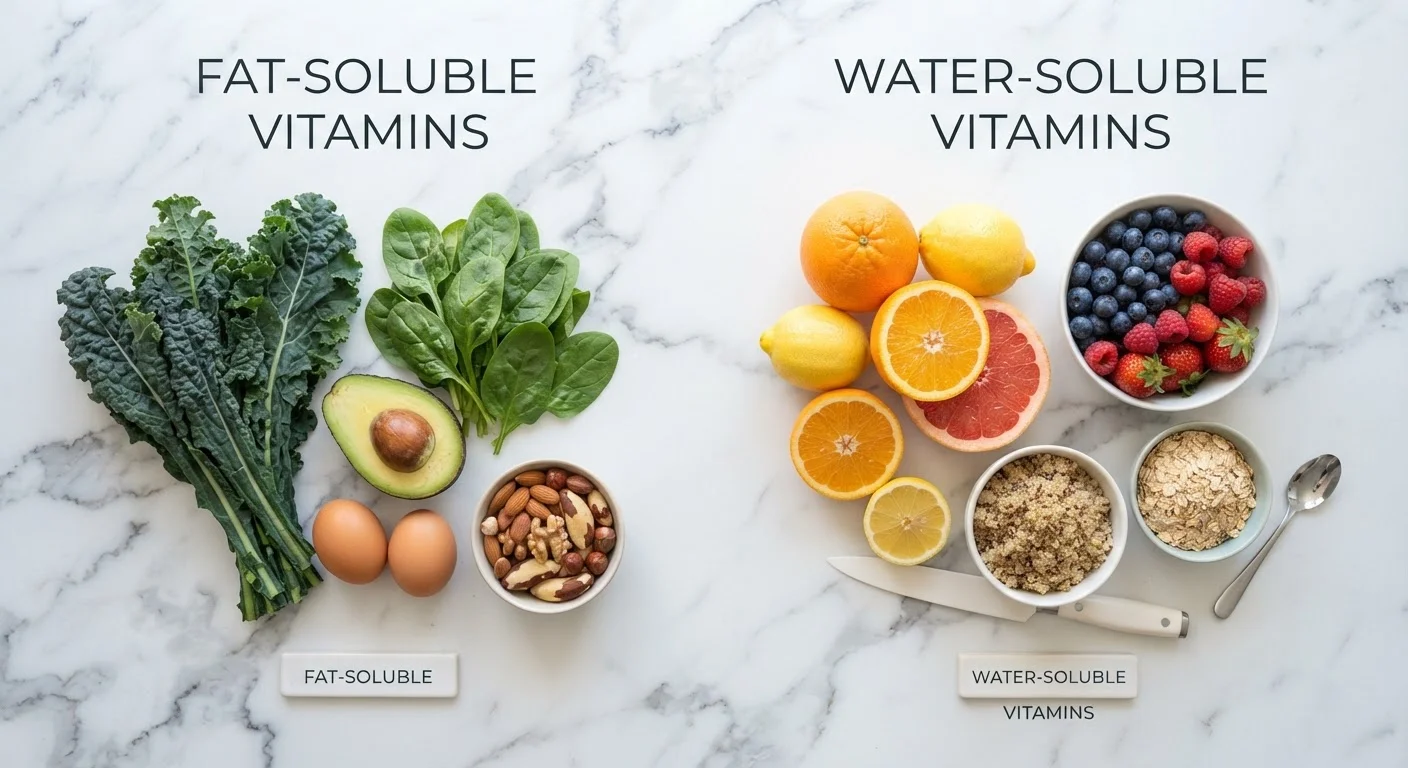
Option A
Fat-Soluble Vitamins
The slow-release, stored nutrients that work with dietary fat.
Best for: Long-term structural and immune functions that benefit from reserve storage in body tissue.
Option B
Water-Soluble Vitamins
The daily-replenishment vitamins that travel freely through the body.
Best for: Ongoing metabolic processes that require consistent daily intake from food.
The Core Distinction: How Each Group Moves Through Your Body
Every vitamin your body needs falls into one of two categories based on a single but consequential characteristic: whether it dissolves in fat or in water. This is not merely a chemistry footnote — it determines how a vitamin is absorbed, transported, stored, and potentially accumulated to harmful levels.
Fat-soluble vitamins — A, D, E, and K — require the presence of dietary fat in the digestive tract to be absorbed through the intestinal wall. They are then packaged into lipoproteins (structures that transport fats through the bloodstream), delivered to target tissues, and stored in adipose (fat) tissue and the liver. Because the body retains reserves, these vitamins do not need to be consumed every single day.
Water-soluble vitamins — the eight B vitamins (B1/thiamine, B2/riboflavin, B3/niacin, B5/pantothenic acid, B6, B7/biotin, B9/folate, and B12) plus vitamin C — dissolve directly in water and are absorbed straight into the bloodstream from the intestine. They travel freely in blood plasma. Excess amounts are generally filtered by the kidneys and excreted in urine, which means the body maintains only modest reserves and requires steady replenishment. See our guide to micronutrient gaps for an overview of which shortfalls are most common in everyday diets.
| Criterion | Fat-Soluble Vitamins | Water-Soluble Vitamins |
|---|---|---|
| Vitamins included | A, D, E, K | B1, B2, B3, B5, B6, B7, B9, B12, C |
| Absorption requirement | Requires dietary fat in the meal | Absorbed directly into bloodstream |
| Storage in body | Stored in fat tissue and liver | Minimal storage; excess excreted in urine |
| Intake frequency needed | Not required daily; reserves buffer intake | Regular daily intake recommended |
| Toxicity risk from excess | Higher risk, especially vitamins A and D | Lower risk, but not zero at high doses |
| Key dietary sources | Liver, fatty fish, eggs, seeds, leafy greens | Whole grains, legumes, citrus, leafy greens |
| Common deficiency concern | Vitamin D deficiency is widespread globally | B12 deficiency common in plant-based diets |
Absorption, Storage, and Toxicity: Why the Difference Matters Practically
The storage capacity of fat-soluble vitamins is both an advantage and a risk. On the benefit side, the liver can release stored vitamin D or vitamin A during periods of low dietary intake — a useful buffer. On the risk side, consistent high-dose supplementation can lead to accumulation that exceeds safe levels. Hypervitaminosis A (excess vitamin A) and hypervitaminosis D are documented clinical conditions linked to liver damage, bone loss, and other serious effects. Vitamins E and K carry lower toxicity risk but are not without concern at very high doses.
Water-soluble vitamins, by contrast, have a narrower window for toxicity under normal dietary conditions, since the kidneys act as a natural overflow valve. However, this does not mean unlimited supplementation is consequence-free — very high-dose B6 supplementation, for instance, has been associated with peripheral neuropathy (nerve damage) in some research contexts.
A practical implication: eating vitamin D-rich salmon alongside a meal containing healthy fats enhances absorption meaningfully. Eating a vitamin C-rich orange enhances iron absorption from plant foods regardless of fat content — a different mechanism entirely. Understanding how each group functions also complements a broader grasp of macronutrients. See our plain-language macronutrient guide for context on how dietary fats support fat-soluble vitamin absorption.
41.6%
US adults estimated to be vitamin D deficient
According to research published in Nutrition Research analyzing NHANES data, vitamin D deficiency affects a substantial portion of the US adult population.
~6%
US adults over 60 with vitamin B12 deficiency
National Health and Nutrition Examination Survey (NHANES) data suggest B12 deficiency prevalence rises notably with age, particularly among older adults and those limiting animal products.
30–40%
Reduction in fat-soluble vitamin absorption on very low-fat diets
Research indicates that diets very low in fat can significantly reduce the absorption of fat-soluble vitamins, underscoring the importance of including healthy fats in meals.
Whole-Food Sources and Smart Dietary Patterns
Meeting your vitamin needs through whole foods rather than isolated supplements ensures you receive vitamins alongside the cofactors — fiber, complementary nutrients, and naturally occurring fats — that support absorption and utilization.
Top whole-food sources of fat-soluble vitamins:
- Vitamin A: Liver, eggs, dairy; beta-carotene (a precursor) in carrots, sweet potato, and leafy greens
- Vitamin D: Fatty fish (salmon, sardines), egg yolks, and UV-exposed mushrooms; sunlight exposure also drives skin synthesis
- Vitamin E: Sunflower seeds, almonds, wheat germ oil, and avocado
- Vitamin K: Kale, spinach, broccoli (K1); fermented foods and some animal products (K2)
Top whole-food sources of water-soluble vitamins:
- B-complex group: Whole grains, legumes, eggs, leafy greens, nutritional yeast, and animal proteins (B12 is found almost exclusively in animal products or fortified foods)
- Vitamin C: Bell peppers, citrus fruits, strawberries, kiwi, and broccoli
Dietary diversity is the most reliable strategy for covering both categories. Understanding the whole foods spectrum can help you make practical, everyday food choices that reliably deliver these nutrients.
This article is for general informational and educational purposes only and does not constitute medical advice. Consult a qualified healthcare professional before making changes to your diet, taking supplements, or if you have concerns about nutrient deficiency or toxicity.
The content on this site is for informational purposes only and is not a substitute for professional advice. Always consult a qualified professional for guidance specific to your situation.