

What Are B Vitamins and Why Do They Work as a Group?
B vitamins are a family of eight water-soluble nutrients that share a central role: they help cells convert food — carbohydrates, fats, and proteins — into usable energy. Because they are water-soluble, the body does not store them in significant quantities (with the notable exception of B12), making regular dietary intake necessary.
Despite being grouped together, B vitamins are chemically distinct compounds with separate functions, separate absorption pathways, and separate food sources. The grouping reflects their historical discovery as a complex found together in certain foods, not a single unified structure. Understanding each one individually — and how they interact — gives a much clearer picture of why dietary variety matters so deeply. For a broader view of how micronutrient shortfalls develop quietly over time, see our guide on micronutrient gaps in everyday diets.
The Eight B Vitamins: Functions and Food Sources
Each B vitamin has a distinct biochemical identity and role in the body.
8
Distinct B vitamins in the complex
Each has a separate chemical structure, function, and set of dietary sources, per established nutritional classification.
~40%
Folate lost during prolonged boiling
Research has estimated that boiling vegetables can reduce their folate content by up to 40%, according to food science literature.
1–4 years
Hepatic B12 storage in healthy adults
The liver can store several years' worth of B12, which is why deficiency in vegans may take years to manifest clinically.
B1 (Thiamine)
Thiamine is essential for converting glucose into energy and supports nerve signal transmission. It is found in whole grains, legumes, pork, and fortified cereals. Heat and prolonged cooking reduce its content substantially.
B2 (Riboflavin)
Riboflavin serves as a precursor to two critical coenzymes — FAD and FMN — involved in cellular energy production and antioxidant activity. Dairy products, eggs, lean meats, and leafy greens are reliable sources. It is sensitive to light, so milk stored in opaque containers retains more riboflavin.
B3 (Niacin)
Niacin, available as nicotinic acid or niacinamide, participates in over 400 enzyme reactions and is critical for DNA repair and energy metabolism. Poultry, fish, peanuts, and enriched grains are strong sources. The body can also synthesize limited niacin from the amino acid tryptophan.
B5 (Pantothenic Acid)
Pantothenic acid is a component of coenzyme A, making it central to fatty acid metabolism and hormone synthesis. It is unusually widespread in food — chicken, beef, eggs, avocado, and mushrooms all contribute meaningfully — making isolated deficiency rare in varied diets.
B6 (Pyridoxine)
B6 supports over 100 enzyme reactions, particularly those involved in amino acid metabolism, neurotransmitter synthesis (including serotonin and dopamine), and immune function. Poultry, fish, potatoes, starchy vegetables, and non-citrus fruits are good sources.
B7 (Biotin)
Biotin supports fatty acid synthesis, gluconeogenesis, and gene regulation. Eggs (cooked), nuts, seeds, and certain fish provide biotin. Raw egg whites contain avidin, a protein that binds biotin and prevents its absorption — a relevant consideration for those eating large quantities of raw eggs.
B9 (Folate / Folic Acid)
Folate is critical for DNA synthesis and cell division, making it especially important during periods of rapid growth. Dark leafy greens, legumes, asparagus, and citrus are among the richest natural sources. Folic acid — the synthetic form used in fortified foods and supplements — is more bioavailable than naturally occurring food folate.
Pair folate-rich legumes with a B12 source at the same meal — the combination supports the methylation cycle more effectively than either nutrient alone.
Folate and B12 are co-dependent in one-carbon metabolism; ensuring both are present in the diet is more meaningful than maximizing one in isolation.
Choose fortified nutritional yeast as a versatile B-vitamin booster — it typically provides B1, B2, B3, B6, and B12 in a single plant-based ingredient.
Fortified nutritional yeast is one of the few plant-based foods that can contribute meaningfully to B12 intake, making it particularly valuable for those limiting animal products.
B12 (Cobalamin)
B12 is unique among B vitamins: it requires a gastric protein called intrinsic factor for absorption, it is found almost exclusively in animal-derived foods, and it can be stored in the liver for years. Meat, shellfish, dairy, and eggs are primary sources. B12 is essential for neurological function and red blood cell formation, and its deficiency — particularly in vegans and older adults — can cause irreversible nerve damage if left unaddressed.
How B Vitamins Interact With Each Other
B vitamins do not operate in isolation. Several pairs and trios have tightly coupled metabolic relationships that matter practically.
The most clinically significant interaction is between B12 and folate. Both are required for the methylation cycle — a set of reactions central to DNA synthesis and homocysteine regulation. High folate intake can correct the anemia caused by B12 deficiency while leaving the neurological damage undetected and progressing. This masking effect is why adequate B12 status should be confirmed independently, particularly in populations at risk.
B6, B12, and folate all work together to convert homocysteine into methionine or cysteine. Elevated homocysteine is associated with cardiovascular risk, and research suggests that adequate intake of all three may help maintain healthy homocysteine levels — though supplementation has not been proven to reduce cardiovascular events in clinical trials.
B2 (riboflavin) is required for the activation of both B6 and folate into their active coenzyme forms. A riboflavin deficiency can therefore impair the functional activity of these vitamins even when their dietary intake appears adequate. This cascade effect underscores why no single B vitamin should be examined in isolation from the broader dietary pattern. For context on how plant-based compounds interact alongside these nutrients, the phytonutrient field guide offers a complementary perspective.
Groups at Higher Risk of B Vitamin Shortfalls
While B vitamin deficiencies are uncommon in well-varied diets, certain populations face elevated risk.
B12 Deficiency Can Be Irreversible If Ignored
Neurological damage caused by prolonged B12 deficiency may not be fully reversible, even after treatment is initiated. Symptoms such as tingling in the extremities, cognitive changes, or unexplained fatigue — especially in vegans, vegetarians, or older adults — warrant prompt evaluation by a healthcare provider. Do not attempt to self-diagnose or self-treat a suspected B12 deficiency.
- Vegans and vegetarians: B12 is found almost exclusively in animal foods. Plant-based eaters require fortified foods or supplementation, as confirmed by major dietary bodies including the Academy of Nutrition and Dietetics.
- Older adults: Gastric acid secretion declines with age, impairing the release of B12 from food proteins. Adults over 50 are generally advised to obtain B12 from fortified foods or supplements, where it does not require gastric acid for absorption.
- Pregnant individuals: Folate requirements increase substantially during early pregnancy. Inadequate folate is associated with neural tube defects. Anyone who may become pregnant is advised to consult a healthcare provider about folate intake before and during pregnancy.
- People with GI conditions: Conditions such as Crohn's disease, celiac disease, and atrophic gastritis can impair absorption of multiple B vitamins. Those on long-term medications such as metformin or proton pump inhibitors should discuss B vitamin status with a clinician.
- Heavy alcohol consumers: Alcohol impairs absorption and increases excretion of several B vitamins, particularly thiamine, with deficiency linked to serious neurological conditions.
Building a B-Vitamin-Rich Eating Pattern
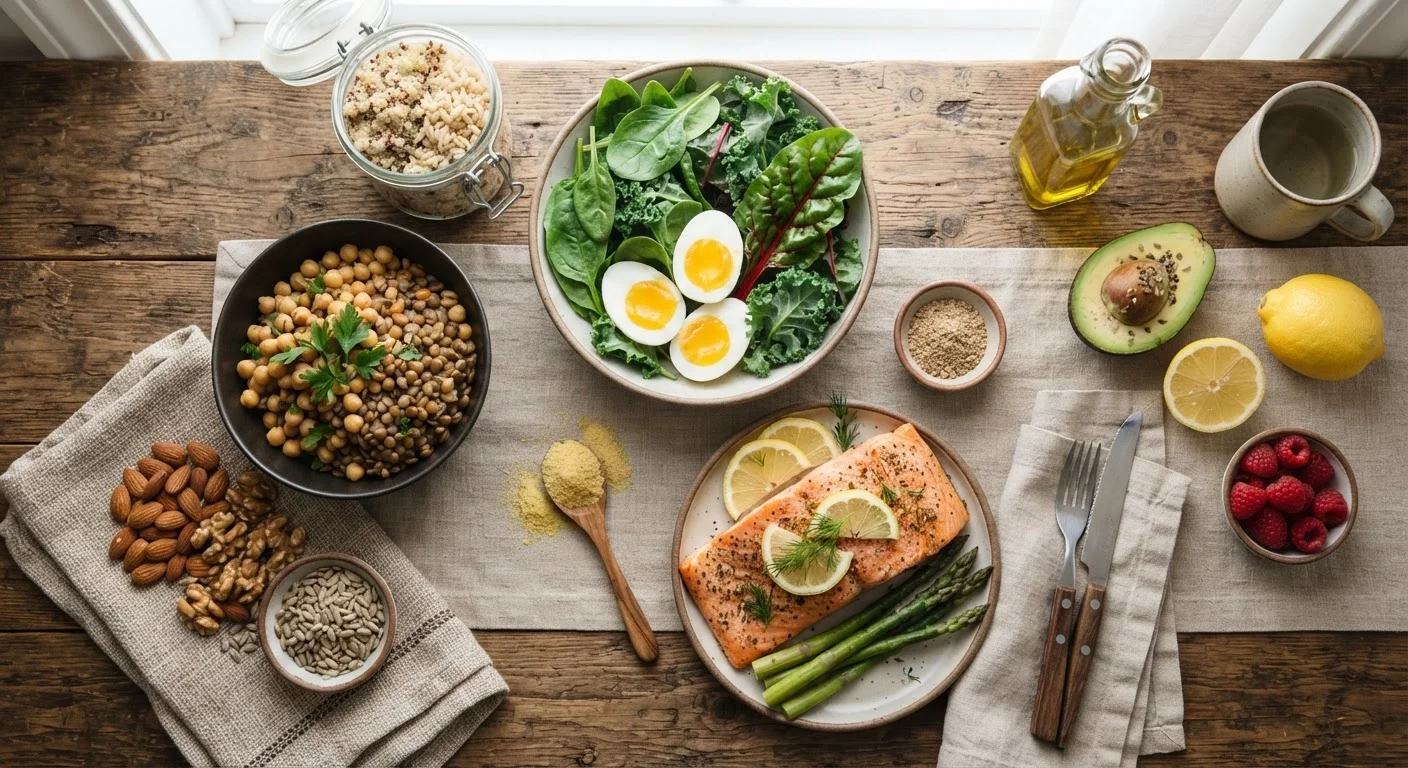
No single food delivers all eight B vitamins in meaningful quantities, which is why dietary breadth matters more than any individual superfood. A practical eating pattern that supports comprehensive B vitamin intake includes:
- Whole grains (oats, brown rice, quinoa) for thiamine, niacin, and B6
- Legumes (lentils, chickpeas, black beans) for folate, thiamine, and B6
- Dark leafy greens (spinach, kale, asparagus) for folate and riboflavin
- Eggs and dairy for B12, riboflavin, and biotin
- Lean meats and fish for B12, B6, niacin, and pantothenic acid
- Nuts and seeds for biotin, niacin, and pantothenic acid
Minimizing overcooking — particularly boiling vegetables — helps preserve heat- and water-sensitive vitamins like folate and thiamine. Steaming or roasting tends to retain more nutrient content than prolonged boiling.
Whole-food B complex supplements exist, but they are not a substitute for dietary variety. Supplements cannot replicate the full matrix of cofactors, fiber, and synergistic compounds present in food. Anyone considering supplementation should discuss their specific needs and any medication interactions with a qualified healthcare provider before starting.
This article is for general informational and educational purposes only and does not constitute medical advice. Consult a qualified healthcare professional for guidance specific to your health circumstances, especially before making changes to supplementation or diet to address a known or suspected deficiency.
The content on this site is for informational purposes only and is not a substitute for professional advice. Always consult a qualified professional for guidance specific to your situation.