

Our Verdict
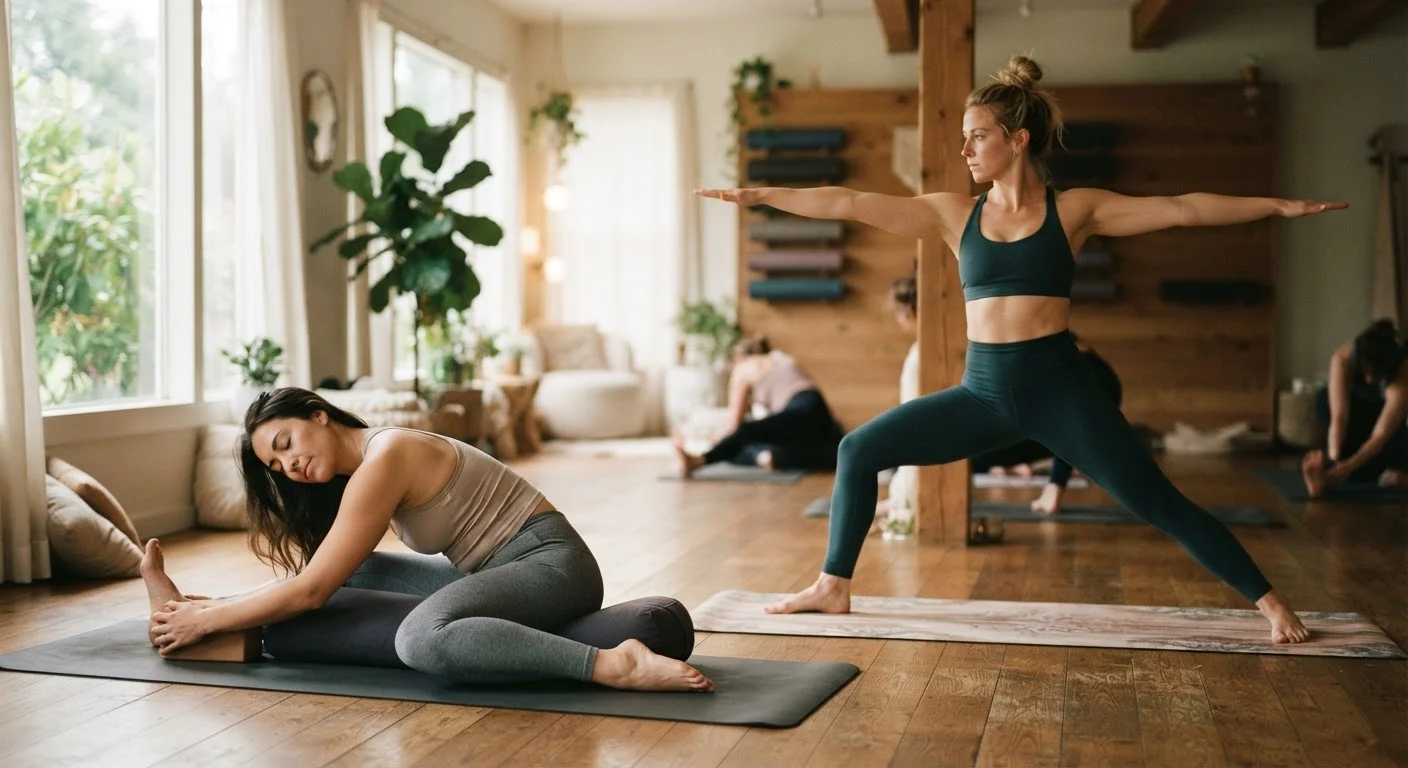
Yin and yang yoga are not competing philosophies — they are complementary tools targeting different biological tissues and nervous system states. Yin excels at restoring range of motion and calming the stress response, while yang styles build the functional strength and heat that support an active life. A balanced practice draws on both.
| Best for | Recommended |
|---|---|
| Those seeking improved joint mobility and stress relief | Yin Yoga |
| Practitioners aiming to build muscular strength and cardiovascular fitness | Yang Yoga (e.g., Vinyasa, Ashtanga) |
| Beginners wanting a gentle, low-impact starting point | Yin Yoga |
| Athletes and active individuals wanting full-spectrum recovery and performance | Combined Yin and Yang Practice |
The Core Distinction: Tissue Type
In yoga philosophy, yin and yang describe opposing but interdependent qualities — stillness and movement, receptivity and effort. In practice, these qualities map onto two distinct biological systems in the body.
Yang yoga — encompassing styles like Vinyasa, Ashtanga, Power Yoga, and much of traditional Hatha — targets myofascial tissue, meaning the muscles and their surrounding sheaths. These tissues respond to rhythmic contraction and load-bearing movement. Yang practices generate heat, stimulate the sympathetic nervous system, and produce the metabolic adaptations associated with strength and endurance training.
Yin yoga, developed in the West largely through the work of Paul Grilley and Sarah Powers drawing on Taoist principles, targets the deeper connective tissues: fascia, joint capsules, ligaments, and cartilage. These tissues are relatively avascular (low in blood supply) and respond not to rapid repetition but to sustained, moderate stress applied over time — typically two to five minutes per posture.
Understanding this tissue-based distinction is the foundation for using each approach intentionally.
What Yang Yoga Builds
Yang-style practices ask muscles to engage actively, often through sequences that link breath to movement. The physiological benefits include:
- Muscular strength and endurance — sustained engagement in poses like Warrior II or Chaturanga creates progressive overload in major muscle groups.
- Cardiovascular conditioning — fast-paced Vinyasa flows elevate heart rate and improve aerobic capacity over time.
- Neuromuscular coordination — balancing poses and transitions train the nervous system to recruit muscles efficiently and safely.
- Bone density maintenance — weight-bearing postures provide mechanical stimulus that supports bone health, particularly relevant with age.
- Body temperature regulation — internal heat generated during practice supports circulation and metabolic function.
Yang practices also cultivate mental focus, discipline, and the capacity to sustain effort — qualities with both physical and psychological value. For a broader look at how yoga compares with other movement-based disciplines, see Yoga, Pilates, and Calisthenics compared.
| Criterion | Yin Yoga | Yang Yoga | |
|---|---|---|---|
| Primary tissue targeted | Connective tissue (fascia, ligaments) | Muscle and myofascia | |
| Pose duration | 2–5 minutes per posture | Seconds to 1 minute, dynamic flow | |
| Muscle engagement | Passive — muscles released | Active — muscles contracted | |
| Nervous system effect | Parasympathetic (rest and digest) | Sympathetic (energising) | |
| Primary benefit | Mobility, restoration, stress relief | Strength, endurance, coordination | |
| Suitable experience level | Beginner to advanced | Beginner to advanced |
What Yin Yoga Develops
Yin postures are held passively — muscles deliberately relaxed — so that gravitational load or gentle manual pressure reaches the connective tissue layers beneath. This approach develops:
- Joint range of motion — sustained stretch gradually lengthens fascial tissue that resists brief, dynamic stretches.
- Fascial hydration and pliability — slow loading encourages fluid movement through fascial networks, reducing stiffness.
- Parasympathetic activation — long holds with conscious breathing stimulate the body's rest-and-digest response, lowering cortisol and heart rate.
- Interoceptive awareness — remaining still with mild discomfort cultivates the ability to notice and interpret internal body signals, a skill with documented relevance to emotional regulation.
- Meditative depth — yin practice functions as a moving meditation, making it an accessible entry point for mindfulness training.
Finding Your Edge in Yin
In yin yoga, the concept of 'finding your edge' refers to settling into a sensation that is noticeable but sustainable for the full hold duration. A mild ache or gentle pull is appropriate; any sharp, shooting, or electrical sensation is a signal to ease out immediately. Over time, your edge will naturally shift as connective tissue adapts.
It is important to note that yin stretches should feel like mild-to-moderate tension — never sharp or acute pain. Connective tissue adapts slowly, and the practice requires patience over weeks and months rather than immediate results.
Building a Balanced Weekly Practice
Most experienced teachers recommend weaving both approaches into a weekly schedule rather than choosing one exclusively. A common framework might include two to three yang sessions for strength and heat, one to two yin sessions for restoration and depth, and at least one practice that combines both — such as a yang flow followed by a 20-minute yin cool-down.
Some considerations when structuring your practice:
- Sequence matters: Doing yin immediately before intense yang practice may temporarily reduce the stability of joint structures; consider placing yin after yang work, or on separate days.
- Recovery signals: Soreness, fatigue, or high-stress periods are natural indicators to lean toward yin.
- Individual anatomy: Joint structure varies significantly between people. What produces an appropriate yin sensation in one body may feel like nothing — or too much — in another.
This article is for general informational and educational purposes only and is not a substitute for personalized medical or professional guidance. Consult a qualified healthcare provider or certified yoga instructor before beginning any new movement practice, especially if you have existing injuries or health conditions.
The content on this site is for informational purposes only and is not a substitute for professional advice. Always consult a qualified professional for guidance specific to your situation.