

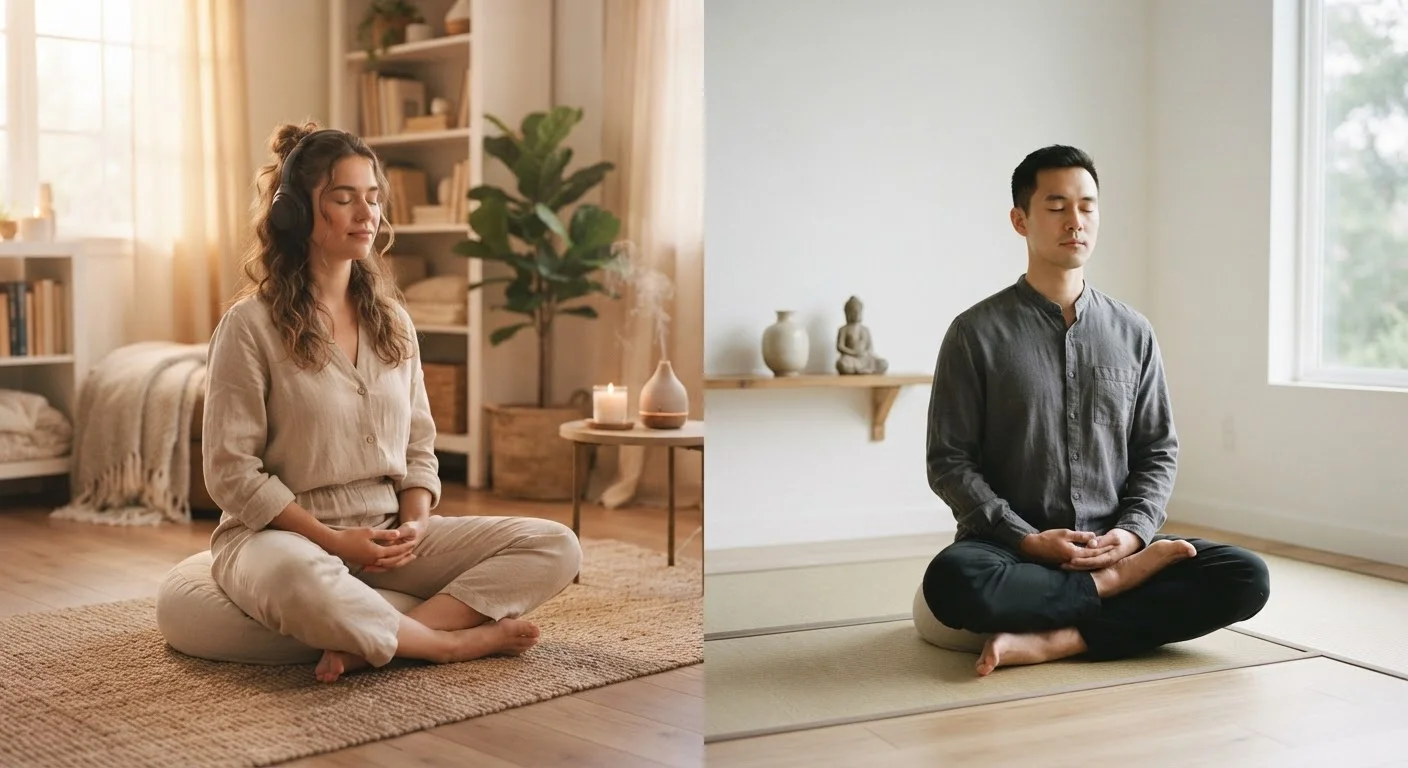
Option A
Guided Meditation
The structured, instructor-led approach to cultivating presence.
Best for: Beginners, those with restless minds, or anyone who benefits from verbal cues to anchor attention.
Option B
Silent Meditation
The self-directed practice of sitting with unmediated awareness.
Best for: Experienced practitioners ready to deepen independence, self-inquiry, and open awareness.
What Sets These Two Environments Apart
At their core, guided and silent meditation differ in one fundamental way: the presence or absence of an external voice directing your attention. In a guided session, a teacher or recorded instruction leads you through specific focal points — the breath, body sensations, visualizations, or compassion phrases. In silent meditation, you sit without prompts, relying entirely on your own intention to initiate and sustain awareness.
This distinction shapes everything else: how your nervous system responds, how quickly concentration develops, and what kinds of insight become available. Both formats draw on the same underlying mechanisms of attention training, but they cultivate different qualities of mind over time.
For a broader look at how attention is used in meditation generally, see our guide on focused attention vs. open monitoring.
| Criterion | Guided Meditation | Silent Meditation |
|---|---|---|
| Structure | Instructor or recording leads each step | Self-directed from start to finish |
| Accessibility for beginners | High — verbal anchors reduce overwhelm | Lower — requires prior attentional skill |
| Attentional independence | Partially outsourced to guide | Fully developed by practitioner |
| Variety of techniques | Wide — body scan, loving-kindness, breath | Narrower — chosen method held independently |
| Traditional roots | Common in modern secular programs | Central to classical traditions (Vipassana, Zen) |
| Depth of self-inquiry | Moderate — instruction shapes awareness | High — unmediated observation of mind |
| Ideal session length | 5–30 minutes; length guided by recording | Flexible; practitioner sets own duration |
The Case for Guided Meditation
Guided meditation lowers the entry barrier significantly. When a calm voice reminds you to notice the weight of your body, the rhythm of your breath, or the quality of a sensation, you spend less cognitive energy managing the structure of the session itself. This scaffolding is particularly valuable for practitioners who, as research on mind-wandering suggests, spend a substantial portion of sitting time following unintentional thought streams rather than their chosen object of focus.
Guided sessions also offer variety. Body scan practices, loving-kindness sequences, and breathwork instructions each target different dimensions of well-being — making it easier to match the format to your current emotional state. If you're struggling to sit still when starting out, a guided recording can serve as a reliable anchor.
One consideration: over-reliance on audio guidance can delay the development of self-directed attention. If you always need a voice to focus, silence may feel unmanageable when guidance isn't available.
47%
Time the mind wanders during waking hours
A Harvard study by Killingsworth & Gilbert (2010) found minds wander nearly half of waking hours, underscoring why structured guidance benefits beginners.
8 weeks
Minimum for measurable attention improvement
Multiple mindfulness-based stress reduction (MBSR) trials report measurable changes in attention and stress regulation after an 8-week program, regardless of format.
~200M
People practicing meditation globally
Global Wellness Institute estimates suggest hundreds of millions engage in some form of meditation, with app-based guided formats driving much of recent growth.
The Case for Silent Meditation
Silent practice places the full responsibility of attention on the meditator — and that demand is precisely its strength. Without external direction, you learn to notice when the mind has wandered, return to your object of focus, and sustain that return repeatedly. Over time, this cultivates a more robust and transferable attentional skill.
Most classical meditation traditions — including Vipassana, Zen, and Tibetan shamatha — are grounded in silent sitting. The absence of instruction invites a subtler quality of observation: you begin to notice the texture of thoughts rather than simply following them. This is the terrain where deeper self-inquiry and equanimity tend to develop.
Silent practice does require a supportive physical environment. Explore our practical advice on setting up a home meditation space to minimize interruptions and sensory distractions that become more noticeable without audio to mask them.
Choosing Wisely — and Combining Both
The most effective approach for many practitioners is not a permanent choice between guided and silent, but a thoughtful integration. A common pattern: use guided sessions to establish technique and build consistency in early practice, then gradually extend periods of unguided sitting as confidence grows.
Context matters too. Mornings with a scattered mind may call for guided structure; a retreat or dedicated weekend sit may invite full silence. Neither format should feel like a test of worthiness — each serves a legitimate purpose at different stages and moments.
If you're building a broader routine that incorporates movement alongside seated practice, our resource on building a unified yoga and meditation practice offers a practical framework. You can also explore the full landscape of styles in our map of major meditation traditions to find methods that resonate across both formats.
This article is for informational purposes only and does not constitute medical or psychological advice. If you have a mental health condition or are new to mindfulness practices, consult a qualified healthcare professional before beginning.
The content on this site is for informational purposes only and is not a substitute for professional advice. Always consult a qualified professional for guidance specific to your situation.