

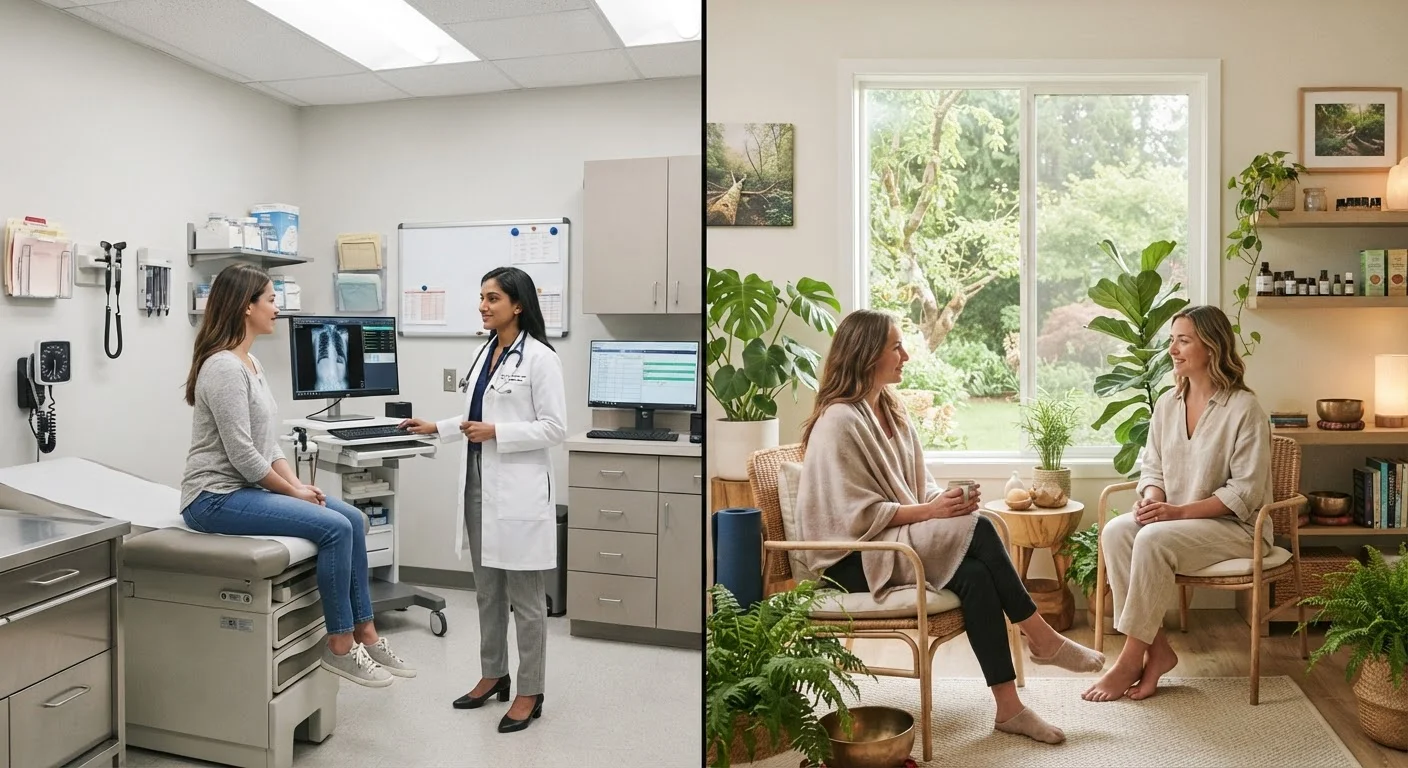
Option A
Integrative Medicine
The collaborative, evidence-informed bridge between conventional and complementary care.
Best for: People who want to combine evidence-based conventional treatments with complementary practices under coordinated medical supervision.
Option B
Alternative Medicine
The standalone, non-conventional approach used in place of mainstream care.
Best for: People who choose to pursue non-conventional therapies independently, often outside the framework of conventional medical oversight.
Two Terms, Two Very Different Philosophies
In everyday conversation, integrative medicine and alternative medicine are often used as if they mean the same thing. They don't — and the distinction has real consequences for how care is delivered, monitored, and coordinated.
Alternative medicine refers to non-conventional therapies used instead of conventional medical treatment. The word "alternative" signals replacement: a person chooses one approach over another. This might include using herbal preparations exclusively to manage a condition a physician would typically treat with medication, or declining a recommended diagnostic procedure in favor of an energy-based therapy. Some alternative practices are rooted in centuries-old healing traditions; others are more recent. Evidence levels vary widely across this broad category.
Integrative medicine takes a fundamentally different stance. Rather than replacing conventional care, it deliberately combines it with evidence-informed complementary approaches — bringing both into a coordinated plan. A person undergoing cancer treatment, for example, might work with an oncologist and also engage in acupuncture or mindfulness-based stress reduction to support wellbeing during treatment. Crucially, this happens with clinical oversight, not in parallel without the medical team's knowledge.
For a broader look at how these concepts fit within a wider worldview of health, see what holistic healing actually means — a concept that overlaps with, but is distinct from, both terms discussed here.
| Criterion | Integrative Medicine | Alternative Medicine |
|---|---|---|
| Relationship to conventional care | Used alongside conventional treatment | Used instead of conventional treatment |
| Medical oversight | Coordinated with licensed clinicians | Often pursued independently |
| Evidence standard | Prioritizes evidence-informed practices | Varies widely; may rely on tradition or anecdote |
| Risk of care gaps | Lower — clinician monitors overall plan | Higher — no coordinating medical oversight |
| Typical setting | Hospitals, integrative clinics, academic centers | Independent practitioners, wellness centers |
| Common examples | Acupuncture + oncology, yoga + cardiac rehab | Homeopathy, energy healing as sole treatment |
Where the Evidence Stands
One of the most important questions to ask about any non-conventional practice is: what does the research actually show? This varies considerably depending on the specific modality — and neither "integrative" nor "alternative" as a label tells you whether a given practice has strong, limited, or no clinical evidence behind it.
Some practices commonly found in integrative settings — such as mindfulness-based stress reduction, certain forms of acupuncture, and cognitive approaches rooted in behavioral science — have accumulated meaningful research support for specific outcomes. Others, particularly those at the alternative end of the spectrum, rely primarily on traditional use, anecdote, or small preliminary studies. Honest practitioners in any of these fields will acknowledge this variability rather than present every modality as equally proven.
38%
U.S. adults using complementary health approaches
According to NCCIH-cited national survey data, roughly 38% of U.S. adults use some form of complementary or integrative health approach in a given year.
~70%
Patients who don't disclose complementary use to doctors
Research published in health communication journals suggests the majority of patients using complementary therapies do not proactively inform their conventional healthcare providers.
40+
Academic medical centers with integrative medicine programs
The Academic Consortium for Integrative Medicine & Health reports that over 40 academic medical institutions in North America now offer formal integrative medicine programs.
The National Center for Complementary and Integrative Health (NCCIH), a division of the U.S. National Institutes of Health, funds and publishes research specifically examining these practices. Their findings consistently underscore the same point: individual modalities must be evaluated on their own merits, not grouped under a single umbrella claim of effectiveness or safety.
Explore a plain-language overview of the most discussed practices in our holistic healing modalities reference guide.
Practical Implications for Health Decisions
Understanding the conceptual difference matters most when you're making actual health decisions. Here are three practical distinctions worth keeping in mind:
- Coordination of care: Integrative medicine assumes a medical provider is aware of and involved in decisions. Alternative medicine, as typically practiced, may not include that coordination — which raises the risk of herb-drug interactions, delayed diagnoses, or duplicated care going undetected.
- Informed consent and transparency: In an integrative setting, a clinician can help you weigh the evidence, potential benefits, and known risks of a complementary practice. This is harder to replicate when pursuing therapies independently.
- Scope of application: Integrative medicine is particularly relevant for chronic condition management, where complementary tools may support quality of life alongside necessary conventional treatment. See our analysis of adopting a holistic approach to chronic conditions for a balanced view of both the benefits and limitations.
Practices such as breathwork, meditation, and mindfulness represent a useful illustration: each can meaningfully complement conventional care as part of an integrative approach, but they are not substitutes for treatment of clinical conditions.
Many of the practices discussed in both integrative and alternative contexts draw on long-standing global healing traditions — from Ayurveda to Traditional Chinese Medicine — whose principles continue to inform modern holistic practice.
This article is for general informational and educational purposes only and does not constitute medical advice. Always consult a qualified healthcare professional before making decisions about your health, treatments, or therapies — particularly if you have an existing condition or are taking medications.
The content on this site is for informational purposes only and is not a substitute for professional advice. Always consult a qualified professional for guidance specific to your situation.