

Our Verdict
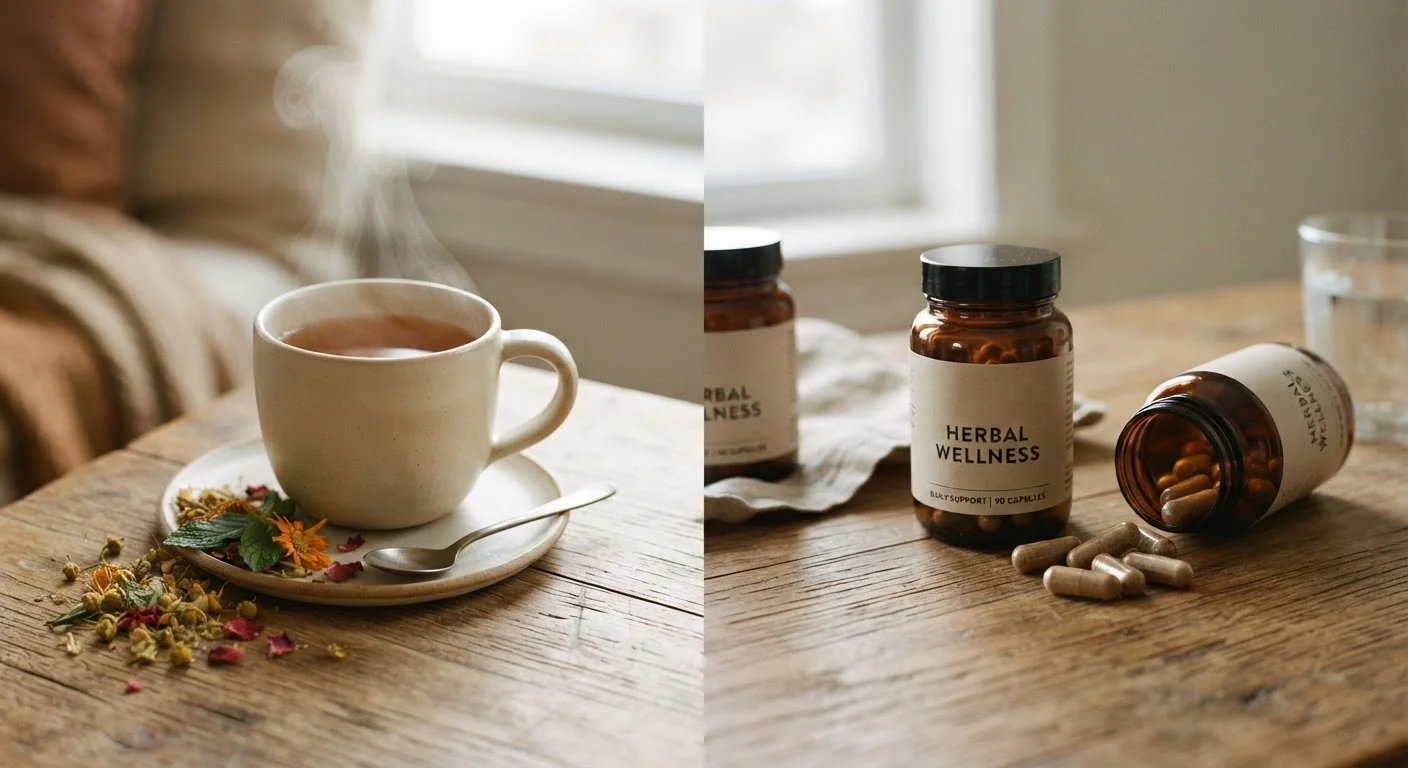
Herbal teas and standardised extracts are not interchangeable — they represent fundamentally different ways of interacting with a plant's chemistry. Teas preserve a broad, gentle spectrum of water-soluble compounds, while standardised extracts deliver concentrated, reproducible doses of specific constituents. The evidence base differs considerably between the two forms even for the same herb.
| Best for | Recommended |
|---|---|
| Gentle, daily wellness rituals and relaxation support | Herbal tea infusions |
| Situations requiring documented, reproducible compound levels | Standardised extracts |
| Those new to herbal wellness seeking low-risk entry points | Herbal tea infusions |
| Researching a specific herb's studied active constituent | Standardised extracts |
The Chemistry Behind the Cup
When you steep chamomile or valerian in hot water, you are performing a selective extraction. Water pulls out hydrophilic (water-loving) constituents — certain flavonoids, polyphenols, mucilages, and some volatile aromatics — while leaving behind fat-soluble compounds, many resins, and a range of other phytochemicals that water simply cannot carry. The resulting infusion is chemically complex but limited in scope.
Standardised herbal extracts take a different route entirely. Manufacturers use solvents such as ethanol, methanol, or supercritical CO₂ to draw out a wider — or more targeted — range of compounds, then concentrate and calibrate the final product so that each capsule or tablet contains a guaranteed minimum percentage of a defined marker compound. A standardised valerian extract, for example, might be guaranteed to contain a set percentage of valerenic acids, whereas a tea brewed from the same root delivers those acids inconsistently depending on water temperature, steeping time, and root age.
See our step-by-step guide to preparing herbal infusions to understand how variables like temperature and steeping time affect what ends up in your cup.
Consistency vs. Complexity: A Key Trade-Off
Standardised extracts exist largely because clinical research requires reproducible doses. If a study examines whether Hypericum perforatum (St. John's Wort) affects mood, researchers need every participant to receive the same amount of hypericin or hyperforin — the marker compounds most studied. This precision is impossible to achieve reliably with a tea.
However, standardisation also introduces a philosophical tension within herbal medicine. Many herbalists and researchers argue that isolating a single marker compound discards the entourage effect — the idea that a plant's full spectrum of constituents works synergistically, with minor compounds modulating the effects of dominant ones. A whole-plant tea, though variable, preserves this complexity. Whether that complexity translates into measurable clinical benefit over a standardised extract remains an open research question for most herbs.
| Herbal Tea (Infusion) | Standardised Extract | |
|---|---|---|
| Compounds extracted | Water-soluble only | Broad or targeted spectrum |
| Dose consistency | Variable batch to batch | Controlled, guaranteed minimum |
| Phytochemical complexity | High — whole-plant profile | Reduced — focused on marker compounds |
| Clinical evidence base | Often limited for specific teas | Most trials use extract forms |
| Ease of use | Simple, accessible at home | Pre-measured capsule or tablet |
| Safety considerations | Generally mild; herb-dependent | Concentration raises interaction risk |
| Ritual / lifestyle value | High — sensory experience | Low — functional supplement |
Practically speaking, batch-to-batch variability is a genuine concern with both forms. Teas vary with soil, climate, harvest time, and storage; extracts vary with manufacturing process and quality control. Reputable extract manufacturers undergo third-party testing to verify potency — a safeguard that loose-leaf teas rarely provide.
Safety Profiles Are Not Always Shared
A common misconception is that if a herb is safe as a tea, its extract must be equally safe at a higher concentration. This is not always the case. Kava (Piper methysticum) offers a cautionary example: traditional aqueous (water-based) kava preparations have a long history of use in Pacific communities with a distinct safety profile, whereas lipid-soluble kava extracts have been associated with rare but serious hepatotoxicity concerns in some regions, leading to regulatory actions in several countries. The extraction solvent appears to change which alkaloids are present and in what ratios.
Concentration Can Change the Risk Profile
Do not assume that a concentrated extract is simply a 'stronger' version of a tea with an otherwise identical safety profile. Higher concentrations of fat-soluble compounds, altered alkaloid ratios from different solvents, and potency far exceeding traditional use can introduce risks not seen with standard infusions. This is especially important for people taking prescription medications or managing chronic health conditions. Seek professional guidance before switching from tea to extract forms of the same herb.
Similarly, compounds that are pharmacologically active in concentrated extract form may be present in amounts too small to trigger equivalent effects — or adverse reactions — in a standard tea. This matters when considering herb-drug interactions: a cup of green tea is unlikely to affect warfarin metabolism significantly, but a highly concentrated green tea extract standardised for EGCG could interact at sufficient doses. Always disclose herbal supplement use to your prescribing clinician.
Choosing the Right Form for Your Goals
There is no single correct answer to which preparation form is better. The decision depends on the herb in question, what you are trying to support, and what the evidence actually says about each form.
- Teas work well when the target compounds are water-soluble, when gentle daily support is the goal, and when the ritual itself contributes to wellbeing — as with chamomile or peppermint for digestive comfort.
- Standardised extracts may be appropriate when clinical research specifically used that extract form and concentration, and when consistent compound delivery matters — such as certain adaptogen or nervine applications studied in controlled trials.
- Consider the evidence base for the specific form: if most studies on an herb used an ethanolic extract standardised to a particular percentage, the tea form has a separate and often thinner evidence trail.
Whatever form you choose, sourcing matters. Look for products that follow Good Manufacturing Practice (GMP) standards. And because herbal products — in any form — can interact with medications and may be inappropriate for certain health conditions, pregnancy, or pediatric use, individual guidance from a qualified healthcare professional is always advisable before beginning any herbal regimen.
This article is for general informational purposes only and does not constitute medical advice. Consult a qualified healthcare provider before using herbal products for any health concern.
The content on this site is for informational purposes only and is not a substitute for professional advice. Always consult a qualified professional for guidance specific to your situation.