

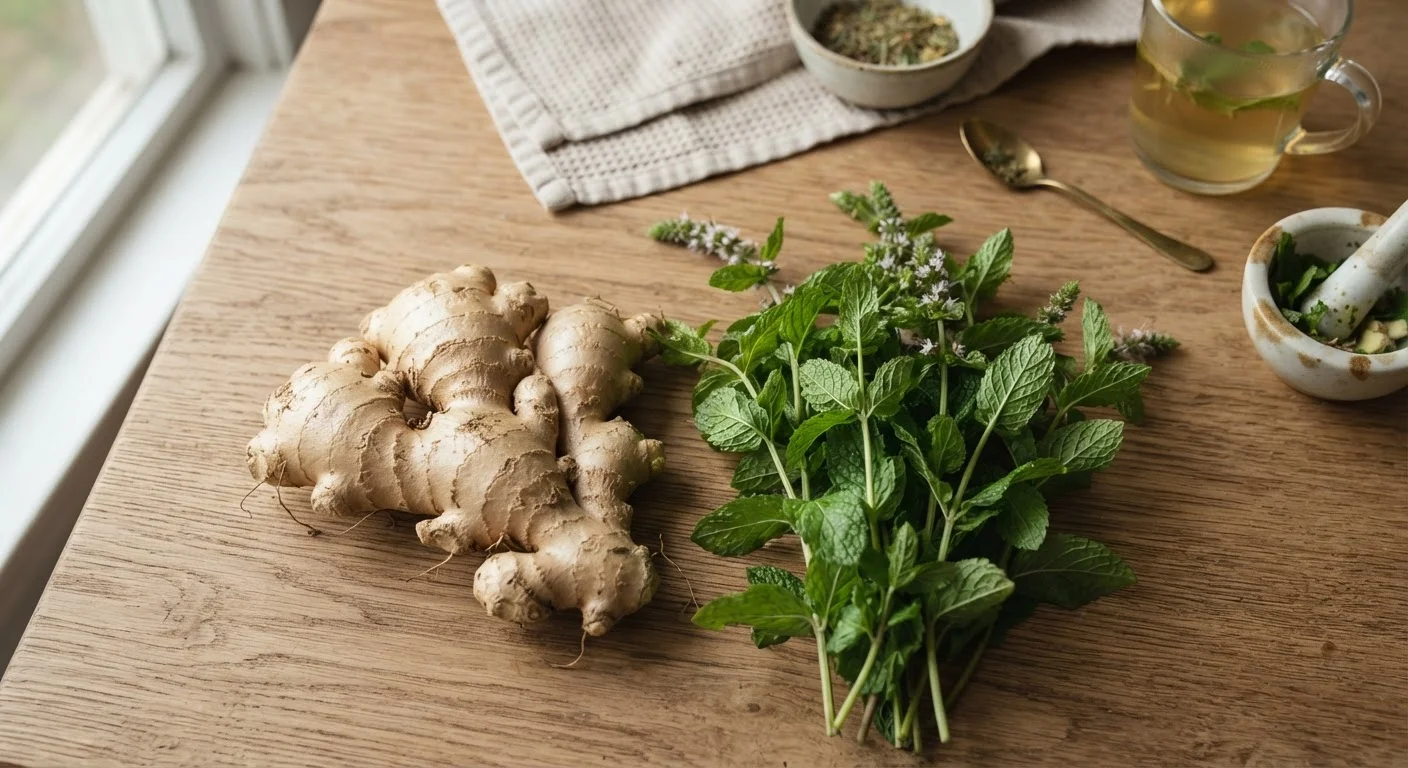
Option A
Ginger (Zingiber officinale)
The warming, motility-enhancing digestive root.
Best for: Best for nausea, slow gastric emptying, and post-meal heaviness where gut movement needs a nudge.
Option B
Peppermint (Mentha × piperita)
The cooling, muscle-relaxing digestive herb.
Best for: Best for bloating, cramping, and irritable bowel-type discomfort where smooth muscle tension needs relief.
How Ginger Acts on the Digestive System
Ginger has been used medicinally for thousands of years across Asian and Ayurvedic traditions, and modern research has begun to clarify why it may help with certain forms of digestive discomfort. Its primary active compounds — gingerols and shogaols — interact with the gut in several distinct ways.
The most studied mechanism is ginger's prokinetic effect: it appears to support gastric motility, meaning it may help the stomach empty its contents more efficiently. Some clinical studies have found that ginger shortens gastric emptying time, which may explain its usefulness for the sensation of fullness or heaviness after meals.
Ginger also interacts with serotonin receptors (specifically 5-HT3 receptors) in the gut and brain pathways involved in nausea. This is thought to underlie its well-recognized effect on nausea — research has examined its use in pregnancy-related nausea and chemotherapy-induced nausea, with generally supportive but mixed results depending on the population and dosage studied.
Additionally, ginger has demonstrated anti-inflammatory properties in laboratory settings, which may contribute to its role in soothing general gastrointestinal irritation, though translating these findings directly to digestive symptom relief in humans requires more research.
~70%
IBS patients reporting peppermint oil benefit
A 2014 meta-analysis in the Journal of Clinical Gastroenterology found peppermint oil significantly reduced IBS symptoms versus placebo in multiple trials.
1.1–1.5g
Daily ginger studied for nausea in trials
Multiple clinical trials examining pregnancy-related nausea have used roughly 1–1.5 g of ginger daily, though dosing should always be discussed with a healthcare provider.
For general wellness context, see our guide to home remedies for digestive discomfort for a broader look at evidence-informed options.
How Peppermint Acts on the Digestive System
Peppermint's digestive action is driven primarily by menthol, the main bioactive compound in its essential oil. Menthol acts as a natural calcium channel blocker in intestinal smooth muscle — by inhibiting calcium ion influx, it reduces muscle contraction and tension in the gut wall.
This muscle-relaxing (antispasmodic) effect is the foundation of peppermint's usefulness for cramping and bloating. When intestinal muscles are less prone to spasm, gas can move through the gut more easily, and the sensation of pressure or pain associated with trapped gas and cramping may be reduced.
Enteric-coated peppermint oil capsules — formulated to dissolve in the intestines rather than the stomach — have been the subject of multiple clinical trials in people with irritable bowel syndrome (IBS). Several systematic reviews and meta-analyses suggest a statistically significant benefit for IBS-related abdominal pain compared to placebo, though researchers note variability in trial quality.
Peppermint tea, while popular and widely used traditionally, delivers substantially less menthol than encapsulated oil formulations, so the evidence from capsule studies does not automatically transfer to tea use. That said, tea may still provide mild symptomatic relief and is generally well tolerated.
| Criterion | Ginger | Peppermint |
|---|---|---|
| Primary mechanism | Prokinetic; serotonin receptor activity | Smooth muscle relaxation via menthol |
| Main use case | Nausea, slow gastric emptying | Cramping, bloating, IBS-type pain |
| Key active compounds | Gingerols, shogaols | Menthol (essential oil) |
| Clinical evidence strength | Moderate; strongest for nausea | Moderate; strongest for IBS (capsules) |
| Reflux / GERD concern | Generally low concern | May worsen reflux — use cautiously |
| Common form studied | Standardized extract, fresh root | Enteric-coated oil capsules |
| Traditional use origins | Asian, Ayurvedic, Middle Eastern | European folk medicine |
One important caution: peppermint can relax the lower esophageal sphincter, potentially allowing stomach acid to reflux into the esophagus. People who experience acid reflux or GERD should approach peppermint thoughtfully and consult a healthcare provider before regular use.
Choosing Between Them — and Knowing Their Limits
Because ginger and peppermint operate through different mechanisms, they may be better suited to different presentations of digestive discomfort rather than being interchangeable. Ginger tends to be more relevant when motility or nausea is the central issue; peppermint tends to be more relevant when cramping, spasm, or bloating is predominant.
However, both herbs have practical limitations. Research studies often use standardized extracts or encapsulated forms rather than teas or culinary amounts, making it difficult to extrapolate clinical findings to everyday use. Individual responses also vary considerably.
Neither herb should replace evaluation by a qualified healthcare professional when symptoms are persistent, severe, recurrent, or accompanied by other signs such as unexplained weight loss, blood in stool, or significant pain. Digestive symptoms can have many underlying causes, and self-treating with herbs is appropriate only as a complement to — not a substitute for — proper medical assessment.
Interactions with medications are also worth noting: ginger may have mild effects on blood thinning at high doses, and peppermint can affect the metabolism of some drugs. Anyone taking prescription medications should speak with their pharmacist or physician before adding herbal supplements regularly.
This article is for general informational and educational purposes only and does not constitute medical advice. Always consult a qualified healthcare professional before starting any herbal supplement, especially if you have an existing health condition, are pregnant, or are taking medications.
The content on this site is for informational purposes only and is not a substitute for professional advice. Always consult a qualified professional for guidance specific to your situation.