

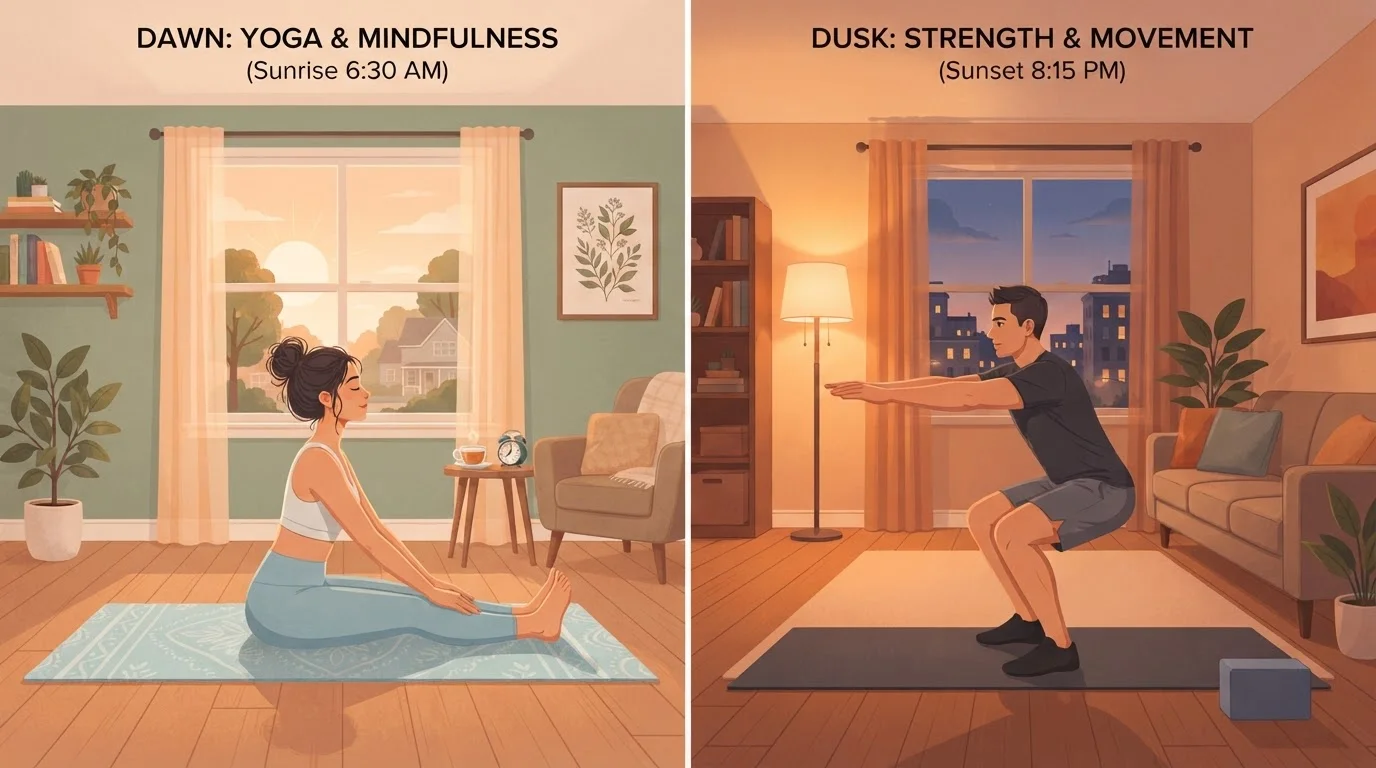
Option A
Morning Exercise
The discipline-driven, day-setting workout window.
Best for: People who want to build consistent habits, avoid schedule conflicts, and prime their mindset before the workday begins.
Option B
Evening Exercise
The performance-ready, stress-releasing end-of-day session.
Best for: People whose bodies feel stronger later in the day and who need movement as a reliable wind-down from work stress.
What the Physiology Actually Says
Research in chronobiology — the study of biological rhythms — shows that several physical capacities follow a predictable daily arc. Core body temperature rises through the day, peaking in the late afternoon to early evening. Higher body temperature correlates with increased muscle elasticity, faster nerve conduction, and improved cardiovascular efficiency. Studies published in sports science literature consistently find that measures like grip strength, anaerobic power, and reaction time tend to be higher in the afternoon and early evening than in the morning.
That said, morning physiology is not simply inferior. Cortisol, a hormone that supports energy mobilization, is naturally elevated shortly after waking — a pattern called the cortisol awakening response. This hormonal environment can support alertness and moderate-intensity effort, making morning sessions well-suited to aerobic work, yoga, and mobility training. For most home exercisers, the difference in raw performance between time windows is modest and becomes less relevant than other practical factors.
| Criterion | Morning Exercise | Evening Exercise |
|---|---|---|
| Body readiness | Lower core temp; needs warm-up | Peak body temp; higher muscle readiness |
| Consistency potential | Higher — fewer competing demands | Lower — vulnerable to schedule conflicts |
| Strength & power output | Slightly reduced vs. peak | Near-peak for most people |
| Sleep impact | Minimal interference | Risk if vigorous and close to bedtime |
| Stress relief | Sets a calm tone for the day | Effective decompression after work |
| Motivation level | May require more effort to start | Often higher after day's activity |
| Hormonal environment | Elevated cortisol supports alertness | Lower cortisol; relies on motivation |
Habit Formation and Consistency
From a behavioral standpoint, morning workouts carry a structural advantage: they happen before the day's unpredictability can interfere. As the hours pass, willpower resources are drawn on by decisions, social interactions, and work demands — a phenomenon researchers call ego depletion. Evening plans are also more likely to be cancelled by social invitations, overtime work, or simple fatigue.
For home-based exercisers specifically, this matters more than it might for gym-goers. Without a commute obligation or a class reservation to anchor commitment, it's easier to push a home session back indefinitely. Placing exercise first in the morning removes one layer of friction. Training at home rewards those who develop strong self-scheduling habits, and morning routines naturally support that structure.
If you're building a new fitness habit, consider exploring morning movement habits that prime the body for activity before a formal workout even begins.
Consistency Beats Optimal Timing
Exercise science broadly agrees that workout timing matters far less than regularity. A session performed at a "suboptimal" time but done consistently will produce greater health benefits than a theoretically ideal session that gets skipped. Choose the window you can protect most reliably and build your routine around it.
Sleep, Recovery, and the Evening Trade-Off
One of the most common concerns about evening exercise is its potential to disrupt sleep. The evidence here is nuanced. A 2019 meta-analysis in Sports Medicine found that moderate evening exercise generally did not impair sleep quality and in some cases improved it. However, vigorous exercise completed within 60–90 minutes of bedtime was associated with delayed sleep onset and reduced slow-wave sleep in a subset of participants.
For home exercisers whose workouts are moderate in intensity — bodyweight circuits, yoga flows, resistance band training — the sleep risk is lower. Those doing high-intensity interval training (HIIT) late at night may want to monitor their sleep quality and adjust timing if needed. See how your evening routine shapes recovery for a deeper look at the pre-sleep window.
~11%
Greater muscle strength in late afternoon vs. morning
Research published in the Journal of Strength and Conditioning Research suggests afternoon workouts can yield slightly higher strength outputs compared to morning sessions.
29%
Adults who report exercising more consistently in the morning
Survey data from the American Council on Exercise indicates morning exercisers are among the most adherent to weekly activity goals.
This article is for general informational purposes only and does not constitute medical or personal training advice. Consult a qualified healthcare or fitness professional before beginning a new exercise program, especially if you have an existing health condition.
The content on this site is for informational purposes only and is not a substitute for professional advice. Always consult a qualified professional for guidance specific to your situation.