

Our Verdict
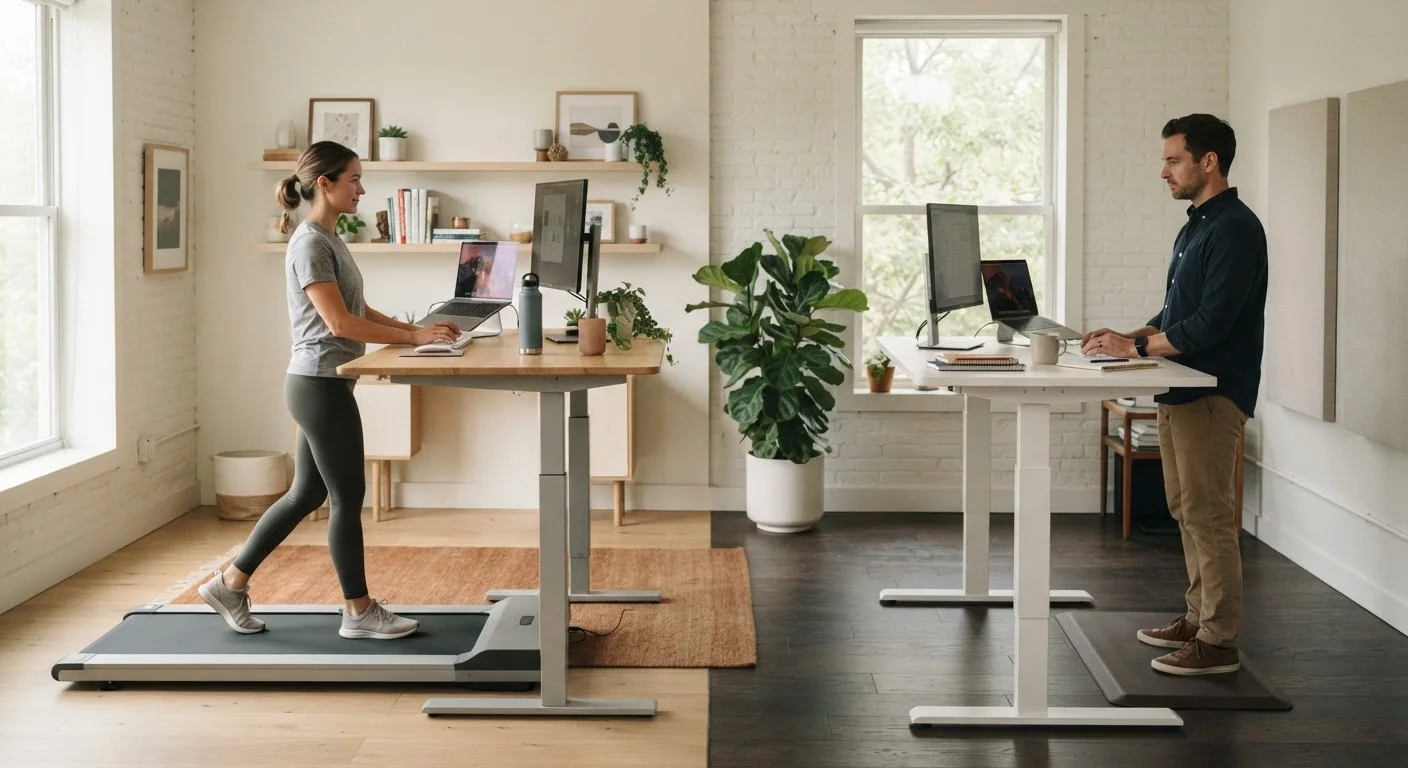
Standing desks lower the barrier to posture variety and are easier to use during demanding cognitive tasks, making them a versatile starting point. Walking pads deliver more meaningful movement volume over time but suit tasks that don't require intense concentration. For many desk workers, the most effective strategy combines both approaches — or neither, if simpler movement habits are built deliberately into the day.
| Best for | Recommended |
|---|---|
| Those who need to stay focused on complex or creative tasks while reducing sitting | Standing desk |
| People with routine, lower-concentration desk tasks who want to accumulate daily steps | Walking pad |
| Those working within strict space or budget constraints | Structured movement breaks (no device required) |
| Readers looking to combine multiple movement strategies throughout the workday | Walking pad paired with a standing desk |
The Problem Both Approaches Are Trying to Solve
Prolonged unbroken sitting is associated with metabolic and cardiovascular risks that appear to exist independently of how much formal exercise a person does. Research has consistently shown that simply breaking up sedentary time — even with light activity — can have measurable physiological effects. That insight has driven interest in two workspace solutions: standing desks and walking pads (sometimes called under-desk treadmills).
Both devices share the same broad goal: interrupt the default of sitting all day. But they differ substantially in how they achieve it, what effort they demand from users, and what kinds of work they're compatible with. Understanding how incidental movement stacks up against structured exercise helps set realistic expectations for what either device can — and cannot — do for your overall health.
Standing Desks: What the Evidence Actually Shows
Standing desks allow users to alternate between sitting and standing throughout the day. The practical benefit is real but more modest than early marketing suggested. Standing burns only marginally more calories than sitting — estimates from published studies typically place the difference at around 8–10 additional calories per hour. Accumulated over a workweek, that remains relatively small.
Where standing desks do show clearer benefit is in reducing continuous sitting time and prompting posture changes. Users who alternate sitting and standing tend to shift position more frequently, which maintains circulation and reduces the compressive loading that comes from extended static postures. Some research also suggests reduced lower-back discomfort with consistent use, though this varies by individual ergonomics.
Too Much Standing Has Its Own Risks
Extended static standing — particularly without movement — can cause lower-limb fatigue, joint discomfort, and circulatory issues over time. Ergonomics experts generally recommend alternating between sitting and standing in regular intervals rather than defaulting to standing as a constant posture. If you experience persistent discomfort, consult a healthcare professional.
Standing for excessive, unbroken periods introduces its own risks — foot fatigue, varicose veins, and lower-limb discomfort. The goal is alternation, not substitution. Anti-fatigue mats and footwear choice meaningfully affect comfort during extended standing.
Walking Pads: Real Movement With Real Trade-offs
Walking pads operate at slow speeds — typically 1 to 3 mph — designed for use while working. At those speeds, users can accumulate several thousand additional steps during a standard workday. That represents a genuine increase in daily movement volume, which is meaningful for people whose baseline step count is low.
The practical limitation is cognitive compatibility. Tasks requiring precise typing, close reading, careful analysis, or video calls tend to be harder to perform while walking. Most users report that walking pads work best during email processing, routine administrative tasks, or passive listening. For knowledge workers whose jobs are primarily concentration-heavy, this creates significant blocks of time when the pad sits unused.
Pairing a walking pad with other step-accumulation strategies can help fill gaps during high-focus work periods.
Start Slow With Walking Pad Speed
New walking pad users often overestimate how fast they can walk while maintaining work quality. Starting at 1 to 1.5 mph and only increasing speed once typing and focus feel natural tends to produce better long-term habits. Give yourself at least two weeks of regular use before evaluating whether it fits your workflow.
Comparing the Two Approaches Side by Side
Both options have genuine merit, and the right choice depends heavily on your work type, available space, and budget. The comparison below covers the dimensions that most affect real-world usability.
| Standing Desk | Walking Pad | |
|---|---|---|
| Movement type | Posture variation, no locomotion | Continuous low-speed walking |
| Calorie impact | Minimal increase over sitting | Moderate increase over sitting |
| Step count contribution | None | Meaningful — thousands per workday |
| Compatibility with focus tasks | High — no interference with typing or calls | Moderate — limited during complex tasks |
| Noise level | Silent | Low motor hum — audible on calls |
| Space footprint | Requires desk surface area | Requires floor space under desk |
| Typical cost range | $200–$700+ for motorized models | $200–$600 for most models |
| Setup complexity | Moderate — desk assembly required | Low — mostly plug-and-use |
One factor the table can't fully capture is habit durability. Devices that feel like an obstacle — too loud, too disruptive, too awkward — tend to be abandoned within weeks. Ease of use and seamless integration into existing workflow predicts long-term consistency more than technical specifications do. If you find staying active despite good intentions difficult, a simpler solution may serve you better than an expensive piece of equipment.
Building a Sustainable Movement Habit Around Either Option
Neither device replaces deliberate movement habits. The most consistent desk workers treat these tools as part of a broader strategy — one that also includes scheduled breaks, walking meetings, and brief mobility routines. Building a daily movement practice around a sedentary job offers a fuller framework for integrating these strategies without restructuring your schedule.
A practical approach for new users: start with one behavioral anchor. If using a standing desk, commit to standing during the first 20 minutes of each work hour. If using a walking pad, designate one recurring task — such as email review — as your walking window. Small, predictable triggers build the habit loop faster than open-ended intentions.
For those who prefer not to invest in equipment, a consistent daily walk before or after work remains one of the most well-supported low-effort interventions for reducing the effects of desk-heavy days.
This article is for general informational purposes only and does not constitute medical or professional health advice. Consult a qualified healthcare provider before making significant changes to your activity levels, especially if you have an existing health condition.
The content on this site is for informational purposes only and is not a substitute for professional advice. Always consult a qualified professional for guidance specific to your situation.