

How Common Activity Trackers Work
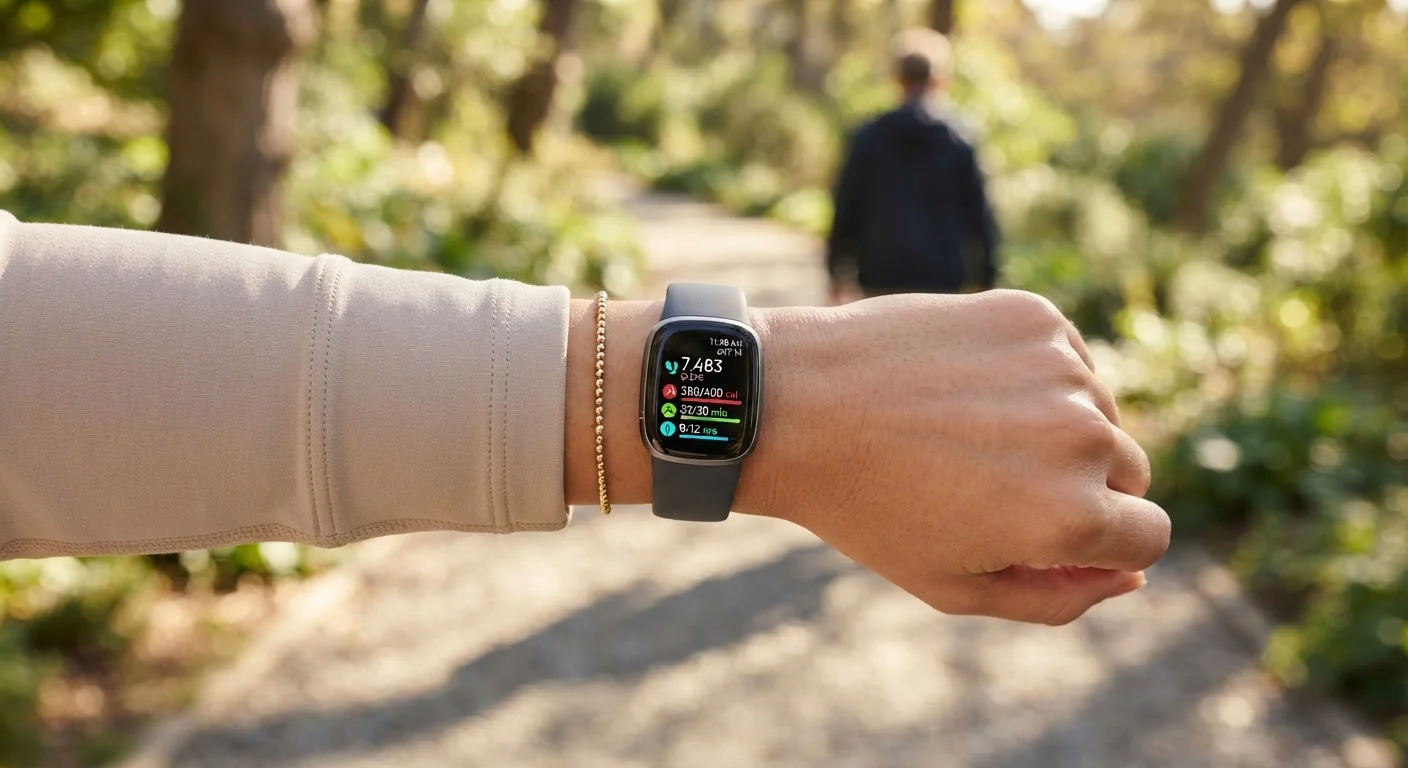
Most consumer fitness trackers — whether a dedicated wristband, a smartwatch, or a phone-based app — rely on a small sensor called an accelerometer. This chip detects changes in acceleration across multiple axes, allowing the device to infer movement patterns. Step counters translate repeated wrist or body motion into discrete step counts using proprietary algorithms. Activity rings (popularized by Apple Watch) add layers: move minutes, exercise minutes, and standing hours, each pulling from the same acceleration data filtered through different thresholds.
Some higher-end devices add a heart rate sensor (usually optical photoplethysmography, or PPG) to estimate exercise intensity and derive metrics like active calories and cardio fitness scores. GPS, when present, captures pace and distance for outdoor movement. Collectively, these inputs give trackers their multi-metric picture of your day.
Understanding what sits beneath these numbers helps you interpret them more critically — and use them to genuinely support your movement habits rather than optimize for a number on a screen.
What Trackers Measure Reliably
Research suggests that modern accelerometer-based devices perform reasonably well at counting steps during straightforward walking on level ground, typically falling within a 5–10% margin of error under controlled conditions. They are also fairly consistent at detecting relative changes — whether you moved more or less today compared to yesterday — which is often the more actionable insight for building daily habits.
Heart rate monitors in wrist-worn devices are generally reliable at rest and during steady aerobic activity. They tend to be less precise during high-intensity intervals or activities involving significant wrist movement, such as weightlifting or cycling. Sleep tracking, which most modern devices include, can distinguish between sleep and wakefulness with moderate accuracy, though it struggles to reliably classify sleep stages (light, deep, REM) compared to clinical polysomnography.
For most healthy adults looking to increase general movement, these relative and trend-based insights are genuinely useful — particularly when paired with broader self-awareness about how your day unfolds. A movement audit can help you spot patterns that device data alone may not reveal.
What Trackers Systematically Miss
This is where it pays to be honest. Fitness trackers are optimized to detect ambulatory movement — walking, running, some gym activities. They are structurally poor at capturing several important categories of daily physical effort:
- Upper-body stationary work: Chopping vegetables, folding laundry, and desk-based manual tasks generate minimal wrist acceleration and rarely register as meaningful movement.
- Cycling and water activities: Step count algorithms largely fail during cycling. Swimming trackers have improved but still undercount effort compared to lab measurement.
- Carrying loads: Walking while carrying groceries or a child increases metabolic demand noticeably, but most devices cannot account for this added effort.
- Posture and muscle tension: Isometric activity — holding a plank, gripping, balance work — produces little movement signal despite genuine physiological cost.
These gaps connect directly to the concept of NEAT (Non-Exercise Activity Thermogenesis) — the energy your body burns through all non-exercise movement. NEAT can significantly shape daily energy use yet it is notoriously hard to capture with a wrist sensor. Similarly, everyday movement opportunities — stairwells, yard work, standing tasks — contribute real activity that trackers often undercount or ignore.
Accelerometer
A microelectronic sensor that measures changes in acceleration across one or more axes. In fitness trackers, it is the primary detector of body movement used to infer steps and activity levels.
NEAT (Non-Exercise Activity Thermogenesis)
The energy expended during all physical activity that is not deliberate exercise — including fidgeting, standing, walking to the kitchen, or doing household tasks. It can form a substantial part of daily calorie burn but is difficult for wearables to capture fully.
Photoplethysmography (PPG)
An optical technique used in wrist-based heart rate sensors that detects blood volume changes in capillaries by shining light into the skin. It enables heart rate estimation without a chest strap.
Polysomnography
The clinical gold-standard sleep study, conducted in a lab setting, that simultaneously records brain waves, blood oxygen, heart rate, and muscle activity to precisely classify sleep stages.
Activity Ring
A visual goal-tracking format that represents daily movement targets — commonly move (active calories), exercise (aerobic minutes), and stand (standing hours) — as circular progress arcs on a device display.
Isometric Activity
Muscle contractions where the muscle generates force without changing its length or producing visible movement — such as holding a plank or gripping an object. Produces minimal sensor signal despite physiological effort.
This article provides general information about wearable technology and is not medical advice. Consult a qualified healthcare professional for personal health decisions.
The content on this site is for informational purposes only and is not a substitute for professional advice. Always consult a qualified professional for guidance specific to your situation.