

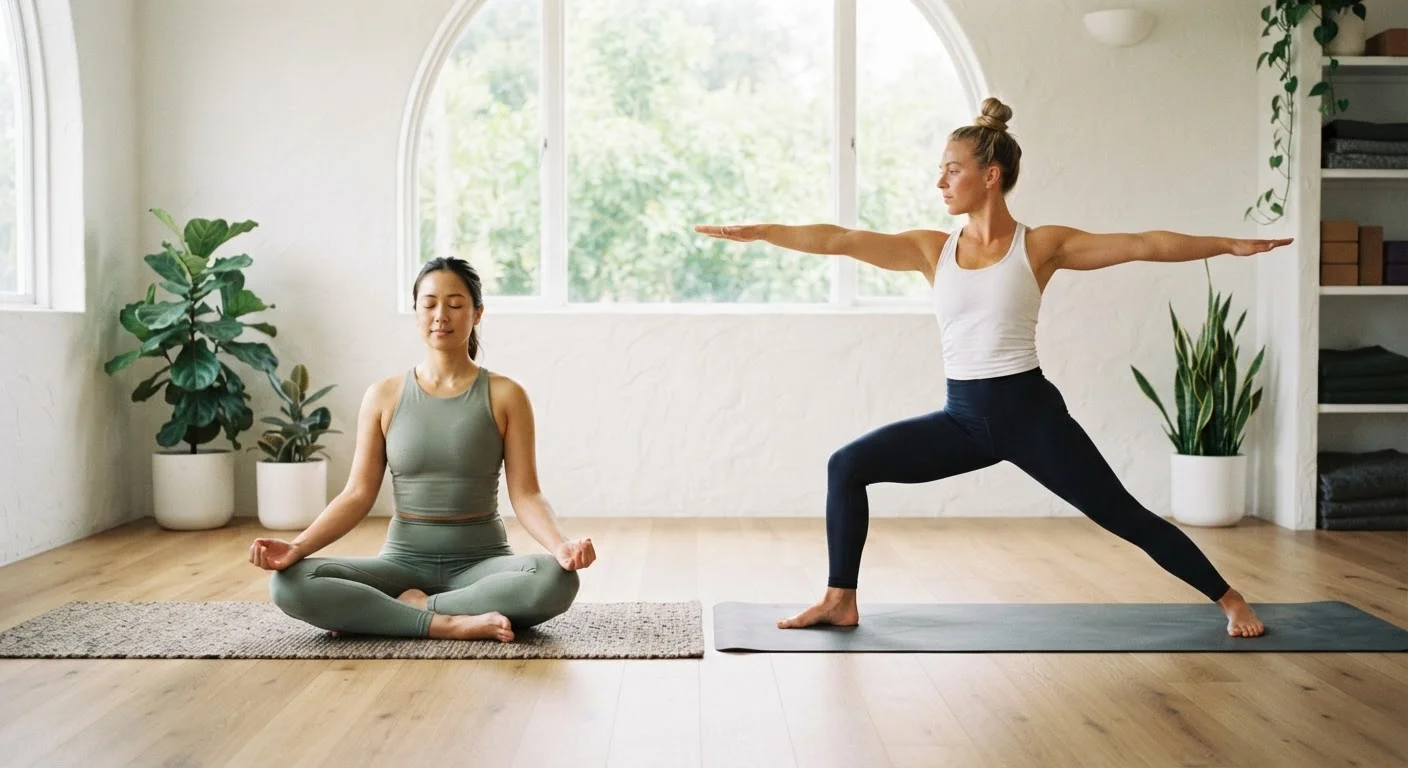
Option A
Hatha Yoga
The foundational, pose-by-pose approach to building yoga literacy.
Best for: Beginners or anyone who wants to explore individual postures slowly, with time to refine alignment and breathe deeply between poses.
Option B
Vinyasa Yoga
The dynamic, breath-linked flow style that keeps the body in continuous motion.
Best for: Practitioners ready for a more cardiovascular, sequenced experience that links movement seamlessly to each inhale and exhale.
What Is Hatha Yoga?
The word hatha comes from Sanskrit and is often translated as a union of opposing forces — ha meaning sun and tha meaning moon. In modern Western studios, the term has come to describe a broad, foundational category of yoga in which postures (asanas) are practiced individually and held for several breaths before transitioning to the next.
A typical hatha class moves deliberately. An instructor cues a pose, students settle into it, breathe, and may receive alignment guidance before the class collectively moves on. This structure makes hatha an excellent entry point for beginners and a reliable anchor for practitioners who want to deepen their understanding of individual postures without the added layer of continuous movement.
Hatha classes commonly incorporate pranayama (breathing exercises) and may include a longer closing relaxation in savasana. Because most of yoga's major physical traditions — iyengar, kundalini, ashtanga — are technically branches of hatha yoga in the broader historical sense, a studio-labeled hatha class is best understood as general hatha: accessible, steady, and pose-focused.
What Is Vinyasa Yoga?
Vinyasa — derived from the Sanskrit term nyasa (to place) and the prefix vi (in a special way) — refers to the intentional linking of movement with breath. In a vinyasa class, each inhale and exhale initiates or completes a transition, so practitioners are rarely stationary for long. The result is a continuous, flowing sequence that can feel almost choreographic.
Because the sequence changes with each class and teacher, vinyasa is inherently varied. A common structural thread is the use of sun salutations (surya namaskar) as a warm-up and recurring transition vehicle. From there, a teacher might build toward peak postures — such as a challenging arm balance or backbend — while weaving in supporting poses that develop the necessary strength and mobility.
The cardiovascular demand of vinyasa is meaningfully higher than hatha. Research published in fitness science literature consistently categorizes yoga flow styles as moderate-intensity aerobic activity, depending on tempo and sequence complexity. This makes vinyasa a popular choice for practitioners who want physical conditioning alongside mindfulness training.
| Criterion | Hatha Yoga | Vinyasa Yoga |
|---|---|---|
| Pace | Slow, deliberate | Continuous, flowing |
| Pose structure | Individual holds | Breath-linked sequences |
| Cardiovascular demand | Low to moderate | Moderate to high |
| Beginner friendliness | Very accessible | Better with some base knowledge |
| Class-to-class variation | Relatively consistent | Highly variable by teacher |
| Emphasis on breathwork | Strong — pranayama often included | Integrated — breath drives movement |
| Meditative quality | High — stillness is central | Present but more active in nature |
Key Differences and How to Choose
The most practical distinction between hatha and vinyasa is pace. Hatha gives you time — to notice how your foot is placed, to find the sensation of lengthening your spine, to simply breathe. Vinyasa asks you to move with your breath, which requires that you already have enough familiarity with poses to transition safely without pausing to think through every alignment cue.
This does not mean vinyasa is always harder. An advanced hatha class holding challenging postures for extended periods can be exceptionally demanding. Conversely, a gentle vinyasa flow can be quite approachable. The defining experience is rhythm, not difficulty.
A Note on Class Labels
Studio class titles are not universally standardized. A class labeled "hatha" at one studio may feel quite vigorous, while a "vinyasa" class elsewhere may be gentler than expected. Reading the class description carefully and, when possible, speaking with the teacher beforehand will give you a clearer sense of what to expect. Most studios welcome questions from newer students.
When selecting a class, consider what you actually need that day. Feeling scattered or anxious? Hatha's stillness may serve you better. Feeling sluggish or in need of energy? A vinyasa flow can be invigorating. Many long-term practitioners keep both styles in their regular rotation rather than committing exclusively to one.
This article is for general informational and educational purposes only and does not constitute medical advice. Consult a qualified healthcare professional before beginning any new physical activity, particularly if you have an existing health condition, injury, or are pregnant.
The content on this site is for informational purposes only and is not a substitute for professional advice. Always consult a qualified professional for guidance specific to your situation.