

Why a Wind-Down Routine Works on Anxiety
Anxiety doesn't switch off the moment you decide you're done for the day. The nervous system — particularly the sympathetic branch responsible for the stress response — often remains activated long after the stressor has passed. A deliberate wind-down routine works by introducing predictable, low-threat signals that tell the brain the day is truly over and that safety is present.
This process is sometimes called physiological deceleration: a gradual reduction in cortisol, heart rate, and cognitive arousal. Research on behavioral sleep medicine consistently finds that pre-sleep routines — even brief ones — improve both sleep onset and subjective anxiety, in part because they interrupt the cycle of evening rumination that feeds anxious thought patterns.
Importantly, the routine doesn't need to be elaborate to be effective. What matters most is that it is consistent, calm, and genuinely separate from the demands of the day. For a deeper look at how pre-sleep habits interact with rest quality, see our guide to building a wind-down routine for better sleep.
When Anxiety Requires Professional Support
A wind-down routine can meaningfully reduce everyday stress and mild anxiety, but it is not a substitute for clinical care. If anxiety is significantly disrupting your sleep, relationships, work, or daily functioning, please consult a licensed mental health professional or your primary care provider. This article provides general wellness information, not medical advice.
What You'll Need Before You Begin
You don't need special equipment or a perfectly quiet home to build an effective wind-down practice. What you do need is a general sense of your schedule, a space where you can be relatively undisturbed, and a realistic expectation that this will take some iteration before it feels natural.
What you will need
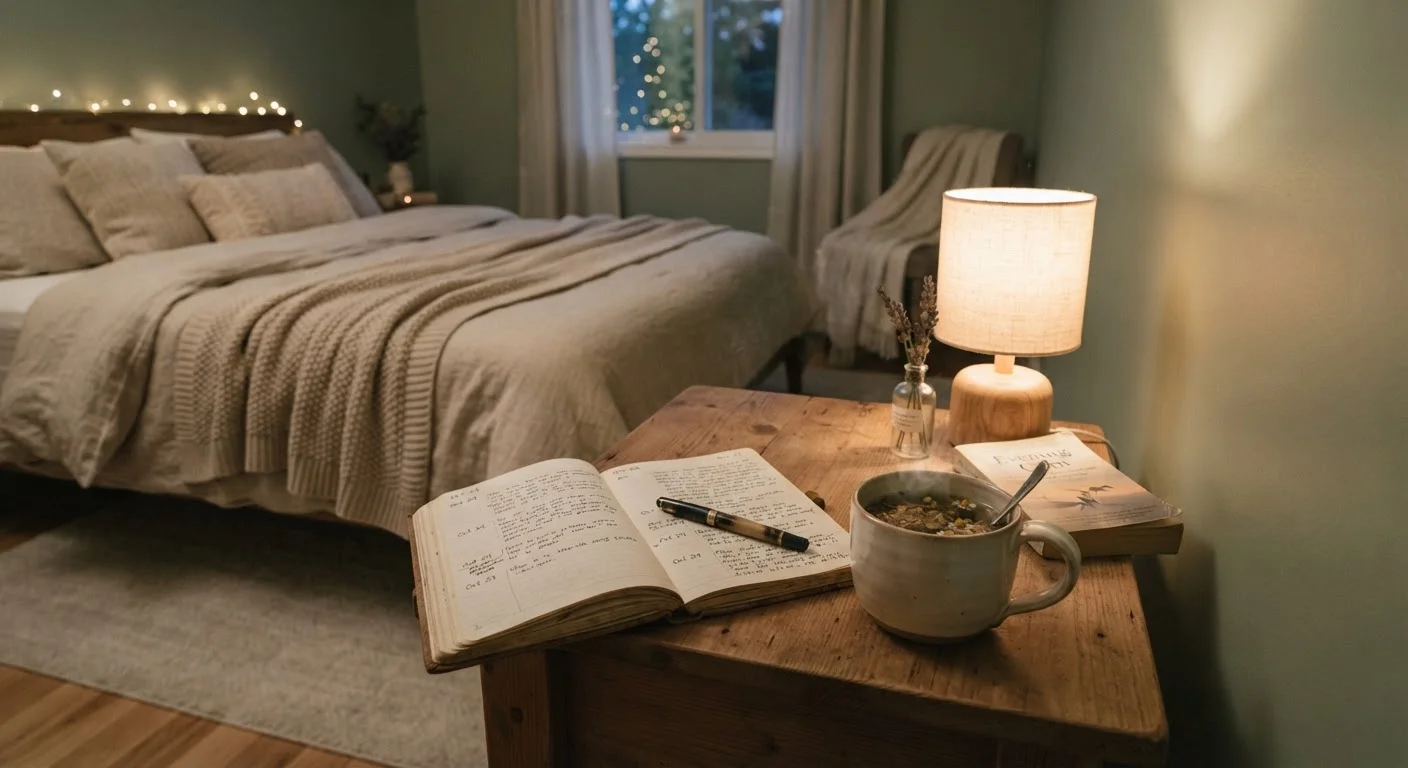
Dimmer switch or warm-toned lamp
Reduces blue light exposure and signals the brain to increase melatonin production as part of the wind-down.
Journal or notepad
Used for brain-dumping worries and tomorrow's tasks so unresolved mental loops don't intrude on rest.
Herbal tea (e.g., chamomile or lemon balm)
Provides a warm, screen-free ritual that occupies the hands and serves as a sensory relaxation anchor.
Phone charging station outside the bedroom
Physically removes the device that most commonly disrupts evening wind-down with stimulating content.
Your Step-by-Step Wind-Down Routine
Follow these steps in order when possible, but adapt freely to your living situation and schedule. The sequence matters less than the consistency of showing up for it each evening.
Set a consistent start time for your wind-down
Choose a time 60–90 minutes before you want to be asleep and treat it as a soft commitment — not a rigid rule. Your nervous system learns to anticipate downshifting when the cue is consistent. Even a rough window, such as between 9:00 and 9:30 p.m., is more effective than no anchor at all. Use a recurring phone reminder if needed, then gradually make it a habit you no longer need to be prompted for.
Dim the lights and reduce screen exposure
Bright overhead lighting and screen blue light suppress melatonin and keep the brain in an alert, problem-solving state. Switch to warm-toned lamps or candles and, if possible, enable night mode on any devices you genuinely need. Ideally, put your phone in another room or a designated charging spot outside the bedroom entirely. This single change has a measurable impact on how quickly your body begins its biological sleep preparation.
Do a written brain dump
Open a journal or notepad and spend five minutes writing down every unresolved thought, worry, or tomorrow's task that's occupying mental bandwidth. Research on this practice — sometimes called a cognitive offloading exercise — suggests it reduces pre-sleep rumination by externalizing concerns the brain would otherwise continue cycling through. You don't need to solve anything; the act of writing it down signals to your mind that the thought has been acknowledged and stored.
Incorporate a slow, sensory ritual
Choose one activity that engages your senses gently without stimulating your cognition: making and drinking a warm herbal tea, taking a warm shower, doing light stretching, or reading a physical book. The goal is to occupy your awareness in the present moment and give the analytical mind something to step back from. This is also when a sensory anchor — a consistent scent, texture, or taste — becomes most powerful as a learned relaxation cue.
Close with a short breathing or body-scan practice
Spend the final three to five minutes of your wind-down with a simple diaphragmatic breathing pattern or a brief progressive body scan. Breathing slowly with a longer exhale than inhale — such as inhaling for four counts and exhaling for six — activates the vagus nerve and shifts the autonomic nervous system toward parasympathetic dominance. Even a few minutes of this, done consistently, has been associated with measurable reductions in heart rate and self-reported anxiety. You can practice this seated or already lying in bed.
Anchor Your Routine to a Sensory Cue
Pairing your wind-down with a consistent sensory signal — a specific candle scent, a dimmed lamp, or a particular herbal tea — can accelerate how quickly your nervous system learns to relax on cue. Over time, that cue alone begins to trigger a calming response before you've completed a single step.
Troubleshooting a Routine That Isn't Working
If you've followed these steps for a week and still feel wired or anxious at bedtime, consider these common friction points:
- The routine starts too late. If you're beginning with only 20 minutes before your target sleep time, there isn't enough runway for the nervous system to shift gears. Try pushing your start time earlier.
- Unresolved conflict or stressors are dominating. A wind-down routine can buffer everyday stress well, but chronic or acute life stressors may require more direct support — including therapy, social connection, or professional guidance.
- The chosen activities aren't genuinely calming for you. Not everyone finds stretching or journaling relaxing. Swap in something that genuinely feels restorative — even light crafting or gentle music can work if it doesn't stimulate rumination.
Avoid Overloading Your Wind-Down Time
Adding too many steps to your routine can turn it into another source of pressure. Start with just two or three practices and only expand once they feel genuinely automatic. A wind-down routine that feels like a chore will not calm your nervous system — it will add to its load.
This article is for general informational and educational purposes only and does not constitute medical advice. If you are experiencing persistent or severe anxiety, please consult a qualified healthcare professional.
The content on this site is for informational purposes only and is not a substitute for professional advice. Always consult a qualified professional for guidance specific to your situation.