

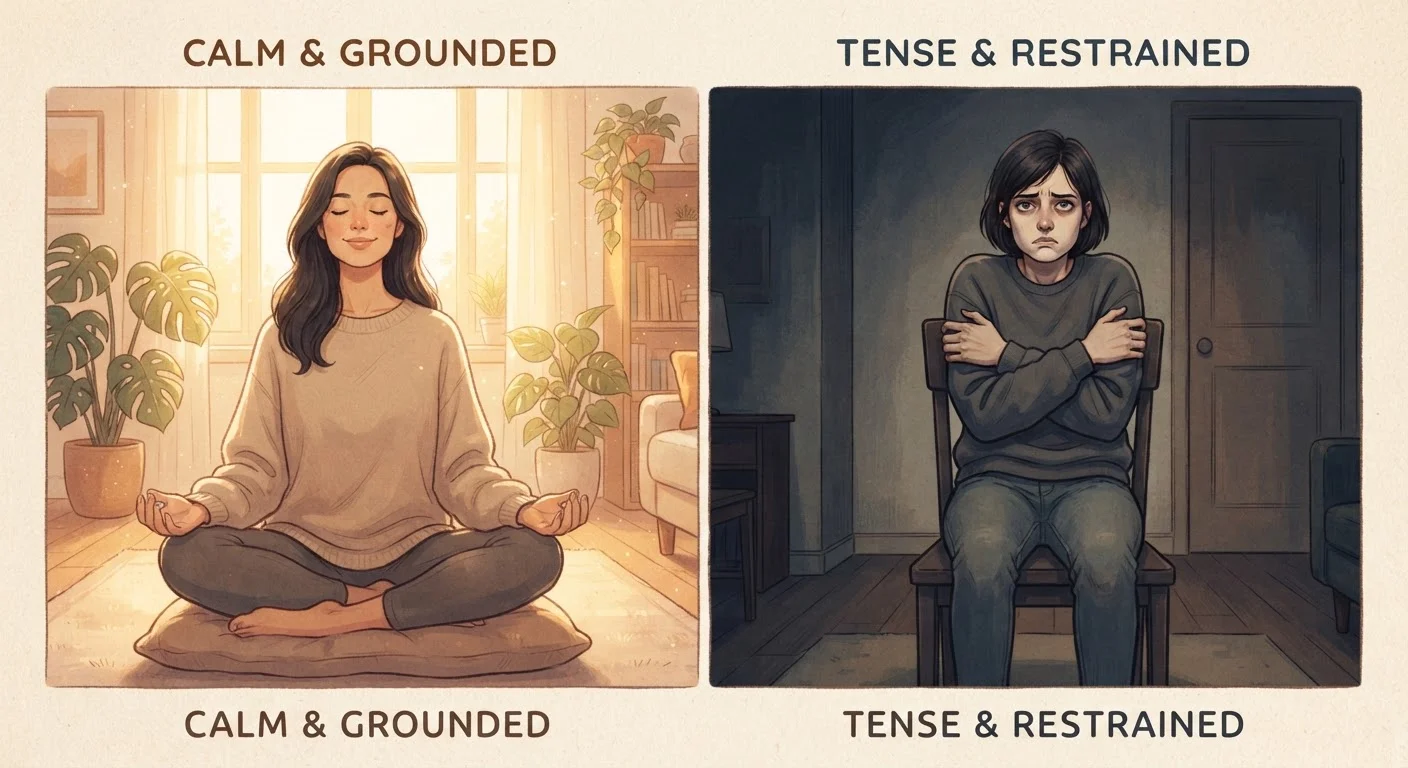
Option A
Emotional Resilience
The adaptive, evidence-supported path to lasting emotional balance.
Best for: People seeking to process difficult emotions in healthy, sustainable ways that strengthen long-term mental wellbeing.
Option B
Emotional Suppression
The instinctive but ultimately costly habit of pushing feelings aside.
Best for: Short-term relief in high-stakes situations, though not a sustainable or healthy long-term coping strategy.
What Each Strategy Actually Means
On a difficult day, two people might both appear calm and composed. One has genuinely processed what happened and found solid footing. The other has tucked the feeling somewhere out of reach and is hoping it stays there. From the outside, they look identical. Internally, the story is very different.
Emotional resilience is the capacity to experience distress, make meaning of it, and return to a functional baseline — not unaffected, but intact. It doesn't mean feeling nothing. Research in psychology consistently frames resilience as a dynamic process of adapting to adversity, not a fixed personality trait that some people have and others don't.
Emotional suppression, by contrast, is the deliberate effort to inhibit or conceal an emotional response — to feel something and consciously push it down. Studies, including foundational work by psychologist James Gross on emotion regulation, distinguish suppression from other coping strategies and consistently link it to higher physiological arousal even as outward expression decreases.
In plain terms: suppression quiets the face, but not the nervous system.
| Criterion | Emotional Resilience | Emotional Suppression |
|---|---|---|
| Core mechanism | Process and adapt to emotion | Inhibit or conceal emotion |
| Short-term effect | May increase discomfort briefly | Immediate reduction in visible distress |
| Long-term effect | Greater emotional flexibility | Accumulated physiological stress |
| Nervous system impact | Regulated over time | Elevated arousal despite calm appearance |
| Learnability | Teachable skills and practices | Often an automatic, habitual response |
| Effect on relationships | Supports authentic connection | Can reduce emotional intimacy |
| Appropriate use | Sustainable, long-term strategy | Situationally useful, not as default |
The Hidden Cost of Suppression
Suppression isn't inherently pathological. In genuinely acute situations — a medical emergency, a high-stakes work presentation — temporarily setting aside strong emotion to act is adaptive. The problem is chronic suppression, when pushing feelings down becomes the default rather than the exception.
Research suggests habitual suppression is associated with:
- Elevated cardiovascular stress responses
- Reduced social closeness and relationship quality, since authentic connection requires emotional transparency
- Greater long-term anxiety and depressive symptoms
- Reduced immune function under stress, according to findings in the psychoneuroimmunology field
There's also what might be called the rebound effect: suppressed emotions often resurface with greater intensity. Attempts to push away recurring thoughts or feelings frequently amplify them — a phenomenon psychologist Daniel Wegner termed ironic process theory.
Suppression vs. Regulation: A Key Distinction
Not all emotional control is suppression. Emotion regulation is a broader category that includes healthy strategies like reframing, problem-solving, and acceptance. Suppression refers specifically to inhibiting expressive behavior while the internal experience continues — a meaningful distinction in both research and daily life. If you're unsure which pattern applies to you, a licensed therapist can help you explore this safely.
This is why suppression can feel like it's working. Short-term, it often is. The costs accrue quietly, over months and years, making the connection harder to draw.
How Resilience Works Differently
Resilience doesn't ask you to feel less. It asks you to relate differently to what you feel. Several evidence-informed practices support this shift:
Emotional labeling — putting precise words to what you're experiencing — has been shown in neuroimaging research to reduce the intensity of the amygdala's response to distress. Naming the feeling appears to engage the prefrontal cortex in a way that softens the emotional signal.
Cognitive reframing is another well-studied tool. Rather than denying that something is hard, reframing involves finding an alternative interpretation that is still honest but less catastrophic. Learn how reframing works in practice — including when it genuinely helps and when it can backfire.
Somatic awareness — noticing where emotion lives in the body, through breathwork or mindful body scans — can interrupt the physiological escalation that suppression leaves unresolved.
The common thread: resilience strategies involve the emotion rather than bypassing it. That engagement, practiced consistently, is what gradually reshapes how the nervous system responds to future stressors.
This article is for general informational purposes only and does not constitute medical or mental health advice. If you are experiencing persistent emotional difficulties, please consult a qualified mental health professional.
The content on this site is for informational purposes only and is not a substitute for professional advice. Always consult a qualified professional for guidance specific to your situation.