

Understanding Intestinal Permeability: The Biology Behind the Buzzword
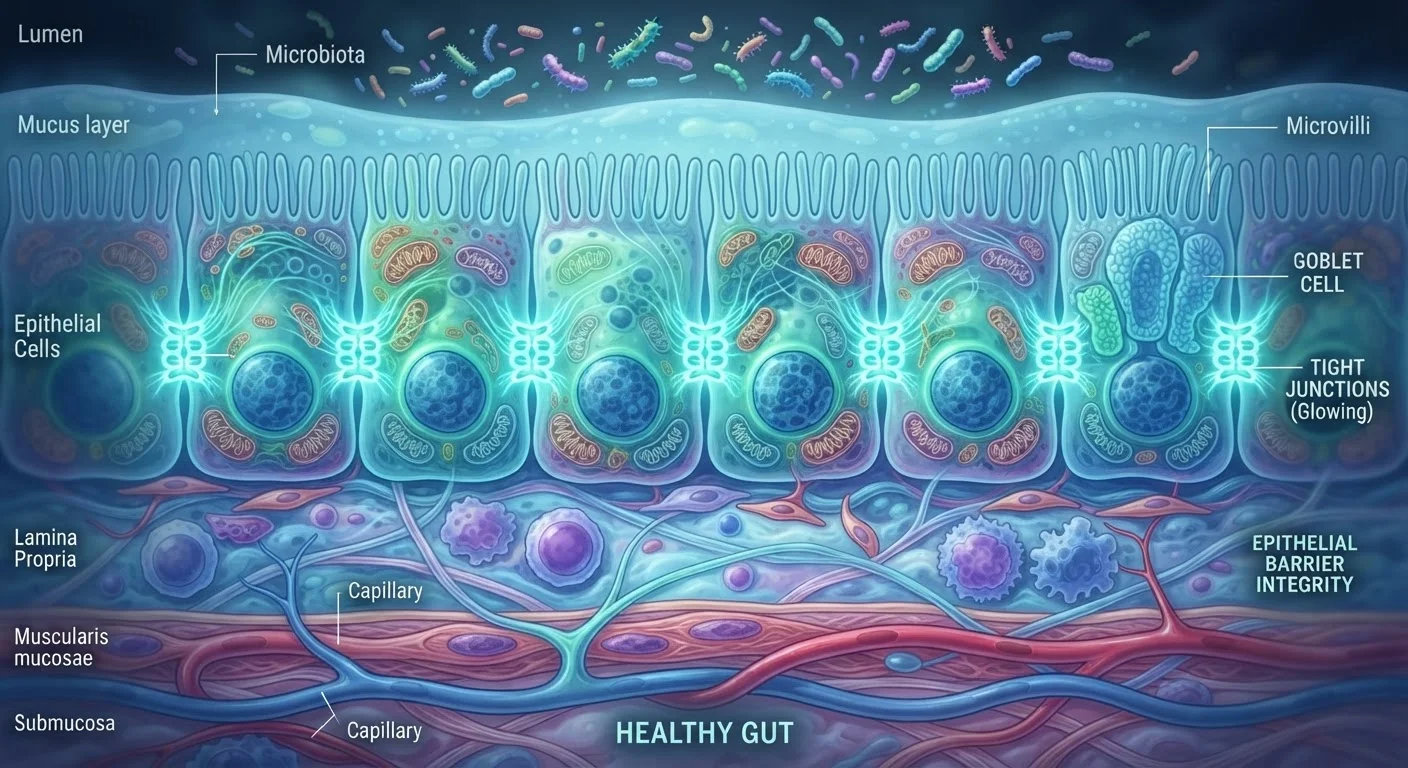
The gut lining is one of the body's most sophisticated barriers — a single layer of epithelial cells spanning roughly 400 square meters when unfolded, responsible for selectively absorbing nutrients while keeping pathogens and undigested particles out. Tight junction proteins, including claudins and occludins, act as the mortar between these cellular bricks.
When these junctions weaken — due to inflammation, infection, certain medications, or dietary factors — the barrier becomes less selective. This is the biological reality behind the popular phrase "leaky gut." It is measurable using tools like the lactulose-mannitol test and has been documented in clinical research across several disease states.
What the evidence does not support is the idea that leaky gut is a singular syndrome driving dozens of unrelated conditions in the general population. The science is nuanced, active, and still developing — which makes the gap between research findings and wellness marketing claims particularly wide.
Myth
Leaky gut syndrome is a well-established medical diagnosis that doctors widely recognize and test for.
Fact
Intestinal permeability is a real physiological concept, but 'leaky gut syndrome' is not a recognized clinical diagnosis in mainstream medicine.
Researchers have long studied the gut's epithelial barrier — the single-cell layer lining the intestines, held together by proteins called tight junctions. When these junctions are disrupted, molecules that wouldn't normally pass through may enter the bloodstream, a state scientists call increased intestinal permeability. This phenomenon is documented in conditions such as celiac disease, Crohn's disease, and irritable bowel syndrome.
However, the broader label "leaky gut syndrome" — used in wellness spaces to describe a root cause of everything from fatigue to autoimmunity — lacks a standardized clinical definition and diagnostic criteria. The distinction matters: the underlying biology is real, but the syndrome framing has outpaced the evidence.
Myth
Leaky gut is the proven root cause of autoimmune diseases, chronic fatigue, and skin conditions.
Fact
Increased intestinal permeability is associated with several conditions, but association is not causation — researchers are still untangling which comes first.
Studies do find elevated intestinal permeability in people with autoimmune conditions, including type 1 diabetes and rheumatoid arthritis. Researchers like Alessio Fasano have proposed mechanisms by which barrier dysfunction could trigger immune dysregulation. However, it remains unclear in most cases whether permeability changes cause these diseases, result from them, or simply co-occur.
Claiming leaky gut as a proven root cause of a broad range of chronic diseases overstates the current evidence. The gut-immune relationship is bidirectional and complex — for a grounding overview, see our beginner's guide to gut and immune health.
Myth
If you have digestive symptoms, you almost certainly have leaky gut.
Fact
Digestive symptoms have many possible causes; increased intestinal permeability is one of numerous factors a clinician would consider.
Bloating, gas, abdominal discomfort, and irregular bowel movements are among the most common complaints in primary care and have a wide differential — from food sensitivities and dysbiosis to functional disorders and structural issues. Attributing symptoms directly to leaky gut without professional evaluation risks missing conditions that warrant different treatment.
The gut-brain axis also plays a significant role. Stress and anxiety can directly alter gut motility and barrier function, creating a feedback loop. Explore the gut-brain connection to understand how psychological and digestive health intertwine.
Myth
Special supplements are the most effective way to heal a leaky gut.
Fact
Dietary patterns and lifestyle modifications have the strongest evidence base for supporting gut barrier integrity.
A range of supplements — including L-glutamine, zinc, collagen peptides, and probiotics — are marketed for gut barrier support. While some show preliminary promise in limited studies, none has robust, large-scale clinical evidence demonstrating they repair intestinal permeability in healthy adults.
By contrast, research consistently supports whole-food dietary approaches: high fiber intake, fermented foods, reduced ultra-processed food consumption, and adequate sleep all measurably influence microbiome composition and barrier function. Building a gut-friendly eating pattern offers practical, evidence-informed dietary guidance without the supplement-first framing.
Myth
Gluten must be eliminated by everyone concerned about gut permeability.
Fact
Gluten triggers measurable intestinal permeability in people with celiac disease and, to a lesser degree, non-celiac gluten sensitivity — but evidence for harm in the general population is limited.
In individuals with celiac disease, gluten exposure causes an immune-mediated attack on the intestinal lining, significantly increasing permeability. Research by Fasano and colleagues showed that gliadin (a gluten component) triggers zonulin release — a protein that opens tight junctions — even in people without celiac disease, though the clinical significance for healthy individuals remains debated.
Broad gluten elimination without a diagnosed condition is not supported by current evidence as a strategy for improving gut health. Unnecessarily restrictive diets can reduce fiber diversity and disrupt the microbiome — the opposite of the intended effect.
What Actually Influences Gut Barrier Health
Several well-studied factors influence intestinal permeability, and understanding them helps distinguish evidence-based action from speculation.
- Diet: Ultra-processed foods, excess alcohol, and low-fiber diets are associated with microbiome imbalance and impaired barrier function. Conversely, diverse plant-based diets and fermented foods support a robust gut lining.
- Stress: Chronic psychological stress activates pathways that increase intestinal permeability and alter gut motility — a direct gut-brain effect documented in both animal and human studies.
- Medications: Long-term use of NSAIDs (non-steroidal anti-inflammatory drugs) and certain antibiotics can compromise the gut lining; this is a recognized and clinically documented risk, not a fringe claim.
- Sleep: Poor sleep quality disrupts circadian regulation of the gut microbiome and has been linked in emerging research to increased permeability markers.
The good news: the interventions that support gut barrier function — varied whole-food diet, stress management, quality sleep, and physical activity — are broadly beneficial for overall health with minimal downside.
Not a Substitute for Medical Evaluation
If you are experiencing persistent digestive symptoms, fatigue, or unexplained inflammation, consult a qualified healthcare provider before self-diagnosing or self-treating. Gut permeability is studied in specific clinical contexts, and proper evaluation is essential to rule out conditions that require medical management.
This article is for general informational and educational purposes only and is not a substitute for professional medical advice, diagnosis, or treatment. Always consult a qualified healthcare provider with questions about your health or symptoms.
The content on this site is for informational purposes only and is not a substitute for professional advice. Always consult a qualified professional for guidance specific to your situation.